Tennis Elbow & Golfer’s Elbow: Physiotherapy Treatment Guide
You haven’t swung a racket in years. You don’t play golf. And yet, every time you pour your morning chai, turn a doorknob, shake someone’s hand, or type through a long meeting, there it is — that deep, stubborn ache on the side of your elbow that just will not go away.
Tennis elbow physiotherapy treatment is one of the most searched topics among Bangalore’s working population — and for good reason. IT professionals, software engineers, cooks, painters, gym-goers, and yes, racket sport players are all walking into clinics across South Bangalore with the same complaint: elbow pain that is affecting their grip, their work, and their daily life.
This guide explains exactly what tennis elbow and golfer’s elbow are, how they differ, what the physiotherapy treatment involves stage by stage, which exercises help, and when you should stop managing alone and see a specialist. Everything you need to understand your elbow pain — and get rid of it properly.
What Is Tennis Elbow? What Is Golfer’s Elbow?
Both conditions are forms of tendinopathy — a degenerative overuse injury of the tendons attaching forearm muscles to the elbow. They are not inflammatory conditions in the traditional sense; research published in the British Journal of Sports Medicine confirms that the histology shows tendon degeneration rather than classical inflammation, which is why anti-inflammatory medications alone rarely resolve them.
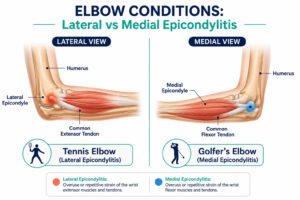
Tennis elbow (lateral epicondylitis) affects the outer side of the elbow, specifically the common extensor tendon at the lateral epicondyle. The extensor carpi radialis brevis — the muscle most responsible for stabilising your wrist during gripping — is the most commonly injured structure. Pain radiates from the outer elbow down the forearm.
Golfer’s elbow (medial epicondylitis) affects the inner side of the elbow at the medial epicondyle, where the forearm flexor and pronator muscles attach. Pain radiates from the inner elbow toward the wrist, and in some cases tingling into the ring and little fingers may occur if the nearby ulnar nerve is irritated.
The One Question That Tells You Which One You Have
Ask yourself this: which side of your elbow hurts?
- Outer elbow pain→ Tennis elbow (lateral epicondylitis)
- Inner elbow pain→ Golfer’s elbow (medial epicondylitis)
A clinical examination with resisted movement tests confirms this. For tennis elbow, resisted wrist extension with the elbow straight reproduces the lateral pain. For golfer’s elbow, resisted wrist flexion and forearm pronation reproduces the medial pain. According to NICE guidelines on tendinopathy management, clinical diagnosis is usually sufficient and imaging is rarely required.
Who Gets Tennis Elbow and Golfer’s Elbow? (It Is Not Just Athletes)
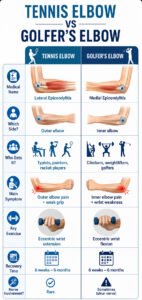
Tennis elbow affects approximately 1–3% of the population, with peak incidence between the ages of 35 and 54. Golfer’s elbow is less common — roughly seven times less frequent than tennis elbow — but both conditions affect men and women equally according to research on the NCBI Bookshelf.
Common Causes in Non-Athletes
The vast majority of people who develop these conditions have never played a racket sport or swung a golf club. Common triggers in Bangalore’s working population include:
- IT professionals and desk workers— prolonged typing, mouse use, and awkward wrist positions during computer work load the common extensor tendon repetitively
- Cooks and kitchen staff— repetitive chopping, stirring, and lifting of heavy vessels
- Painters and construction workers— repetitive gripping and forearm rotation with tools
- Musicians— particularly guitarists, violinists, and keyboard players
- Gym-goers— improper technique during barbell rows, pull-downs, or grip-heavy exercises
- Homemakers— wringing clothes, scrubbing, and repetitive household tasks
If you are a desk worker in Bangalore experiencing elbow pain alongside neck stiffness or upper back tightness, the two problems are often linked. Read our blog on Cervical Spondylosis vs Neck Pain to understand how postural problems at your workstation can create a chain of upper limb issues.
“In our clinic, we see as many software engineers and IT professionals with tennis elbow as we do athletes. The repetitive, sustained forearm loading from keyboard and mouse use — especially with poor workstation setup — is every bit as damaging to the common extensor tendon as a tennis backhand. The difference is that the desk worker often waits six to twelve months before seeking help, by which time the tendon has become significantly more degenerated.”
— Dr. Kiran S. Murthy, PT, Founder & Lead Physiotherapist, Rayara Kirana Physiotherapy Clinic, Bangalore
Symptoms: What Tennis Elbow and Golfer’s Elbow Actually Feel Like
Tennis Elbow Symptoms
- Pain and tenderness directly over the lateral epicondyle — the bony prominence on the outer elbow
- Pain that radiates down the outer forearm toward the wrist
- Weak or painful grip strength — difficulty holding a mug, pen, or phone
- Pain when lifting, gripping, or extending the wrist
- Morning stiffness and aching that warms up slightly with activity
- Worsening pain when shaking hands or opening jars
Golfer’s Elbow Symptoms
- Pain and tenderness over the medial epicondyle — the inner bony prominence
- Pain that radiates down the inner forearm toward the wrist and sometimes into the ring and little fingers
- Weakness in grip and wrist flexion
- Discomfort when flexing the wrist or pronating the forearm
- Possible tingling or numbness into the ring and little fingers if the ulnar nerve is involved
- Pain aggravated by throwing, swinging, or lifting with a bent elbow
If you are experiencing tingling or numbness in the fingers alongside elbow pain, a physiotherapy assessment is important to distinguish between tendon involvement and nerve involvement — these require different treatment approaches.
How Is Tennis Elbow Different from Other Elbow Conditions?
Elbow pain is not always tennis elbow. Conditions that are commonly confused with it include:
Tennis Elbow vs Elbow Arthritis
- Tennis elbow pain is localised to the epicondyle and forearm; arthritis pain is diffuse around the whole joint
- Tennis elbow does not typically restrict full elbow bending and straightening; arthritis does
- Tennis elbow rarely shows changes on X-ray; arthritis will show joint space narrowing
- Tennis elbow responds well to loading exercises; arthritis management is different
Tennis Elbow vs Cubital Tunnel Syndrome
- Cubital tunnel syndrome involves ulnar nerve compression at the elbow — producing tingling and numbness in the ring and little fingers
- Tennis elbow does not typically produce neurological symptoms unless the nerve is also irritated
- Cubital tunnel pain is usually on the inner elbow; tennis elbow on the outer
- Nerve conduction studies may be needed to confirm cubital tunnel syndrome
Tennis Elbow vs Referred Pain from the Neck
Cervical nerve root irritation from the neck — particularly at C6 or C7 levels — can refer pain into the elbow and forearm that mimics tennis elbow. This is why a thorough physiotherapy assessment includes examination of the cervical spine. If you have neck pain alongside elbow pain, read our article on Cervical Spondylosis vs Neck Pain for more detail on how cervical problems can produce arm symptoms.
When in doubt, get a clinical assessment. Do not self-diagnose and self-treat — the wrong treatment for the wrong diagnosis will delay your recovery.
Physiotherapy Treatment for Tennis Elbow and Golfer’s Elbow: A Stage-Based Approach
The cornerstone of treatment for both conditions is physiotherapy. Surgery is required in fewer than 5% of cases, even after one to two years of symptoms, according to data from the Cleveland Clinic. The right physiotherapy programme — applied at the right stage — is the most effective path to full recovery.
“The biggest mistake I see is patients who either do nothing and wait for the pain to resolve, or who keep pushing through the pain and make the tendon worse. Tendons respond to progressive, graded loading — but the loading must be matched to what the tendon can currently tolerate. That is the art of tendon rehabilitation, and it is why a physiotherapy assessment is so important before starting any exercise programme.”
— Dr. Rajesh Jain, PT, Senior Physiotherapist, Rayara Kirana
Phase 1: Acute Pain Management (Weeks 1–3)
The priority in the early phase is reducing pain and protecting the tendon from further aggravation.
- Activity modification— identify and reduce the specific movements that reproduce your pain. This does not mean complete rest, which actually slows tendon healing
- Ice therapy— apply ice for 15–20 minutes after activity, 2–3 times daily, to manage pain. Ice is most useful in the first few days to weeks. Read our comparison of Ice Pack vs Game Ready therapy to understand which recovery method suits your stage
- Counterforce brace or elbow strap— worn 2–3 finger widths below the elbow, it reduces tension at the tendon insertion during activity and provides meaningful pain relief
- Isometric exercises— gentle sustained muscle contractions without joint movement have strong evidence for reducing tendinopathy pain in the acute phase
- Electrotherapy— ultrasound therapy and TENS may be used by your physiotherapist to reduce pain and support tissue healing in the early stage
Phase 2: Tendon Loading and Mobility (Weeks 3–8)
Once acute pain is controlled, the focus shifts to graduated tendon loading — the most important phase of recovery.
Eccentric exercises are the gold standard for tendinopathy rehabilitation. Eccentric loading — lengthening the muscle under tension — stimulates tendon collagen remodelling, restores tendon structure, and rebuilds load capacity more effectively than concentric exercise alone, according to research published in the British Journal of Sports Medicine.
Key Exercises for Tennis Elbow (Lateral Epicondylitis)
- Wrist Extensor Stretch
- Extend your arm in front with the elbow straight
- Use your other hand to gently bend your wrist downward until you feel a stretch along the outer forearm
- Hold 30 seconds. Repeat 3 times, 2–3 times daily
- Which stage: All phases. Reduces tightness in the extensor muscle group
- Eccentric Wrist Extension (Tyler Twist / Dumbbell)
- Sit with your forearm resting on your thigh, palm facing down, holding a light weight (0.5–1 kg)
- Use your other hand to lift the weight into wrist extension
- Slowly lower the weight using only the affected hand over 3–4 seconds
- 3 sets of 15 repetitions, once daily. Progress weight gradually over weeks
- Which stage: Phase 2 onward. This is the primary tendon remodelling exercise
- Forearm Pronation and Supination with Weight
- Hold a light hammer or dumbbell with elbow bent to 90 degrees
- Slowly rotate the forearm palm-up, then palm-down
- 3 sets of 15 reps each direction
- Which stage: Phase 2 onward. Restores rotational forearm strength

Key Exercises for Golfer’s Elbow (Medial Epicondylitis)
- Wrist Flexor Stretch
- Extend your arm with elbow straight, palm facing up
- Gently bend the wrist backward (fingers pointing toward the floor) with your other hand
- Hold 30 seconds. Repeat 3 times, 2–3 times daily
- Which stage: All phases
- Eccentric Wrist Flexion
- Sit with forearm supported on your thigh, palm facing up, holding a light weight
- Use your other hand to bring the wrist into flexion
- Slowly lower back to neutral using only the affected hand over 3–4 seconds
- 3 sets of 15 reps daily. Progress weight over weeks
- Which stage: Phase 2 onward
- Grip Strengthening with Putty or Stress Ball
- Squeeze a therapy putty or stress ball to a comfortable, pain-free level
- Hold 5 seconds, release slowly
- 3 sets of 15 reps, twice daily
- Which stage: Phase 2 onward when gripping is tolerated without sharp pain
Phase 3: Strengthening and Return to Activity (Weeks 8–16)
In the final phase, the focus shifts from tendon healing to rebuilding full strength, endurance, and sport or work-specific function.
- Progressive resistance training— systematic increase in load through wrist curls, reverse curls, and grip exercises
- Shoulder and rotator cuff strengthening— weakness in the shoulder and upper arm forces the forearm tendons to compensate; addressing the full kinetic chain prevents recurrence
- Sport or work-specific rehabilitation— racket technique correction, workstation ergonomic assessment, or task-specific grip retraining
- Return-to-sport or return-to-work planning— a structured, progressive return based on pain response rather than arbitrary timelines
Athletes returning from tennis elbow or golfer’s elbow benefit from the same integrated rehabilitation principles we apply in our Sports Medicine and Physiotherapy programme. Yoga-based mobility work is also a powerful complement during recovery — read our article on Yoga for Injury Prevention in Athletes to understand how it fits into a return-to-sport plan.
Advanced Physiotherapy Treatments at Rayara Kirana
For cases that have not responded adequately to exercise-based rehabilitation alone, Rayara Kirana offers several advanced treatment modalities:
Shockwave Therapy (ESWT)
Extracorporeal shockwave therapy delivers acoustic energy pulses to the tendon, stimulating cellular repair, increasing blood flow, and disrupting the pain signals at the nerve endings. It is one of the most evidence-backed treatments for chronic tendinopathy that has not responded to exercise alone. Read our detailed guide on Shockwave Therapy for Chronic Pain to understand how it works and who it is best suited for.
Dry Needling
Dry needling involves inserting fine needles into the trigger points and tendon tissue to stimulate localised healing, reduce muscle tightness, and interrupt pain sensitisation patterns in the forearm. It is particularly effective for the muscular component of tennis and golfer’s elbow that persists alongside tendon degeneration.
Ultrasound Therapy and TENS
Therapeutic ultrasound promotes tissue healing by increasing local blood flow and cellular activity within the tendon. TENS (transcutaneous electrical nerve stimulation) is used for pain relief, particularly in the acute and subacute phases of treatment.
Kinesio Taping
Taping techniques — specifically Kinesio tape applied along the forearm extensor or flexor group — can offload the tendon, reduce pain during daily activities, and support the elbow during the rehabilitation period without restricting full movement.
Manual Therapy
Soft tissue release, myofascial techniques, and joint mobilisation of the elbow, wrist, and cervical spine all play a role in addressing the full picture of elbow pain — particularly when neck or shoulder dysfunction is contributing to the forearm loading pattern.
If your elbow pain is accompanied by shoulder stiffness or upper back tightness, read our comprehensive Shoulder Pain: Types, Causes, and Treatment guide and our Master Guide to Shoulder Rehabilitation for a full picture of how the shoulder and elbow work together.
Nutrition and Supplements for Tennis Elbow Recovery: What the Evidence Says
Most patients focus entirely on exercises and physiotherapy — and overlook the fact that tendon healing is a biological process that depends heavily on nutritional adequacy. Without the right building blocks, even the best rehabilitation programme will produce slower results.
Tendons are primarily composed of Type I collagen. Collagen synthesis, tissue repair, and inflammation resolution all require specific nutrients. Deficiencies — even subclinical ones — can significantly impair tendon recovery.
Key Nutrients That Support Tendon Healing
Collagen Peptides (10–15g daily)
The most directly relevant supplement for tendinopathy. A landmark study published in the American Journal of Clinical Nutrition (Shaw et al., 2017) found that 15g of hydrolysed collagen taken with Vitamin C 30–60 minutes before exercise significantly increased collagen synthesis in tendons compared to placebo. For tennis elbow, this means taking collagen before your rehabilitation exercises — not randomly throughout the day.
Vitamin C (200–500mg daily)
Essential co-factor for collagen synthesis. Without adequate Vitamin C, the body cannot convert proline and lysine into the collagen cross-links that give tendons their tensile strength. Food sources include amla (Indian gooseberry — one of the richest Vitamin C sources globally), guava, bell peppers, and citrus fruits.
Protein (1.6–2.0g per kg body weight daily)
Tendons are protein structures. Inadequate overall protein intake limits the raw material available for tendon repair. Protein quality matters — prioritise complete protein sources including eggs, paneer, legumes with rice, chicken, and fish. Athletes in active rehabilitation should aim for the higher end of this range.
Magnesium (300–400mg daily)
Magnesium supports muscle relaxation, reduces delayed-onset muscle soreness, and plays a role in over 300 enzymatic processes including those involved in protein synthesis. Many Indians are mildly magnesium deficient due to soil depletion. Food sources include dark leafy greens, pumpkin seeds, almonds, and whole grains.
Omega-3 Fatty Acids (2–3g EPA+DHA daily)
Omega-3s reduce pro-inflammatory cytokines and support resolution of the chronic low-grade inflammation associated with tendinopathy. Research published in the British Journal of Sports Medicine supports omega-3 supplementation as a useful adjunct to tendinopathy rehabilitation. Sources include fatty fish (mackerel, sardines, salmon), flaxseeds, and fish oil supplementation.
Vitamin D (check serum levels first)
Vitamin D deficiency is extremely prevalent in urban India — counterintuitively, despite abundant sunshine. Low Vitamin D impairs muscle function, reduces pain thresholds, and slows tissue healing. A serum 25(OH)D level below 30 ng/mL warrants supplementation, typically 2000–4000 IU daily under medical guidance.
Turmeric / Curcumin (500–1000mg curcumin daily with black pepper)
Curcumin has well-documented anti-inflammatory properties. A systematic review in the Journal of Medicinal Food found curcumin supplementation reduced pain and improved function in musculoskeletal conditions. Bioavailability is significantly enhanced by piperine (black pepper extract) — look for formulations that include it.
What to Avoid During Tendon Recovery
- Excessive NSAIDs (ibuprofen, diclofenac)— short-term use can mask pain, but chronic NSAID use impairs tendon collagen synthesis and delays structural healing
- Alcohol— inhibits protein synthesis and disrupts sleep quality, both critical for tissue repair
- Ultra-processed foods— pro-inflammatory dietary patterns slow recovery and impair immune-mediated tissue repair
- Crash dieting or caloric restriction— insufficient energy intake limits the anabolic environment needed for tendon remodelling
Practical Nutrition Timing
- Take collagen peptides + Vitamin C 30–60 minutes beforeyour rehabilitation exercises
- Consume a complete protein source within 2 hoursafter exercise
- Ensure consistent daily intake of Omega-3s and Magnesium — single large doses are less effective than daily maintenance
Recovery Timeline: How Long Does Tennis Elbow Take to Heal?
This is the question every patient asks — and the honest answer is: it depends on how long you have had symptoms and how consistently you follow your rehabilitation programme.
- Acute cases (symptoms under 6 weeks)— significant improvement in 4–8 weeks with structured physiotherapy; full recovery in 8–12 weeks
- Subacute cases (6 weeks to 3 months)— meaningful improvement in 6–10 weeks; full recovery typically in 3–6 months
- Chronic cases (over 3 months)— these require the longest rehabilitation; recovery typically takes 3–6 months of consistent treatment, sometimes longer
- Very chronic cases (over 1 year)— may require shockwave therapy, dry needling, or in rare cases a corticosteroid injection alongside physiotherapy; surgery is considered only after 6–12 months of failed conservative care
The most important message: early intervention consistently produces faster, more complete recovery. Patients who begin physiotherapy within the first 6 weeks of symptoms recover in roughly half the time compared to those who wait.
“Patients often come to us after six months of managing with painkillers and rest, wondering why they are not getting better. Rest alone does not heal a degenerated tendon — progressive loading does. The sooner we start loading the tendon correctly, the sooner it rebuilds. We regularly get people back to full function who thought they might need surgery.”
— Dr. Bhavana, PT, Rayara Kirana Physiotherapy Clinic
Tennis Elbow and Golfer’s Elbow in Desk Workers: A Special Note for Bangalore’s IT Professionals
Bangalore is home to one of the largest concentrations of IT and technology professionals in the world — and elbow tendinopathy is genuinely prevalent in this population. Sustained forearm loading from keyboard and mouse use, combined with poor workstation ergonomics and inadequate recovery, creates the perfect conditions for tendon overuse.
Key ergonomic modifications that reduce elbow loading during desk work:
- Position your keyboard so your elbows are at approximately 90 degrees and your wrists are neutral — not extended or flexed
- Use a mouse pad with a wrist rest to prevent sustained wrist extension
- Take micro-breaks every 45–60 minutes — shake out your hands and perform a brief wrist flexor and extensor stretch
- Switch to a vertical mouse if standard mouse use consistently aggravates symptoms
- Strengthen your shoulder rotator cuff — a weak shoulder forces the forearm to work harder during computer tasks

Poor desk posture also contributes significantly to both neck and elbow symptoms. Read our guide on Text Neck Syndrome and Spine Damage from Phone and Screen Use, which covers the postural chain from screen to shoulder to elbow in detail.
Medical Interventions: When Physiotherapy Needs Extra Support
Physiotherapy resolves the vast majority of tennis and golfer’s elbow cases without medical intervention. However, some patients benefit from adjunctive medical treatment:
Corticosteroid Injections
Steroid injections can provide rapid short-term pain relief — typically lasting 6–8 weeks — but research consistently shows they do not improve long-term outcomes and may actually weaken the tendon if repeated. They are most useful for breaking a pain cycle that is preventing the patient from engaging with rehabilitation exercises. They should always be accompanied by physiotherapy, not used as a standalone treatment.
PRP (Platelet-Rich Plasma) Injections
PRP involves injecting a concentration of the patient’s own platelets into the tendon to stimulate biological healing. The evidence base is growing, and PRP is increasingly used for chronic cases that have not responded to conservative physiotherapy. It requires a medical assessment and is typically considered after 3–6 months of physiotherapy has not produced adequate improvement.
Surgery
Surgical debridement of the degenerated tendon tissue is reserved for cases where 6–12 months of comprehensive conservative treatment — including physiotherapy, bracing, and at least one injection if appropriate — has failed to produce meaningful improvement. This applies to fewer than 5% of patients. Our Post-Surgical Rehabilitation programme provides structured recovery support for those who do require surgery.
When to See a Physiotherapist Near You for Elbow Pain
Do not wait until the pain becomes debilitating. Seek physiotherapy assessment for elbow pain if:
- Pain has persisted for more than 2–3 weeks despite rest and home management
- You are waking at night with elbow pain
- Grip strength is noticeably reduced on the affected side
- Pain is spreading into the forearm, wrist, or fingers
- You have tingling or numbness in any fingers
- Pain is affecting your ability to work, exercise, or perform daily tasks
- Symptoms returned after a previous episode of tennis or golfer’s elbow
If you are in South Bangalore, our team at Rayara Kirana is available at both our Banashankari and Basavanagudi clinics, as well as for Home Care Physiotherapy for patients who are unable to travel. We also offer a comprehensive guide on what physiotherapy in South Bangalore looks like in our article on The Ultimate Guide to Modern Injury Recovery: Physiotherapy in South Bangalore.
Elbow pain that does not resolve with physiotherapy alone may sometimes involve underlying joint or bone pathology. If you are also dealing with chronic or widespread joint pain, read our related guides on Back Pain: When You Need Physiotherapy or Specialist Care and Managing Ligament Injuries, which cover overlapping pain management principles.
Frequently Asked Questions
Q1: What is the difference between tennis elbow and golfer’s elbow?
Tennis elbow (lateral epicondylitis) causes pain on the outer side of the elbow where the wrist extensor tendons attach. Golfer’s elbow (medial epicondylitis) causes pain on the inner side where the wrist flexor tendons attach. Both are overuse tendon injuries caused by repetitive forearm loading, but they affect different muscle groups and require slightly different exercises.
Q2: Can tennis elbow heal without physiotherapy?
Mild cases can improve with rest and activity modification alone, but this typically takes 12–18 months. Research shows that structured physiotherapy — particularly eccentric exercise programmes — significantly reduces recovery time, prevents chronicity, and lowers the risk of recurrence. Waiting without treatment often allows the tendon to degenerate further.
Q3: How long does tennis elbow take to heal with physiotherapy?
Most people with acute tennis elbow see significant improvement within 6–12 weeks of physiotherapy. Subacute cases (1–3 months duration) typically recover in 3–6 months. Chronic cases (over 3 months) can take 3–6 months or longer. Early treatment consistently produces faster outcomes than delayed intervention.
Q4: What exercises help tennis elbow recover faster?
Eccentric wrist extension exercises are the most evidence-backed rehabilitation tool for tennis elbow. Wrist extensor stretching, forearm pronation and supination exercises, and progressive grip strengthening complete a comprehensive programme. All exercises should be guided by a physiotherapist to ensure correct technique and appropriate loading progression.
Q5: Is it OK to exercise with tennis elbow pain?
Yes — but the type, intensity, and loading of exercise must be carefully managed. Complete rest is not recommended as it allows the tendon to weaken further. Pain during exercise should not exceed 3–4 out of 10 on a pain scale, and should settle back to baseline within 24 hours of exercise. If pain worsens or lingers, reduce the load.
Q6: What causes tennis elbow in people who don’t play tennis?
The vast majority of tennis elbow cases occur in people who have never played tennis. Any repetitive activity that loads the wrist extensor tendons can cause it — including typing, mouse use, painting, cooking, using screwdrivers, gardening, playing musical instruments, or lifting at the gym with improper form.
Q7: What causes golfer’s elbow in people who don’t play golf?
Golfer’s elbow develops from repetitive forearm flexion and grip activities. Common non-golf causes include rock climbing, weightlifting, throwing sports, manual labour, carrying heavy bags, and repetitive wrist flexion tasks at work or home. Like tennis elbow, it is fundamentally an overuse tendon injury.
Q8: How do I know if I have tennis elbow or something else?
Key distinguishing features of tennis elbow are: pain localised to the outer elbow, pain reproduced by gripping or extending the wrist, and no significant restriction of full elbow movement. If you have neurological symptoms (tingling, numbness), significant joint swelling, pain at rest, or restriction of elbow motion, these point toward other conditions and require clinical assessment.
Q9: Is heat or ice better for tennis elbow?
Ice is generally preferred in the acute phase (first 1–3 weeks) for pain relief, applied for 15–20 minutes after aggravating activity. Heat can be useful before exercise in the subacute and chronic phases to improve tissue extensibility. Many patients benefit from both at different stages. See our detailed guide on Ice Pack vs Game Ready therapy for a comprehensive comparison of recovery tools.
Q10: Do I need an MRI or X-ray for tennis elbow?
In most cases, no. Tennis elbow and golfer’s elbow are clinical diagnoses — a thorough physiotherapy assessment with specific resisted movement tests is sufficient to confirm the diagnosis. X-rays are used to rule out bone pathology. MRI may occasionally be requested if the diagnosis is unclear, symptoms are severe, or there is concern about a tendon tear. NICE guidelines confirm that imaging is rarely required for straightforward cases.
Q11: Can a steroid injection cure tennis elbow permanently?
No. Steroid injections provide short-term pain relief (typically 6–8 weeks) but do not address the underlying tendon degeneration. Studies show that patients who receive steroid injections without physiotherapy have higher recurrence rates than those who complete a rehabilitation programme. Injections are most useful for breaking a pain cycle that is preventing engagement with exercise — and should always be combined with physiotherapy.
Q12: What is eccentric exercise and why does it help tennis elbow?
Eccentric exercise involves lengthening a muscle under load — for example, slowly lowering a weight during a wrist extension exercise using only the affected arm. Research consistently shows that eccentric loading stimulates tendon collagen synthesis, promotes structural remodelling, and rebuilds the tendon’s load capacity more effectively than concentric (shortening) exercise alone. It is the most evidence-backed approach to tendinopathy rehabilitation.
Q13: Can tennis elbow come back after treatment?
Yes, recurrence is possible — particularly if the underlying cause (poor ergonomics, training errors, technique issues) is not addressed. The key to preventing recurrence is completing the full rehabilitation programme including the strengthening phase, correcting the workstation or technique, and maintaining forearm strength through regular exercise. Patients who only treat the pain without completing rehabilitation have significantly higher recurrence rates.
Q14: Is tennis elbow common in IT professionals and desk workers?
Very common — and increasingly so. Bangalore’s large IT workforce is one of the highest-risk groups for elbow tendinopathy. Sustained keyboard and mouse use loads the wrist extensor tendons repetitively for hours each day, often in positions that increase mechanical stress. Poor workstation setup, inadequate recovery between work sessions, and lack of forearm strengthening all compound the risk.
Q15: Is physiotherapy for tennis elbow available as a home visit in Bangalore?
Yes. Rayara Kirana Physiotherapy & Rehab Clinic offers Home Care Physiotherapy across South Bangalore, including Banashankari, Basavanagudi, JP Nagar, BTM Layout, Jayanagar, and surrounding areas. Home visits are particularly suitable for patients with severe pain, those recovering from surgery, or those who cannot travel during the acute phase of treatment. Contact us at +91 99727 77111 to arrange a home visit assessment.
Q16: When should I see a physiotherapist near me for elbow pain?
See a physiotherapist if your elbow pain has lasted more than 2–3 weeks without improvement, is affecting your grip or daily tasks, is waking you at night, is spreading into the forearm or fingers, or has returned after a previous episode. Earlier intervention consistently leads to faster recovery — do not wait until the pain becomes chronic.
Conclusion
Tennis elbow and golfer’s elbow are among the most common and most treatable causes of elbow pain — in athletes and desk workers alike. The good news is that with the right physiotherapy treatment, the vast majority of people recover fully without surgery.
Three key takeaways:
- Tennis elbow physiotherapy treatment works— eccentric exercise, manual therapy, shockwave therapy, and progressive loading deliver reliable recovery when applied correctly and at the right stage.
- Early treatment saves time— patients who start physiotherapy within the first 6 weeks of symptoms recover significantly faster than those who wait months before seeking help.
- Address the root cause— whether it’s poor workstation ergonomics, training technique, or load management, treating the symptom without correcting the cause leads to recurrence.
Elbow Pain Stopping You? We Can Help.
At Rayara Kirana Physiotherapy & Rehab Clinic, Bangalore, our Sports Medicine and Orthopedic Physiotherapy specialists provide evidence-based treatment for tennis elbow and golfer’s elbow — without surgery, without prolonged waiting, and with a clear plan from day one.
We offer:
✔ Tennis Elbow & Golfer’s Elbow Physiotherapy
✔ Shockwave Therapy for Chronic Tendinopathy
✔ Dry Needling & Manual Therapy
✔ Workstation Ergonomic Assessment
✔ Sports Injury Rehabilitation
✔ Home Physiotherapy Across South Bangalore
📞 Call / WhatsApp: +91 99727 77111
🌐 Website: www.rayarakirana.com
📍 Banashankari: 461, 27th Cross Rd, 23rd Main Rd, Banashankari Stage II, Bengaluru – 560070
📍 Basavanagudi: No. 64, Shankar Mutt Road, Basavanagudi, Bangalore – 560004
🕗 Mon–Sat: 8:30 AM–12:30 PM & 4:30–8:30 PM
“Don’t manage the pain. Fix the cause. Let’s get your grip back.”