A stroke can change a person’s ability to walk, use an arm, maintain balance, communicate, or perform everyday activities. For many stroke survivors, returning home after hospital treatment is an important milestone—but it is not necessarily the end of rehabilitation.
In fact, for some patients, home becomes one of the most important environments in which recovery skills need to be practised.
Getting out of bed safely, standing from a chair, walking to the bathroom, using the affected arm, dressing, bathing, preparing a meal, or moving around the house are all functional activities that can become part of a structured rehabilitation programme.
This is where stroke rehabilitation at home can play an important role.
A physiotherapist can assess movement limitations, balance, muscle weakness, walking ability, posture, coordination, fatigue, and safety within the patient’s actual home environment. Therapy can then be designed around meaningful functional goals rather than simply prescribing a list of exercises.
At Rayara Kirana Physiotherapy & Rehab Clinic in Bangalore, neurological physiotherapy and home-care rehabilitation are designed around individual needs, with rehabilitation extending beyond the clinic when appropriate. The clinic’s neurological rehabilitation programme includes personalised care, balance and mobility work, fall-prevention guidance and selected rehabilitation technologies such as Functional Electrical Stimulation (FES), suspension therapy, tilt tables, balance-training systems and task-oriented virtual exercises.
For patients interested in understanding the broader approach, Rayara Kirana’s neurological physiotherapy programme in Bangalore provides additional information about stroke, Parkinson’s disease and other neurological rehabilitation services.
The goal is not simply to make a patient “exercise more.” The goal is to help the person regain as much safe, meaningful independence as possible.
What Is Stroke Rehabilitation?
Stroke rehabilitation is a structured process that helps a person recover or compensate for physical, functional, cognitive, communication and other difficulties that may occur after a stroke.
A stroke can affect different areas of the brain, so the resulting problems vary significantly from one person to another.
One person may primarily experience:
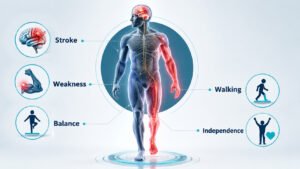
Weakness on one side of the body
Difficulty walking
Poor balance
Reduced coordination
Difficulty using an arm or hand
Another person may experience:
Shoulder pain
Muscle stiffness or spasticity
Difficulty transferring from bed to chair
Fatigue
Reduced endurance
Difficulty performing daily activities
Some people may also have problems involving speech, swallowing, vision, memory, mood or cognition.
That is why stroke rehabilitation should not be treated as a one-size-fits-all programme.
Physiotherapy is particularly important when stroke has affected movement, strength, balance, walking, coordination or physical independence.
Rehabilitation may involve physiotherapy alongside occupational therapy, speech and language therapy, medical management and caregiver support, depending on the patient’s individual needs.
Will stroke recovery at home be effective?
For a person recovering from stroke, travelling to a clinic can sometimes be difficult.
Getting into a car, navigating stairs, sitting through a long journey, transferring from a wheelchair, or managing fatigue can make regular outpatient visits challenging.
Home physiotherapy can remove some of these barriers.
Rayara Kirana provides home physiotherapy in Bangalore for patients who may have difficulty travelling because of mobility limitations, age, post-surgical recovery, chronic conditions or neurological problems such as stroke.
1. Therapy Takes Place in the Patient’s Real Environment
A clinic provides a controlled rehabilitation environment.
Home provides the environment where the patient actually has to live.
A physiotherapist can therefore observe questions such as:
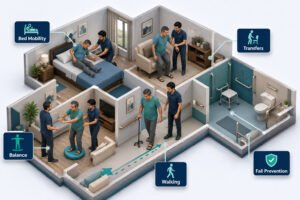
Can the patient safely get out of bed?
Is the pathway to the bathroom clear?
Can the patient stand from the usual chair?
Are stairs creating a major problem?
Does the patient require assistance while walking?
Is the walking aid being used correctly?
Is the bathroom creating a fall risk?
Can the patient safely transfer between bed and chair?
These observations can make rehabilitation more functional and practical.
2. Family Members Can Learn How to Help Safely
Family members often become an important part of stroke recovery.
However, helping a stroke survivor does not simply mean lifting or physically supporting them whenever they struggle.
Incorrect assistance can encourage dependence or create safety problems.
A physiotherapist can teach caregivers appropriate techniques for:
Bed mobility
Transfers
Walking assistance
Positioning
Exercise support
Fall prevention
Use of mobility aids
Safe practice of daily activities
The objective is to help caregivers support independence rather than unintentionally replacing the patient’s own effort.
What Does a Physiotherapist Assess After Stroke?
Before designing a programme, a physiotherapist should understand what the patient can and cannot currently do.
A stroke rehabilitation assessment may include several areas.
Muscle Strength
The physiotherapist checks weakness in the affected and unaffected limbs and determines how strength limitations affect functional movement.
Joint Range of Motion
Reduced movement can develop because of weakness, stiffness, pain, prolonged positioning or other neurological and musculoskeletal factors.
Muscle Tone and Spasticity
Some stroke survivors develop increased muscle tone or spasticity, which can interfere with movement and positioning.
Balance
Balance may be assessed during:
Sitting
Standing
Transfers
Turning
Reaching
Walking
Walking and Gait
The physiotherapist may examine:
Step length
Walking speed
Foot placement
Symmetry
Use of an assistive device
Ability to turn
Ability to negotiate obstacles
Functional Mobility
The assessment may look at tasks such as:
Rolling in bed
Sitting up
Standing
Sitting down
Moving between surfaces
Walking indoors
Using stairs
Upper-Limb Function
If the arm or hand is affected, therapy may focus on the patient’s ability to reach, grasp, release, support body weight, or use the arm during everyday activities.
Fatigue and Exercise Tolerance
Stroke recovery can be physically demanding. Rehabilitation therefore needs to be adjusted to the person’s capacity, medical condition and goals.
Stroke Rehabilitation Is More Than “Stroke Exercises”
One of the biggest misconceptions about physiotherapy after stroke is that recovery simply means performing a fixed list of exercises every day.
Effective rehabilitation is more specific than that.
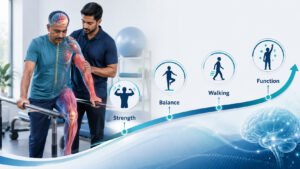
Modern stroke rehabilitation places considerable emphasis on repetitive, meaningful, task-specific and goal-oriented practice.
For example, instead of only strengthening the legs, a physiotherapist may practise:
Sit → stand → maintain balance → take several steps → turn → return to the chair → sit safely.
That sequence directly relates to daily life.
Similarly, instead of simply moving an affected arm through a range of motion, therapy may incorporate reaching, grasping, releasing, folding clothes, lifting a lightweight object or other meaningful activities when appropriate.
The objective is to translate physical improvements into better function.
This functional approach is also consistent with Rayara Kirana’s broader rehabilitation philosophy, where physiotherapy is positioned as more than pain management. Its article on physiotherapy beyond pain relief and long-term wellness discusses personalised rehabilitation, neurological progress, functional mobility and long-term independence.
What Can Physiotherapy Do for Stroke Recovery at Home?
A personalised programme may target several major areas.
1. Improving Bed Mobility
A patient may initially struggle to:
Roll from one side to another
Move from lying to sitting
Reposition themselves
Move their legs independently
Physiotherapy can break these activities into manageable components and practise them repeatedly.
Improving bed mobility can reduce dependence on caregivers and provide a foundation for later transfers and walking.
2. Sit-to-Stand Training
Standing from a chair is one of the most important functional movements after stroke.
It requires:
Leg strength
Trunk control
Balance
Weight shifting
Coordination
Confidence
A physiotherapist can progressively train the movement according to the patient’s ability.
The emphasis is not simply on completing repetitions but on improving the quality and safety of the movement.
3. Balance Training
Balance problems are common after stroke and can increase fall risk.
Balance rehabilitation may include progressively challenging tasks such as:
Supported standing
Weight shifting
Reaching
Turning
Stepping
Changing direction
Standing during functional activities
The exercises must be selected according to the patient’s current ability.
A person with significant balance impairment should not be asked to perform challenging standing exercises independently without appropriate supervision.
Rayara Kirana’s neurological rehabilitation programme also includes balance and mobility training as part of its approach to neurological physiotherapy.
4. Gait and Walking Rehabilitation
Walking is one of the most common goals of stroke survivors.
A gait programme may address:
Weakness
Poor foot clearance
Reduced walking speed
Asymmetrical movement
Poor balance
Difficulty turning
Reduced endurance
Fear of falling
Depending on the individual’s condition, rehabilitation may include over-ground walking, treadmill-based training, supported gait practice, strengthening, balance work and functional mobility exercises.
The exact approach depends on assessment findings.
The objective is not simply to make someone walk farther. It is to improve safe, efficient and functional mobility.
5. Upper-Limb and Hand Rehabilitation
Stroke may affect the arm and hand more severely than the leg.
A person may have difficulty:
Raising the arm
Reaching forward
Holding an object
Opening the hand
Releasing an object
Using both hands together
Performing fine motor tasks
Upper-limb rehabilitation should encourage meaningful use of the affected side where safe and appropriate.
Examples may include practising:
Reaching
Picking up objects
Placing objects
Folding
Buttoning
Pouring
Supported arm movements
The difficulty can then be progressed according to recovery.
6. Strength and Conditioning
Weakness and reduced physical activity can contribute to loss of independence after stroke.
A physiotherapist may incorporate appropriate strengthening and conditioning into the rehabilitation plan.
However, strengthening should not be treated as a standalone solution.
The programme should connect strength improvements with function.
For example:
Leg strengthening → better sit-to-stand ability → improved transfers → improved walking practice.
Similarly:
Trunk control → better sitting balance → improved reaching → improved functional independence.
Exercise intensity should be individualised and monitored according to medical status, symptoms, fatigue and functional ability.
7. Spasticity, Stiffness and Movement Restrictions
Some stroke survivors develop spasticity or increased muscle tone.
This may affect:
Elbow position
Wrist and hand posture
Hip movement
Knee control
Ankle position
Physiotherapy may include positioning, active movement, stretching where appropriate, strengthening of relevant muscle groups, functional practice and coordination with the wider medical team.
Importantly, physiotherapy does not replace medical management when spasticity requires specialist intervention.
8. Fall Prevention
Fall prevention is particularly important for stroke survivors with:
Poor balance
Weakness
Reduced sensation
Poor coordination
Visual problems
Difficulty turning
Unsafe transfers
Home-based physiotherapy provides a useful opportunity to identify environmental risks.
The therapist may consider:
Floor surfaces
Rugs
Stairs
Bathroom access
Lighting
Furniture arrangement
Walking routes
Appropriate use of walking aids
This is one of the key advantages of home-care physiotherapy at Rayara Kirana: rehabilitation can be considered in relation to the patient’s actual home environment.
Advanced Physiotherapy Techniques and Technologies at Rayara Kirana
Stroke rehabilitation should primarily be driven by clinical assessment and functional goals—not by the number of machines used.
However, selected technologies can sometimes serve as useful adjuncts to active rehabilitation.
Rayara Kirana’s physiotherapy techniques and technologies page describes a broader range of treatment approaches, including manual therapy, electrotherapy, strengthening and balance tools, proprioceptive training, muscle re-education and functional training.
For neurological rehabilitation, Rayara Kirana specifically lists:
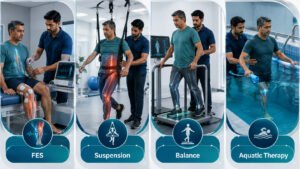
Functional Electrical Stimulation (FES)
Suspension therapy
Tilt tables
Balance-training systems
Task-oriented virtual exercises
Evidence-based manual therapy
Let’s understand how these may fit into a rehabilitation programme.
Functional Electrical Stimulation (FES)
FES uses electrical stimulation to activate muscles during functional movement.
Depending on the patient’s presentation and clinical indication, FES may be considered as an adjunct to active rehabilitation.
It is not a universal treatment for every stroke survivor.
The physiotherapist needs to determine whether it is appropriate based on the patient’s movement pattern, muscle response, medical history and rehabilitation goals.
Suspension Therapy
Suspension-based systems can assist supported movement and allow therapists to modify the amount of load or assistance during selected exercises.
For some patients, this can help make movement practice more achievable while maintaining a controlled environment.
The technique should be selected according to the individual’s functional capacity.
Tilt Tables
A tilt table can be useful in selected rehabilitation situations where gradual progression toward upright positioning is required.
This may be particularly relevant for patients with significant mobility limitations or difficulty tolerating upright positions.
Its use requires clinical assessment and appropriate monitoring.
Balance-Training Systems
Balance rehabilitation can involve structured exercises and, where available and appropriate, technology-assisted feedback.
The goal remains functional: improving postural control, weight shifting, standing stability and movement confidence.
Task-Oriented Virtual Exercises
Technology-assisted or virtual exercises can increase repetition, feedback and engagement.
They may be used as an adjunct to conventional rehabilitation when appropriate.
The important point is that technology should complement—not replace—skilled clinical assessment and functional practice.
What About Aquatic Therapy After Stroke?
Aquatic therapy, also known as water-based rehabilitation, can be an interesting option for selected patients.
Water changes the physical environment in several ways.
Buoyancy can reduce the effective load on the body, while the resistance of water provides a different environment for movement practice.
Depending on the patient’s condition, aquatic rehabilitation may be considered for:
Movement practice
General conditioning
Balance-related work
Lower-limb exercise
Functional movement
Confidence with supported movement
Rayara Kirana also offers aquatic therapy as part of its broader rehabilitation services, with the suitability of water-based therapy depending on the individual patient’s condition and clinical assessment.
Aquatic therapy should not be presented as a guaranteed stroke-recovery treatment.
It should be considered selectively and only after assessing factors such as:
Medical stability
Cardiovascular status
Ability to enter and exit the pool safely
Balance
Communication and cognition
Skin integrity
Continence
Fatigue
Fear of water
Supervision requirements
For the right patient, it may be a useful complement to land-based rehabilitation—not a replacement for it.
Can Physiotherapy Be Done Completely at Home?
Sometimes home rehabilitation can cover a substantial part of a person’s rehabilitation needs.
However, the answer depends on the individual’s condition.
A patient with significant neurological impairment may require coordinated input from:
Neurologist
Physiotherapist
Occupational therapist
Speech and language therapist
Rehabilitation physician
Dietitian
Psychologist or neuropsychologist
Other medical professionals as required
Therefore, home physiotherapy should be viewed as part of a rehabilitation pathway, rather than assuming that one professional can address every consequence of stroke.
Rayara Kirana’s home-care service can be useful for patients who require neurological rehabilitation while remaining at home, particularly when travelling to a clinic is difficult.
How Family Members Can Support Stroke Recovery
Family participation can make a major difference—but it needs to be structured.
Encourage Independence
Do not automatically perform every task for the patient.
If the person can safely complete part of a task independently, allow them to participate.
Follow the Prescribed Programme
Consistency matters.
The home programme should follow the physiotherapist’s instructions rather than introducing random internet exercises.
Make the Home Safer
Remove avoidable hazards and ensure walking routes are practical.
Encourage Meaningful Activity
Safe daily activities can provide opportunities for movement practice.
Watch for Fatigue
More exercise is not always better.
The programme should be adjusted when excessive fatigue, dizziness, pain or other concerning symptoms occur.
Communicate With the Rehabilitation Team
Changes in function, falls, new pain, worsening stiffness or other concerns should be communicated to the relevant healthcare professional.
A Typical Home Stroke Rehabilitation Session
Every patient will have a different programme, but a session might include:
Step 1: Reassessment
The physiotherapist checks how the patient is doing that day.
Step 2: Preparation
This may include positioning, gentle movement, warm-up or mobility exercises.
Step 3: Functional Training
The therapist may practise:
Rolling
Sitting
Standing
Transfers
Walking
Reaching
Balance
Step 4: Targeted Exercises
Specific strengthening, mobility, coordination or motor-control exercises may be added.
Step 5: Task-Specific Practice
The patient practises an activity that directly relates to their daily goals.
Step 6: Home Programme
The physiotherapist provides appropriate activities for practice between sessions.
Step 7: Caregiver Education
Where appropriate, family members are shown how to assist safely.
This structure makes rehabilitation more than a collection of exercises. It connects therapy to everyday life.
How Long Does Stroke Rehabilitation Take?
There is no universal recovery timeline.
Some people make significant improvements in the early months. Others continue to make meaningful functional gains later.
Recovery depends on factors including:
Type and location of stroke
Severity
Age and general health
Initial neurological impairment
Balance and mobility
Cognitive status
Fatigue
Medical complications
Rehabilitation intensity
Consistency of practice
Individual goals
Family and environmental support
The focus of rehabilitation can change over time.
Early goals might include:
Sitting → standing → walking.
Later goals may become:
Walking outdoors → climbing stairs → returning to work → participating in hobbies → improving endurance and community mobility.
The key is to continue reassessing what matters to the patient.
What Are Realistic Goals After Stroke?
A good rehabilitation programme uses measurable and meaningful goals.
Instead of saying:
“Improve leg strength.”
A more functional goal might be:
“Stand from a standard chair with minimal assistance.”
Instead of:
“Improve balance.”
A more meaningful goal might be:
“Walk safely from the bedroom to the bathroom using the prescribed walking aid.”
Instead of:
“Improve arm movement.”
The goal might be:
“Use the affected hand to assist with dressing or eating.”
These goals make progress easier to monitor.
Why Consistency Matters
Stroke rehabilitation is not usually a single-session solution.
The nervous system and musculoskeletal system need repeated opportunities to practise movement.
This is why the home environment can be so valuable.
A patient can practise safe functional movements in the same environment where those skills will eventually be used.
However, repetition should be quality repetition.
Repeating an unsafe movement hundreds of times is not necessarily beneficial.
The therapist’s role is to determine:
What movement should be practised?
How much assistance is needed?
How many repetitions are appropriate?
When should the task become harder?
When should the patient rest?
When should the exercise be changed?
When Should You Seek Physiotherapy After Stroke?
A person may benefit from physiotherapy when stroke-related problems are affecting:
Walking
Balance
Transfers
Sitting or standing
Arm or hand function
Strength
Coordination
Mobility
Independence
Confidence with movement
However, new or worsening neurological symptoms require urgent medical evaluation rather than waiting for a routine physiotherapy appointment.
Sudden new facial weakness, arm weakness, speech difficulty, severe dizziness, loss of coordination, vision changes or other possible stroke symptoms should be treated as a medical emergency.
Physiotherapy is part of rehabilitation after appropriate medical assessment and stabilisation; it is not a substitute for emergency stroke care.
Why Choose a Home-Based Rehabilitation Approach in Bangalore?
If travelling to the clinic is hard for your family member, you can arrange home care physiotherapy in Bangalore so the therapist comes to you.
For a stroke survivor, even a relatively short journey can involve:
Transfers
Walking
Waiting
Vehicle travel
Fatigue
Navigating stairs or entrances
Home physiotherapy can reduce some of these practical barriers.
Rayara Kirana provides home-care physiotherapy in Bangalore and describes its home programme as tailored to the patient’s condition and environment, including neurological rehabilitation for stroke and other neurological conditions.
For patients who are appropriate for home-based care, this can make rehabilitation more accessible and allow the therapist to address real-world movement challenges.
Rayara Kirana also provides neurological physiotherapy through its Bangalore centres. Its broader physiotherapy services in Bangalore include neurological rehabilitation, orthopaedic physiotherapy, sports physiotherapy, geriatric rehabilitation, women’s health and paediatric physiotherapy.
Why Rayara Kirana Takes a Broader Rehabilitation Approach
A modern physiotherapy programme should not be based on one technique.
The right intervention depends on the person’s:
Diagnosis
Functional limitations
Medical status
Rehabilitation stage
Goals
Response to treatment
Rayara Kirana’s physiotherapy techniques and technologies in Bangalore include manual therapy, electrotherapy, strengthening and balance tools, functional training, proprioceptive training and muscle re-education.
For stroke rehabilitation specifically, the most important principle is that these tools should be selected based on clinical need.
For example:
FES may be appropriate for selected movement problems.
Suspension therapy may help facilitate supported movement.
Balance systems may support structured balance training.
Task-oriented virtual exercises may provide additional repetition and feedback.
Aquatic therapy may be considered for selected patients.
But none of these should replace active, meaningful, goal-oriented rehabilitation.
The foundation remains functional recovery.
Frequently Asked Questions About Stroke Rehabilitation at Home
1. Can physiotherapy help after a stroke?
Yes. Physiotherapy can help address movement-related problems after stroke, including weakness, balance difficulties, walking limitations, transfers, coordination and functional mobility.
2. Is home physiotherapy suitable for every stroke patient?
No. Suitability depends on the patient’s medical condition, functional abilities, safety, home environment and rehabilitation needs. Some patients may require hospital-based, outpatient or multidisciplinary rehabilitation.
3. What exercises are best after stroke?
There is no single “best” exercise for every stroke survivor. Exercise selection should be based on the person’s impairments and functional goals.
4. Can physiotherapy help a stroke patient walk again?
Physiotherapy can work on the strength, balance, coordination and task-specific walking skills required for mobility. However, the amount of recovery varies considerably between individuals, so no responsible clinician should guarantee that a patient will regain independent walking.
5. Is it safe to exercise after stroke?
Exercise can be an important part of rehabilitation, but the programme should be individually assessed and progressed. People with medical complications or significant limitations may require closer monitoring.
6. Can physiotherapy help with a paralysed arm after stroke?
Physiotherapy can address movement, positioning, range of motion, motor control and functional use of an affected arm. Upper-limb rehabilitation should be tailored to the patient’s abilities and goals.
7. Does aquatic therapy help stroke recovery?
Aquatic therapy may be useful for selected patients, but it should be considered as an adjunct to a broader rehabilitation programme when clinically appropriate.
8. What is FES in stroke rehabilitation?
Functional Electrical Stimulation uses electrical stimulation to activate selected muscles, often as part of functional movement training. It may be appropriate for certain patients but is not suitable for everyone.
9. Can family members participate in stroke rehabilitation?
Yes. Family and caregiver participation can be valuable when appropriate. Healthcare professionals can teach caregivers safe ways to support mobility and daily activities.
10. How often should stroke physiotherapy be done?
Frequency depends on the person’s rehabilitation needs, tolerance, goals and overall care plan. The programme should be individualised rather than based on a fixed number of sessions.
11. Can stroke rehabilitation continue after six months?
Yes. Rehabilitation can continue when it is helping a person achieve meaningful goals. The focus may evolve from basic mobility to endurance, community participation, work, hobbies and long-term independence.
12. Should stroke patients only do exercises prescribed by a physiotherapist?
Patients should avoid starting unfamiliar or challenging exercises without appropriate professional guidance, particularly when there are significant balance, weakness, cardiovascular or neurological issues. Internet exercise videos should not replace an individual assessment.
Stroke Recovery Is a Process, Not a Single Exercise
Stroke can affect movement and independence in complex ways.
That is why effective rehabilitation needs more than a generic exercise sheet.
Stroke rehabilitation at home can bring physiotherapy into the environment where recovery ultimately needs to happen: the patient’s own home.
A structured programme may address:
Bed mobility
Transfers
Standing
Balance
Walking
Upper-limb function
Strength
Coordination
Fall prevention
Functional independence
Caregiver education
Depending on the patient’s needs, rehabilitation may also incorporate selected technologies and approaches such as Functional Electrical Stimulation, suspension therapy, balance systems, task-oriented virtual exercises and aquatic therapy.
At Rayara Kirana, these approaches are positioned within a broader, personalised rehabilitation model rather than being treated as standalone solutions.
The most important question is therefore not:
“Which machine or exercise is best for stroke?”
It is:
“What does this particular person need to do better, and what is the safest and most effective way to help them practise it?”
That is the foundation of meaningful neurological rehabilitation.
If you or a family member is recovering from stroke and finding it difficult to travel for regular sessions, home physiotherapy may be worth discussing with a qualified physiotherapist or rehabilitation professional.
For patients in Bangalore, Rayara Kirana provides neurological physiotherapy and home-care rehabilitation services designed around individual functional needs.
The goal of rehabilitation is not simply movement. It is helping a person regain the greatest possible level of safe, meaningful independence.
About Rayara Kirana Physiotherapy & Rehab Clinic
Rayara Kirana Physiotherapy & Rehab Clinic provides physiotherapy and rehabilitation services in Bangalore, including neurological physiotherapy, home-care physiotherapy and functional rehabilitation.
The clinic’s neurological rehabilitation services cover conditions including stroke, Parkinson’s disease, spinal cord injuries, traumatic brain injury, neuropathy and balance disorders.
Patients can explore the clinic’s neurological physiotherapy and stroke rehabilitation services or learn more about home-care physiotherapy in Bangalore.
For patients interested in the clinic’s broader treatment options, the physiotherapy techniques and technologies page provides an overview of available approaches and rehabilitation tools.