
Back pain is one of the most common reasons people miss work or skip the gym. Finding effective physiotherapy for back pain is the most critical step toward reclaiming your mobility when a sudden ache or injury strikes. In fact, nearly 80% of adults will experience a significant episode of back pain at some point in their lives. When it strikes, the first instinct is often a mix of panic and confusion: Should I just rest? Do I need an MRI immediately? Is this a slipped disc, or just a muscle pull?
The truth is, while back pain feels alarming, the vast majority of cases do not require surgery or heavy medication. At Rayara Kirana Physiotherapy & Rehab Clinic, we believe that movement is medicine. Understanding the “why” behind your pain is the first step toward a permanent fix rather than a temporary bandage.
This guide will walk you through everything you need to know about back pain treatment, when to worry, and why physiotherapy for back pain is the gold standard for long-term recovery.
Not All Back Pain Is the Same: Identifying Your Type
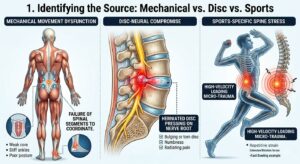
Most people search for “how to fix lower back pain fast,” but the solution depends entirely on the type of pain you have. Physiotherapy starts with a clinical assessment to categorize your pain into one of these three common buckets:
Mechanical Back Pain
This is pain triggered by movement or posture. It usually involves the muscles, ligaments, or the small joints of the spine (facet joints). If your pain feels better when you sit a certain way or worse after standing too long, it’s likely mechanical.
Slipped Disc / Nerve Pain (Sciatica)
Often searched as slip disc symptoms, this occurs when a spinal disc presses on a nerve. You might feel “electric” shocks, tingling, or numbness traveling down your leg. While it sounds scary, most slipped discs heal beautifully with targeted spine rehabilitation rather than surgery.
Sports-Related Back Pain
Common in athletes and gym-goers, this is often due to “overloading”—doing too much, too soon, or using poor form during deadlifts or squats.
How Physiotherapy Helps:
We don’t just look at the spot that hurts. We analyze how you move, your core stability, and your joint flexibility to find the “root cause” of the mechanical failure.
When Do You Really Need an X-ray?
A very common question we hear is: “Do I need a scan for back pain?”
In the first 4 to 6 weeks of non-traumatic back pain, an X-ray is rarely helpful. X-rays show bones, but they don’t show the muscles, nerves, or discs where the actual problem usually lies.
The Rayara Kirana Approach:
A thorough clinical assessment by a senior physiotherapist is often more accurate than a standalone X-ray in determining which movements are restricted and which muscles are inhibited.
When Is MRI Required for Back Pain?
If you are searching for MRI for slip disc, you might be worried about the severity of your injury. However, an MRI is a “snapshot,” not a full movie of your health.
MRI is generally reserved for:
Pain that hasn’t improved after 6 weeks of dedicated physiotherapy.
Severe neurological symptoms (weakness in the legs, loss of bladder control).
Suspected underlying “red flag” conditions (infections or fractures).
Physiotherapy Screening:
Before rushing for an MRI, a physiotherapist performs a “Neurological Screen.” We check your reflexes, muscle strength, and sensation. If these are intact, your recovery can often proceed successfully without expensive imaging.
Sports & Gym Back Pain: From Cricket to Crossfit
Gym back pain and cricket back injuries are trending topics because higher activity levels often expose weak links in our movement patterns.
In the Gym: Pain often stems from poor “bracing” of the core or restricted hip mobility, which forces the lower back to overcompensate during lifts.
In Sports (like Cricket): The repetitive rotation and fast bowling actions can cause “stress reactions” in the vertebrae.
At Rayara Kirana, we specialize in functional rehab. We don’t just tell you to stop lifting; we teach you how to lift correctly.
When Can You Return to Gym or Sports?
The most asked question by athletes is about back pain recovery time. You are ready to go back when:
You have a full, pain-free range of motion.
Your core can handle “load” without the spine shifting.
You pass specific physiotherapy clearance tests (like hopping or sport-specific drills).
Normal Back Pain vs. Serious Spine Problems
How do you know if it’s just a “sore back” or something serious? Use this comparison:
Feature | Normal/Mechanical Pain | Serious Spine Problem (Seek Help) |
Onset | Gradually or after a specific lift | Sudden, after a major fall or trauma |
Leg Symptoms | Usually none | Numbness, weakness, or “heaviness” |
Bladder/Bowel | Normal | Any loss of control (Emergency!) |
Night Pain | Improves with position change | Constant, deep pain that prevents sleep |
Response | Improves with light movement | Gets worse regardless of position |
Why Physiotherapy Works Better Than Rest Alone
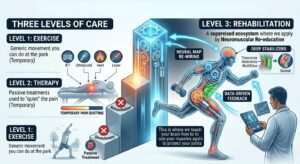
For decades, the advice was “bed rest.” Today, science proves that bed rest is actually bad for back pain. Physiotherapy for back pain works because it addresses the three pillars of recovery:
Pain Relief: Manual therapy to “calm” the nervous system.
Restoring Mobility: Getting the stiff segments of your spine moving again.
Strengthening: Activating the “deep core” muscles that act as a natural brace.

The Role of Rayara Kirana in Faster Recovery
Our recovery protocol includes:
Manual Therapy: Hands-on techniques to mobilize stiff joints.
Movement Retraining: Identifying “energy leaks” in your posture.
Core Strengthening: Specific exercises tailored to your strength level.
Ergonomic Advice: Helping you set up your workstation to prevent “Slumped Spine.”
Conclusion: Reclaiming Your Life
Back pain doesn’t have to be your permanent reality. Whether it’s a slipped disc, a gym injury, or chronic lower back pain, the path to recovery is built on movement, not just medicine.
Schedule Your Assessment at Rayara Kirana Today
FAQ: Your Back Pain Questions Answered
- How to fix lower back pain fast?
The fastest way is to stay gently active. Avoid bed rest. Use heat packs for muscle stiffness and consult a physiotherapist for “unloading” techniques that reduce immediate pressure on your spine.
- When to see a doctor for back pain?
You should see a specialist if you experience “Red Flags” like sudden leg weakness, numbness in the groin area, fever along with back pain, or if the pain is the result of a high-impact accident.
- Is physiotherapy for back pain effective for a slipped disc?
Yes! Over 90% of slipped disc cases recover with physiotherapy. We use specific exercises (like the McKenzie method) to help “centralize” the pain and take pressure off the nerve.
- What are the best back pain recovery exercises?
There is no “one size fits all,” but generally, Bird-Dog, Cat-Cow, and Pelvic Tilts are great for mobility. However, an assessment is needed to ensure these are right for your specific spine shape.
- Why does my back hurt when I wake up?
This is often due to “inflammatory stasis” (stiffness from lack of movement overnight) or an unsupportive mattress. Physiotherapy can help improve your joint lubrication to reduce morning stiffness.
- Can stress cause back pain?
Absolutely. Stress increases muscle tension, particularly in the lower back and shoulders, and makes your nervous system more sensitive to pain signals.
- How can I prevent back pain at my desk job?
Follow the 20-20-20 rule: Every 20 minutes, stand up for 20 seconds. Ensure your monitor is at eye level and your feet are flat on the floor to maintain a neutral spine.
- Is walking good for lower back pain?
Walking is one of the best “low-impact” exercises for back pain. It increases blood flow to the spinal structures and strengthens the muscles that support your posture.
- Do I need surgery for a herniated disc?
Rarely. Surgery is usually the last resort if physiotherapy and conservative management fail to show progress after several months, or if there is a progressive loss of nerve function.
- What is a “pinched nerve” in the back?
This happens when a disc or bone spur presses on a nerve root. It causes pain, tingling, or weakness in the area that the nerve supplies (often the leg).
- How long does a back muscle strain take to heal?
A typical muscle strain heals within 2 to 4 weeks, provided you don’t keep re-injuring it. Physiotherapy speeds this up by ensuring the muscle heals with “functional” strength.
- Can physiotherapy help with old (chronic) back pain?
Yes. Even if you’ve had pain for years, physiotherapy can help “desensitize” your nervous system and strengthen the muscles that have become weak over time.
- Why is my back pain worse when I cough or sneeze?
Coughing increases “intra-abdominal pressure,” which can push a slipped disc slightly further against a nerve. This is a common sign that you should seek a professional assessment.
- Are injections (Epidurals) better than physiotherapy?
Injections can reduce inflammation temporarily, but they don’t fix the movement problem that caused the inflammation. Physiotherapy provides the long-term solution by fixing the mechanics.
- Does Rayara Kirana offer specialized sports physiotherapy?
Yes! We specialize in functional rehab for athletes, focusing on movement correction, power restoration, and injury prevention for a safe return to sports

.