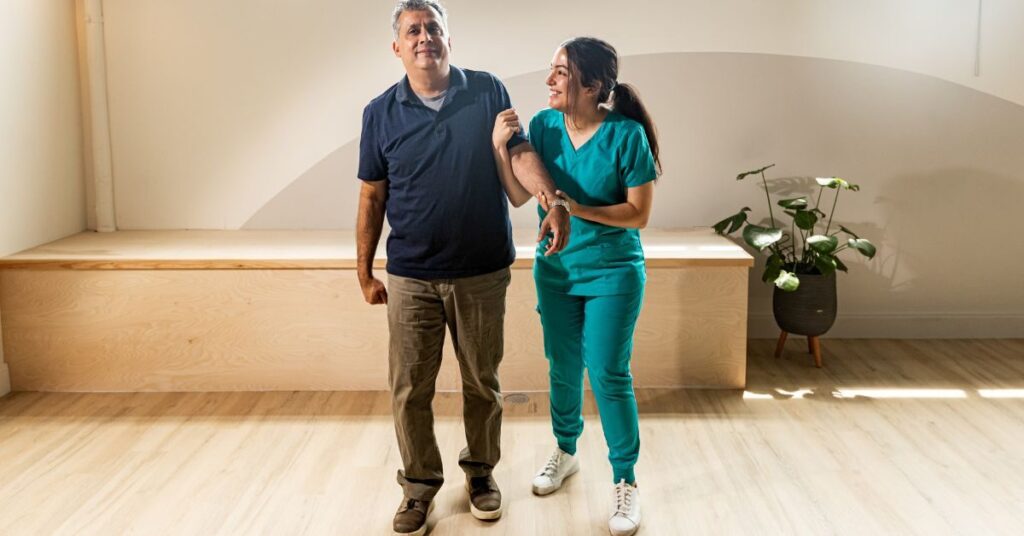
If you have ever twisted your ankle while running, felt a sharp ‘pop’ in your knee during a football match, or felt your shoulder slip after a fall, you have likely experienced a ligament injury. These injuries, ranging from mild sprains to complete tears, are incredibly common in both athletes and active individuals in daily life.
Often, the first reaction to a significant ligament injury is panic, followed by the assumption that surgery is the only path to recovery. However, as experienced physiotherapy and sports injury specialists at Rayara Kirana Physiotherapy & Rehab Clinic in Banasankari, Bangalore, we treat these injuries successfully every day.
The reality is that for a vast number of ligament injuries, a comprehensive, structured ligament injury rehab program is not just an alternative to surgery; it is the most effective way to restore full function, strength, and stability. Ignoring these injuries or merely ‘resting’ and hoping they heal can lead to chronic joint instability, persistent pain, and long-term degenerative changes like osteoarthritis.
This guide will explain exactly what ligament injuries are, how they are managed through specialized physiotherapy for ligament tear, and why rehabilitation is essential for a safe, strong return to your favorite activities.
Understanding Ligaments and Their Role
Before we look at the treatment, it is crucial to understand what we are dealing with.
What are Ligaments?
Ligaments are tough, fibrous bands of connective tissue that connect one bone to another bone within a joint. Think of them as strong, slightly elastic ropes or stabilizers that hold your skeleton together.
The Function of Ligaments
The primary role of a ligament is joint stability. They:
Restrict abnormal movement: They prevent your joints from moving in directions they aren’t supposed to (e.g., preventing your knee from buckling sideways).
Guide normal movement: They ensure the joint moves smoothly through its intended range of motion.
Provide proprioceptive feedback: They contain sensory nerve fibers that send signals to your brain about the joint’s position, helping with balance and coordination.
Vulnerability to Injury
Ligaments are vulnerable because they are often under significant tension. When a joint is forced beyond its normal range of motion—due to a sudden twist, a direct blow, or a fall—the ligament is stretched. If the force is too great, the fibers begin to tear.
Examples of Critical Ligaments:
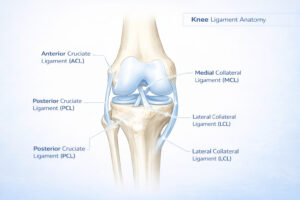
Knee Ligaments: Perhaps the most frequently injured. These include the Anterior Cruciate Ligament (ACL), which prevents the shinbone from sliding too far forward, and the Medial Collateral Ligament (MCL), which stabilizes the inner knee.
Ankle Ligaments: The ligaments on the outside of the ankle are often stretched during a sprain (twisting inward).
Shoulder Ligaments: These are crucial for keeping the highly mobile shoulder joint in its socket.
Common Types of Ligament Injuries:
We classify ligament injuries based on the severity of the damage. This classification guides our ligament sprain rehabilitation approach.
Mild Sprain
What it is: A Grade 1 injury involves microscopic tearing of the ligament fibers. The ligament is stretched, but the joint remains stable.
Symptoms: Mild pain, slight swelling, and some tenderness. You can usually still bear weight or move the joint, though it might be uncomfortable.
Partial Tear
What it is: A Grade 2 injury is a more significant, partial tearing of the ligament. The joint begins to feel unstable.
Symptoms: Moderate pain, significant swelling, bruising, and noticeable joint tenderness. You will likely feel that the joint ‘gives way’ or is loose during movement.
Complete Tear
What it is: A Grade 3 injury is a complete rupture or tear of the ligament, separating it into two pieces. The joint is usually very unstable.
Symptoms: Severe pain (though sometimes the pain stops quickly because the nerve fibers are severed), extensive swelling and bruising, and a complete inability to bear weight or move the joint without it giving way.
Most Common Ligament Injuries in Sports and Daily Life
Ligament injuries occur frequently in dynamic sports that require rapid changes in direction, jumping, and contact. However, they are just as common from tripping on uneven pavement or falling down stairs. In our sports injury physiotherapy Bangalore clinic, we commonly see the following:
1. Knee Ligament Injuries
Knee ligament injuries are incredibly common. Athletes in football, badminton, basketball, and cricket are at high risk.
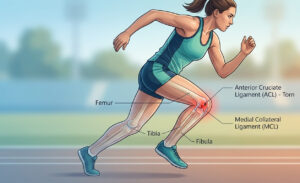
ACL Injuries: The ACL injury physiotherapy is perhaps the most well-documented sports rehab program. An ACL tear often occurs when an athlete pivots sharply, lands awkwardly from a jump, or receives a direct blow to the side of the knee.
MCL Injuries: These usually happen when the outside of the knee is hit, forcing the knee to buckle inward (a common mechanism in rugby or contact sports).
2. Ankle Sprains
The lateral (outside) ankle ligaments are the most frequently injured ligaments in the entire body. It happens when you ‘roll’ your ankle inward. It’s common in runners, but also in people walking on uneven surfaces. Proper ankle ligament sprain treatment is vital to prevent recurrent sprains.
3. Shoulder Ligament Injuries
The shoulder joint has extraordinary mobility, making its stabilizing ligaments crucial. Injuries often happen during a fall on an outstretched hand (FOOSH), in collision sports like rugby, or during heavy lifting (e.g., gym training) that forces the shoulder into a vulnerable position.
Why Rehabilitation is Essential for Ligament Healing
A common misconception is that “rest is all that’s needed for a sprain.” While initial rest is important, prolonged inactivity is detrimental. Here is why structured physiotherapy for ligament tear is essential:
Rest Alone is Not Enough: If you only rest, the ligament might heal (slowly), but it will often heal with disorganized, weak scar tissue. It also won’t address the primary issues that caused the injury or the surrounding muscle weakness that developed while you were immobile.
Improves Ligament Healing: Controlled loading and specific ligament healing exercises guided by a physiotherapist stimulate the repair cells in the ligament to align parallel to the line of stress. This makes the newly formed ligament tissue stronger and more elastic.
Preventing Re-Injury: After a ligament injury, your brain’s ability to “sense” the joint’s position (proprioception) is impaired. This increases the risk of the joint giving way again. A dedicated rehab program focuses on balance and coordination training to restore this “sixth sense.”
Restoring Strength and Mobility: Inactivity causes surrounding muscles to atrophy (weaken) very quickly. If you return to sports without restoring that muscle strength, the ligament will be overloaded again, leading to re-injury.
Achieving Long-Term Stability: The muscles around a joint act as active stabilizers. After a ligament injury, you rely more heavily on these muscles. We design comprehensive knee stability exercises and general joint strengthening programs to ensure your muscles are strong enough to protect the joint.
The Rehab-Based Treatment Approach: A Step-by-Step Process
At Rayara Kirana Physiotherapy & Rehab Clinic, our comprehensive ligament injury rehab program is evidence-based and tailored to your specific injury, grade, and goals (e.g., returning to high-level sports or simple daily walking).
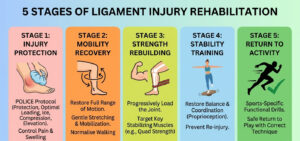
Stage 1 – Pain and Swelling Control (Protection and Acute Phase)
The initial days after an injury are about minimizing damage and managing symptoms. We use the “POLICE” principle (Protection, Optimal Loading, Ice, Compression, Elevation) rather than the older, purely rest-focused RICE.
Goals: Reduce swelling, decrease pain, protect the ligament from further injury.
Interventions: Therapeutic modalities (like ultrasound or laser therapy), manual therapy to reduce muscle guarding, and gentle “optimal loading” (very light movement that doesn’t pain) to start the healing process.
Stage 2 – Mobility and Range of Motion Restoration
Once pain and swelling are manageable, we focus on moving the joint again. Scar tissue can become rigid, so early mobility is key.
Goals: Restore full joint flexibility and normalize gait (how you walk).
Interventions: Gentle mobilization techniques, structured stretching, and active-assisted range of motion exercises.
Stage 3 – Strength Building (The Core of Rehab)
This is the most time-consuming yet critical stage. The muscles around the injured joint must become robust enough to take the load off the weakened ligament.
Goals: Progressively strengthen key muscle groups.
Interventions: Therapeutic exercises, resistance training using bands and weights, and functional movements (like squats, lunges, or modified movements) tailored to your progress.
Stage 4 – Proprioception and Stability Training
Strength alone is not enough; the muscles must activate at the right time.
Goals: Restore balance, joint position sense, and stability during movement.
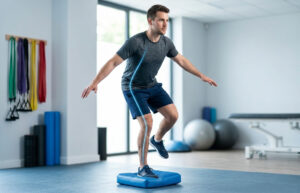
Interventions: Single-leg balance training, unstable surface training (e.g., on foam pads), and plyometric (jumping/landing) drills in a controlled environment.
Stage 5 – Functional Rehab and Return to Sports/Activity
We bridge the gap between “standard rehab” and the specific demands of your life or sport.
Goals: Execute sports-specific movements or demanding daily tasks with confidence and correct technique.
Interventions: Tailored drills for your sport (e.g., badminton footwork drills, controlled running progression for athletes), advanced stability challenges, and performance testing to ensure you are ready for a safe return.
Expert Comments from Rayara Kirana Physiotherapy
Dr. Kiran S. Murthy, PT “Many patients believe ligament injuries require surgery immediately. However, structured physiotherapy rehabilitation can restore stability and function in many cases without surgery.”
Dr. Yoginder Balaji, PT “Early rehabilitation is the key to preventing chronic joint instability. A well-designed physiotherapy program strengthens surrounding muscles and improves joint control, reducing the long-term risk of arthritis.”
When to Visit a Physiotherapist: Warning Signs
Do not ignore a joint injury. Early intervention dramatically improves long-term outcomes. You should consult our specialized physiotherapy clinic in Banasankari Bangalore if you experience:
Persistent or increasing swelling that doesn’t resolve.
The feeling that the joint is unstable, wobbly, or “gives way” unexpectedly.
Difficulty bearing weight (even limp) on the injured leg.
Significant limitations in joint movement (e.g., you can’t fully straighten or bend your knee).
A history of repeated ankle sprains or joint discomfort after minimal activity.
Preventing Ligament Injuries
While you can’t eliminate the risk entirely, you can significantly reduce it. As sports physiotherapy Bangalore experts, we emphasize prevention:
Proper Warm-Up: Never skip dynamic stretching and movements that prepare your joints for activity.
Dedicated Strength Training: Strong muscles, particularly the core and leg muscles, protect the ligaments.
Balance Exercises: Integrate simple balance challenges into your daily routine.
Correct Sports Technique: Learning the proper way to land from a jump, cut, and tackle is vital.
Supportive Footwear: Ensure your shoes are appropriate for your specific activity and provide adequate support.
Frequently Asked Questions (FAQs)
1. What is the fastest way to heal a ligament injury?
The fastest way to heal is to follow a structured, early rehabilitation program. Ignoring the injury, or merely resting, prolongs the recovery and risks chronic problems. Progressive loading stimulates faster tissue repair than complete rest.
2. Can ligament tears heal without surgery?
Yes, many Grade 1 and 2, and even some Grade 3 tears can be managed effectively through physiotherapy rehabilitation without surgery. The body repairs the tissue, and a robust strength program ensures muscle compensation for any residual ligament laxity.
3. How long does ligament recovery take?
Recovery timelines vary significantly by severity and individual. As a rough guide: Mild sprains (Grade 1) often take 2 to 4 weeks; moderate injuries (Grade 2) may require 6 to 8 weeks; and severe, complete tears (Grade 3), particularly if affecting critical stabilizers like the ACL, will take several months (6–9+ months) of dedicated rehab.
4. What exercises help ligament healing?
Specific ligament healing exercises are progressive. We might start with isometric holds (contracting muscles without moving), progress to gentle stretching, and then move to controlled resistance training and functional movements like squats or single-leg exercises.
5. Can physiotherapy repair ligament damage?
Physiotherapy does not technically “repair” the ligament in the way a surgeon stitches it back together. However, our therapies stimulate the body’s natural repair mechanisms and, crucially, focus on building compensatory muscle strength and restoring neuro-muscular control to stabilize the joint in place of the damaged ligament.
6. Is walking good after a ligament injury?
It depends on the stage and grade. Early on, walking (if possible) is often recommended with crutches to minimize load. In later stages, walking is encouraged to restore normal gait, though you must progress to more complex movements. We provide guidance on when it is safe for you to walk.
7. How do I know if my ligament is torn?
A thorough physical examination by a healthcare professional (physiotherapist or orthopedist) is required. They will perform special manual tests. While symptoms like instability, significant swelling, and ‘hearing a pop’ are strong indicators, an MRI scan is often the only definitive way to visualize the extent of a ligament tear.
8. Can ligament injuries become permanent?
If unmanaged, the instability caused by a ligament injury can become chronic, leading to recurring sprains. This chronic instability often accelerates degenerative changes within the joint, eventually resulting in permanent osteoarthritis.
9. What physiotherapy treatments help ligament injuries?
Our comprehensive treatments include therapeutic exercises (strength and flexibility), manual therapy techniques to improve joint motion, proprioception and balance training, muscle re-education, and modern therapeutic modalities (e.g., shockwave, laser, or dry needling) as needed to support recovery.
10. When should I start rehab after a ligament injury?
Rehab should ideally begin within 24–48 hours for mild sprains. For serious injuries, the initial phase focuses on protection and managing symptoms (POLICE). Starting controlled movement early prevents joint stiffness and muscle wasting.
11. Can gym exercises worsen ligament injuries?
Yes, inappropriate gym exercises (e.g., heavy loading on an unstable joint, deep squats too early) can worsen an injury. You must follow a physiotherapist’s guided program before returning to high-load, open-gym workouts.
12. What is the difference between a sprain and a tear?
“Sprain” is the broader medical term for any injury to a ligament. A tear is the specific damage within that sprain. Grade 1 is a micro-tear, Grade 2 is a partial tear, and Grade 3 is a complete tear.
13. Are knee braces helpful for ligament injuries?
Braces can be extremely helpful during the early stages (Grade 2–3) to protect the joint from further abnormal movement, but they should be used as a supplement to, never a replacement for, rehabilitation. Your physio will recommend the right brace if it is necessary.
14. Can ankle ligament injuries come back again?
Unfortunately, yes. If you have sprained an ankle once, the risk of recurrence is much higher—unless you complete a full rehab program focusing on strengthening the surrounding muscles and restoring balance (proprioception).
15. How does physiotherapy prevent re-injury?
We address not just the ligament, but the whole functional system. By maximizing muscle strength around the joint and, crucially, retraining your balance and movement coordination (proprioception), we ensure your body can automatically stabilize the joint before an abnormal movement causes injury again.
Why Choose Rayara Kirana Physiotherapy & Rehab Clinic?
Located conveniently in Banasankari, Bangalore, Rayara Kirana Physiotherapy & Rehab Clinic is a premier destination for expert, professional, and patient-centered rehabilitation care.
We are dedicated to:
Evidence-Based Treatment: Our methods are backed by the latest medical research to ensure the most effective, safest recovery pathways.
Highly Experienced Specialists: Our team includes dedicated physiotherapists with extensive experience in sports injury management and ligament rehabilitation.
Personalized Rehab Programs: We do not believe in a one-size-fits-all approach. Every program is custom-designed for your specific injury, progress, and goals.
Comprehensive Management: We manage you from the acute phase of pain control all the way to advanced sports-specific functional retraining.
Community Focused: Proudly serving patients across Banasankari and the surrounding areas of Bangalore.
Conclusion
Managing a ligament injury is a marathon, not a sprint. The keys to success are early diagnosis, a patient-friendly educational approach, and a comprehensive, evidence-based ligament injury rehab program. Ignoring these injuries, rushing recovery, or opting for surgery before trying structured rehabilitation can have serious long-term consequences.
A carefully guided rehabilitation process can often restore stability and full function without the need for unnecessary surgical interventions.
If you have suffered a recent sprain, are concerned about persistent joint instability, or are an athlete looking for sports injury physiotherapy in Bangalore, we invite you to consult the experienced team at Rayara Kirana Physiotherapy & Rehab Clinic. We are dedicated to guiding you through a safe, strong, and lasting recovery.