
Medically Reviewed by Dr. Kiran S. Murthy, Founder & Senior Physiotherapist at Rayara Kirana
Last Updated: July 2026
Neck Pain After Screen Time? Your Body Is Trying to Tell You Something
Picture this: It’s 10 PM. You’re lying on the couch, neck bent at a steep angle, phone six inches from your face. You’ve been scrolling for the last 45 minutes — emails, news, reels, messages. Your neck aches. You roll your shoulders and think, I’ll stretch later. Later never comes. And that dull ache you keep brushing off? It has a name. It’s called Text Neck Syndrome, and millions of people across India are living with it without ever knowing what’s actually happening to their spine. At Rayara Kirana Physiotherapy & Rehab Clinic in Banashankari, Bangalore, our physiotherapy specialists see patients from all walks of life — teenagers, software engineers, homemakers, students, seniors — all sharing one thing in common: persistent neck and upper back pain that began quietly and gradually took over their daily lives. This article will help you understand what text neck syndrome is, why it is far more serious than most people assume, and what you can do right now to protect your spine before the damage becomes irreversible.
What Is Text Neck Syndrome? The Modern Spine Condition Caused by Screen Habits
Text Neck Syndrome — sometimes called tech neck — is a modern postural condition caused by the repetitive strain of holding your head in a forward-tilted position for extended periods while using smartphones, tablets, laptops, or other screens. The term was coined by US chiropractor Dr. Dean L. Fishman in 2008, and in the years since, it has gone from a niche clinical observation to one of the most common musculoskeletal complaints treated by physiotherapists worldwide. It is not just about the pain in your neck after a long phone call. Text neck syndrome involves structural changes to the cervical spine, muscular imbalances, disc stress, and over time, nerve compression — all triggered by something as ordinary as checking your messages.
The Science of Spinal Load: What Happens to Your Neck at Every Tilt Angle
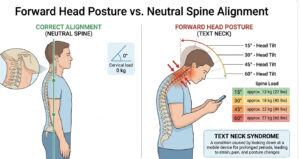
Your cervical spine — the seven vertebrae forming the neck — is engineered to carry the weight of your head (roughly 4.5–5.5 kg) in perfect balance when your ears are aligned directly over your shoulders. The problem starts the moment you tilt your head forward. According to a landmark study published in Surgical Technology International by Dr. Kenneth Hansraj (2014), the effective forces on the cervical spine increase dramatically with every degree of forward tilt:
15° tilt → ~12 kg of effective load
30° tilt → ~18 kg of load
45° tilt → ~22 kg of load
60° tilt → ~27 kg of load
The average person spends 3 to 6 hours daily on their smartphone, often with their neck tilted at 45 to 60 degrees. That is your cervical spine carrying more than four times its intended load — for hours, every single day. Over weeks and months, this cumulative stress causes:
Muscle fatigue and tightening in the posterior neck
Compression of cervical intervertebral discs
Gradual flattening of the natural cervical curve (cervical lordosis)
Micro-tears in cervical ligaments
In advanced stages — disc herniation or nerve impingement
Forward Head Posture: The Root Cause of Text Neck Syndrome Explained
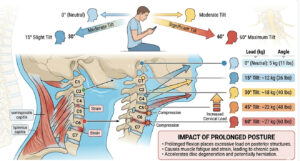
Forward head posture (FHP) is the biomechanical root of text neck syndrome. In healthy posture, the head sits directly over the spine’s center of gravity. When FHP develops, the head migrates forward — sometimes by 2 to 4 centimeters — placing the entire weight-bearing burden on the posterior neck muscles, ligaments, and discs. The muscles most affected include:
Levator scapulae – becomes chronically shortened and tender
Upper trapezius – develops trigger points and spasm
Suboccipital muscles – responsible for tension headaches
Sternocleidomastoid (SCM) – tightens, restricting rotation
Deep cervical flexors – weaken significantly, losing their stabilizing role
As these imbalances accumulate, the body compensates. The thoracic spine rounds forward, the shoulders protract, and what began as a neck problem slowly becomes a full-body postural collapse.
Which Muscles and Cervical Structures Are Most Affected by Poor Screen Posture
Text neck syndrome is a lifestyle-driven condition. The causes are woven into everyday habits most of us don’t think twice about. Primary causes include:
Prolonged smartphone use with the device held at chest or lap level
Binge-watching content on tablets or laptops in reclining positions
Working from home without ergonomic setup
Long hours of video gaming with screens below eye level
Online studying using phones or low-positioned laptops
Social media overuse — the average person opens their phone over 100 times per day
Poor sitting habits — slouching without lumbar support
The common thread: the screen is below eye level, and the head drops to follow it.
Common Causes of Text Neck Syndrome in Students, Professionals & Gamers
One of the reasons text neck syndrome becomes serious is that its early symptoms are easy to dismiss. People attribute the discomfort to tiredness, stress, or poor sleep. By the time they seek help, the condition has often progressed significantly. Early symptoms often overlooked:
A dull, persistent ache at the base of the skull or upper neck
Mild morning stiffness that loosens after a few minutes
Tightness between the shoulder blades
Occasional headaches at the back of the head
Reduced neck rotation when checking your blind spot while driving
Eye strain after prolonged screen use
Moderate to severe symptoms that demand attention:
Constant neck pain radiating to the shoulders or arms
Numbness or tingling in the hands or fingers
Muscle spasms in the neck and upper back
Visible forward head posture — chin jutting out, rounded shoulders
Frequent headaches or migraines
Difficulty sleeping due to neck discomfort
Jaw pain or clicking (temporomandibular effects) If you recognize three or more of these symptoms, it is time to consult a physiotherapist.
Long-Term Spinal Complications
Left untreated, text neck syndrome is a progressive spinal health problem with serious long-term consequences:
Cervical disc degeneration — accelerated wear and thinning of intervertebral discs
Cervical herniated disc — disc material pushing into the spinal canal or nerve roots
Cervical spondylosis — arthritic changes occurring earlier than expected
Cervical myelopathy — spinal cord compression causing weakness and coordination problems
Thoracic outlet syndrome — nerve and vascular compression causing arm symptoms
Permanent postural changes — structural deformity of the cervical and thoracic spine Physiotherapists and spine specialists across Bangalore are seeing these complications in patients who are younger and younger each year.

Who Is Most at Risk for Text Neck Syndrome?
Teenagers and School Students
Young spines are still developing. Prolonged forward head posture during formative years can alter the natural cervical curve permanently. Many adolescents in Bangalore spend 6–8 hours daily on screens for both study and recreation.
IT Professionals and Software Engineers
Bangalore’s tech sector means thousands of professionals spending 8–12 hours at computers with suboptimal workstation ergonomics. Cervical pain treatment in Bangalore for IT professionals is one of our most common physiotherapy referrals.
Office Workers
Prolonged desk sitting compounds with mobile phone habits outside work hours to create a constant cycle of postural stress.
Gamers
Mobile and console gaming requires sustained attention to screens held at suboptimal angles, often for 4–6 hours per session, combining poor posture with minimal movement.
College Students
Competitive exam preparation, online classes, and social media exposure combine to create almost continuous screen time — with the neck paying the price.
How Poor Posture Damages Muscles, Cervical Discs, and Spinal Nerves
Muscles: When the head sits consistently forward, posterior neck muscles are under constant eccentric load — stretching while contracting — developing painful trigger points. Deep cervical flexors simultaneously weaken from underuse. Intervertebral Discs: Forward head posture repeatedly compresses the front of cervical discs, accelerating degeneration. Over time, nucleus pulposus material may herniate toward the spinal canal, triggering nerve root compression. Nerves: The cervical nerve roots (C5, C6, C7 most commonly) exit through small foramina. Disc degeneration, bone spurs, or tight muscles can narrow these openings — causing tingling, numbness, or weakness traveling down the arm. This is why advanced text neck syndrome can mimic carpal tunnel syndrome or shoulder pathology.
Daily Habits That Make Text Neck Worse
Using your phone while walking — eyes drop, neck follows
Phone use in bed with neck bent at 90 degrees
Holding the phone at lap level instead of eye level
Staying in one position for 45+ minutes without movement
Carrying a heavy bag on one shoulder — shifts spinal alignment
Sleeping on your stomach — sustained neck rotation for hours
Taking painkillers and continuing the same habits instead of addressing the cause
Psychological and Lifestyle Effects of Chronic Neck Pain
The impact of text neck goes beyond the physical: Sleep disruption is common — finding a comfortable position becomes difficult, leading to fatigue and irritability. Concentration and productivity suffer when pain competes for your attention. Students report difficulty focusing; professionals describe reduced afternoon output. Mood and mental health are affected. Research consistently links chronic musculoskeletal pain with higher rates of anxiety and depression — and stress, in turn, causes people to tense neck and shoulder muscles further. Social withdrawal sometimes follows — people avoid events, exercise, and driving because of pain or limited mobility.
When Should You Consult a Physiotherapist?
Seek physiotherapy assessment if you experience:
Neck pain lasting more than 1–2 weeks despite rest
Pain that returns every few weeks
Numbness, tingling, or weakness in the arms or hands
Headaches originating from the base of the skull
Neck stiffness limiting full head rotation
Pain that disrupts sleep or affects work performance You do not need to wait until you cannot move your neck. Early intervention means faster recovery, less treatment, and significantly better long-term outcomes.
Physiotherapy Treatment for Text Neck Syndrome
Physiotherapy is the most evidence-based, non-surgical treatment for text neck syndrome. At Rayara Kirana Physiotherapy & Rehab Clinic, our approach is thorough, personalized, and focused on long-term correction.
Manual Therapy
Hands-on cervical joint mobilization, soft tissue release, and myofascial trigger point therapy. These reduce pain, restore mobility, and release tight muscles — often providing meaningful relief from the very first session.
Therapeutic Exercises
Targeted programs to strengthen deep cervical flexors, retrain scapular stabilizers, restore thoracic mobility, and correct forward head posture progressively over time.
Postural Re-education
Teaching the neuromuscular system to return to and maintain correct alignment — first with conscious awareness, then as an automatic habit.
Adjunct Therapies
IFT, TENS, and dry needling are used selectively to manage pain, reduce muscle spasm, and accelerate tissue healing where appropriate.
Ergonomic Assessment and Counseling
A thorough review of your work setup, phone habits, and daily posture with practical, tailored recommendations you can actually follow.
Structured Home Exercise Program
Recovery continues between sessions. Patients receive a clear, manageable home program that supports long-term independence — not long-term clinic dependency.

Exercises and Stretches for Neck Posture Correction
(Consult your physiotherapist before beginning if you have significant pain, arm symptoms, or a known cervical condition.)
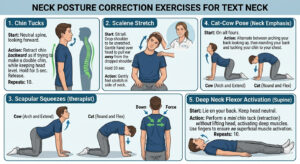
1. Chin Tucks (Cervical Retraction)
Sit tall against a chair back. Draw your chin straight backward — creating a “double chin” sensation. Hold 5 seconds, release slowly. 10 repetitions, 2–3 sets daily. Strengthens deep cervical flexors and directly corrects forward head posture.
2. Upper Trapezius Stretch
Sit or stand upright. Drop your right ear toward your right shoulder. Place your right hand gently on your head for light overpressure. Hold 20–30 seconds, breathe slowly. Repeat on the left side. 2–3 times each.
3. Doorway Chest Opener
Stand in a doorway with both arms at 90 degrees on the frame. Step one foot forward and lean gently through the opening. Feel the stretch across the chest and front of shoulders. Hold 20 seconds, 3 repetitions. Counteracts rounded-shoulder posture.
4. Thoracic Extension Over a Chair
Sit in a firm chair, clasp hands behind your head, and gently arch backward over the chair back. Hold 10 seconds, return slowly. 5–8 repetitions. Mobilizes the thoracic spine and relieves upper back tightness.
5. Scapular Squeeze (Retraction)
Sit or stand tall. Squeeze shoulder blades together as if holding a pencil between them. Hold 5–8 seconds, release. 10–15 repetitions, 2 sets. Strengthens scapular stabilizers and counteracts rounded shoulders.
6. Gentle Neck Rotation with Overpressure
Slowly rotate your head to the right as far as comfortable. Use your hand gently on your chin to add mild overpressure. Hold 5 seconds, return to center. Repeat to the left. 5–8 repetitions per side.
Ergonomic Tips for Mobile and Laptop Use
For smartphones:
Hold your phone at eye level — not chest or lap level
Use voice-to-text for long messages
Keep screen sessions to 20–30 minutes before a movement break
Avoid phone use in bed
For laptops and computers:
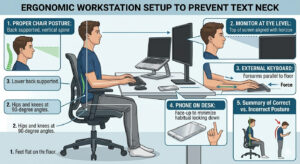
Position the monitor so the top of the screen is at or just below eye level
Use an external keyboard and mouse for extended laptop sessions
Sit with back fully supported, feet flat on the floor, elbows at 90 degrees
For tablets:
Use a stand to prop the tablet upright rather than laying it flat on a table
General:
Follow the 20-20-20 rule: every 20 minutes, look 20 feet away for 20 seconds — and roll your shoulders while you do
Set hourly posture reminder alarms on your phone
Invest in a chair with proper lumbar support if working from home
Prevention Strategies
Prevention is not about abandoning technology — it’s about using it more wisely.
Raise your screen. The single most impactful adjustment most people can make.
Strengthen postural muscles. Chin tucks and scapular squeezes build the muscular foundation your spine needs daily.
Move regularly. Stand, walk, and stretch every 45–60 minutes during screen work.
Mind your sleep posture. Use a cervical contour pillow. Avoid sleeping on your stomach.
Educate children early. Good screen habits formed in childhood prevent a lifetime of cervical problems.
Take pain seriously. Neck pain is not a normal part of life, even if it feels common. It is your body asking for attention.
Expert Insight: Dr. Kiran S. Murthy
“Over 25 years of clinical practice, I have watched text neck syndrome transform from something we occasionally encountered in heavy laptop users to one of the most common conditions we treat — across every age group. What concerns me most is not the pain itself, but how normalized it has become. Patients tell me they have had neck stiffness for two or three years and assumed everyone lived like that. The cervical spine is remarkably resilient when it receives the right care. Most patients — even those with moderate disc changes — respond beautifully to physiotherapy when they commit to the process. The combination of manual therapy, targeted exercises, and genuine lifestyle adjustment can restore function and significantly reduce pain — without surgery and without prolonged medication. My advice: do not wait for the pain to become unbearable. Come in when you first notice something is not right. Early treatment means less treatment — and a much faster return to living your life comfortably. At Rayara Kirana, we don’t just treat conditions — we invest in the long-term health of every person who walks through our door. That is a commitment we have kept for 25 years, and one we will continue to honour.” — Dr. Kiran S. Murthy Founder & Senior Physiotherapist Rayara Kirana Physiotherapy & Rehab Clinic, Banashankari, Bangalore
Why Choose Rayara Kirana Physiotherapy & Rehab Clinic?
Choosing the right physiotherapy clinic matters — especially for a condition that requires skilled hands, a careful eye, and a treatment approach built around you as an individual. 25+ Years of Clinical Excellence Founded and led by Dr. Kiran S. Murthy, the clinic brings exceptional depth of knowledge in cervical spine care, posture rehabilitation, and physiotherapy — accumulated across thousands of patient cases and continuous professional development. Trusted by Generations of South Bangalore Families Patients from Banashankari, Basavanagudi, Jayanagar, JP Nagar, and across South Bangalore have trusted us with their spine health, their parents’ rehabilitation, and now their children’s posture concerns. That generational trust is something we carry with great responsibility. Compassion-Driven Care Good physiotherapy begins with truly listening. Understanding your lifestyle, your work, your pain patterns, and your goals shapes every treatment plan we create. You are not a diagnosis to us — you are a person. Personalized Rehabilitation Plans No two spines are alike. Our assessments are thorough and our treatment plans are tailored — not generic protocols. Whether you are a 17-year-old student or a 55-year-old professional, your program is designed specifically for you. Specialist Spine and Posture Care From text neck and cervical spondylosis to post-surgical spine rehabilitation, our focus on musculoskeletal and spine physiotherapy means you receive specialist-level attention. Modern, Evidence-Based Approach We combine time-tested clinical techniques with current physiotherapy evidence — manual therapy, therapeutic exercise, neuromuscular re-education, and ergonomic counseling — to deliver care that genuinely works. Focus on Long-Term Recovery Our goal is not to keep you coming back indefinitely. It is to help you recover well, understand your body, and have the tools to maintain your health independently. That is what real rehabilitation looks like.
Conclusion: Your Spine Is Speaking — Are You Listening?
Every time you feel that familiar tightness after a long phone session, your spine is sending you a message. The question is whether you act on it now — or years from now, when options are fewer and recovery takes longer. Text neck syndrome is entirely preventable. When it has already developed, it is highly treatable — especially when caught early. You don’t have to choose between staying connected and protecting your health. You simply need the right guidance, some mindful adjustments, and when pain is already present, the expert support of a qualified physiotherapy team. At Rayara Kirana Physiotherapy & Rehab Clinic, we are here for exactly that. If you are experiencing neck pain, stiffness, headaches, or upper back discomfort — don’t normalize it. Book a professional physiotherapy evaluation at our clinic in Banashankari, Bangalore. Let us assess your posture, identify what is happening in your cervical spine, and build a personalized recovery plan that gets you back to feeling like yourself. Your spine has been carrying you. It’s time to take care of it. 📍 Rayara Kirana Physiotherapy & Rehab Clinic, Banashankari, Bangalore 📞 Call or WhatsApp us today to book your appointment. 🌐 Trusted by South Bangalore for 25+ years.
This article is for general informational purposes and does not replace a physiotherapy consultation. If you’re experiencing persistent neck pain, please book an assessment with our team.