
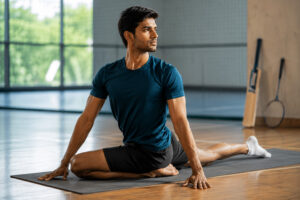
Yoga for injury prevention in athletes is no longer a fringe idea — it is fast becoming a clinical priority in modern sports medicine. Picture this: two athletes with similar training loads. One incorporates yoga into their weekly routine. The other focuses purely on strength and sport-specific drills. Over the course of a season, their injury histories begin to look very different.
Every year on June 21st, International Yoga Day reminds us of one of India’s greatest contributions to global health and wellness. But beyond the cultural significance, sports medicine and physiotherapy are increasingly recognising yoga as a clinically relevant tool — one that supports injury prevention, mobility, recovery, and long-term athletic performance.
This article explores why athletes who intelligently integrate yoga into their training experience fewer injuries, how physiotherapy complements (and sometimes precedes) yoga practice, and why aquatic therapy and nutrition are the often-overlooked pieces of the performance puzzle.
What Does Yoga Actually Do for an Athlete’s Body?
Modern sports demand far more than strength and endurance. Athletes require mobility, balance, joint stability, neuromuscular control, recovery capacity, and mental focus.
According to research published by the National Institutes of Health, regular yoga practice is associated with improved flexibility, better postural alignment, enhanced breathing efficiency, greater body awareness, reduced physiological stress response, and improved movement symmetry.
These benefits directly reduce the risk of some of the most common sports injuries — including hamstring strains, lower back pain, shoulder overuse injuries, knee overload syndromes, neck stiffness, and pain caused by muscle imbalances.
The mechanism is straightforward. When muscles remain excessively tight and joints lose their normal range of motion, movement patterns become inefficient. Over time, this creates excessive stress on tissues and predisposes athletes to injury. Yoga helps maintain healthy, efficient movement patterns.
Who Benefits Most?
Athletes across disciplines — swimmers, martial artists, runners, racket sport players, team sport athletes, and fitness enthusiasts — have all reported meaningful benefits. Desk workers and active adults managing early musculoskeletal complaints also respond well.
The 3 Performance Benefits That Matter Most
1. Mobility and Flexibility
Yoga systematically works through the body’s major movement chains. Poses that address hip flexors, thoracic rotation, hamstring extensibility, and shoulder mobility directly translate into better sports performance and reduced injury risk. A stiff hip, for example, is a common upstream cause of both knee and lower back problems.
2. Neuromuscular Control and Balance
Balance and proprioception — the body’s sense of joint position — are among yoga’s most underappreciated benefits. Single-leg standing postures, slow controlled transitions, and sustained holds all train the neuromuscular system in ways that reduce the risk of ankle sprains, knee injuries, and falls during sport.
3. Breathing Efficiency and Stress Recovery
Controlled breathing is a cornerstone of yoga practice. Research from the NHS and other clinical bodies supports the use of breath-focused movement for reducing the physiological stress response, improving recovery between sessions, and enhancing aerobic efficiency — particularly relevant for endurance athletes and swimmers.
Can Yoga Replace Physiotherapy for Frozen Shoulder, Knee Pain, and Injuries?
This is one of the most common misconceptions among active individuals — and the answer is an unambiguous no.
Yoga primarily focuses on movement, flexibility, breathing, and general wellness. It is an excellent maintenance and prevention tool.
Physiotherapy focuses on injury diagnosis, pain management, functional rehabilitation, movement correction, and structured return-to-sport planning.
Attempting yoga without understanding an underlying injury may sometimes worsen symptoms — particularly in conditions involving disc prolapse, ligament injury, rotator cuff tears, or joint instability.
“Yoga is excellent for maintaining mobility and wellness. However, when pain, weakness, instability, or injury is present, assessment becomes essential. Physiotherapy identifies the root cause and guides patients toward appropriate movement. Once symptoms improve, yoga can become an excellent long-term maintenance strategy.”
— Dr. Rajesh Jain, PT, Senior Physiotherapist
When to Choose Yoga, Physiotherapy, or a Combined Approach
Yoga as a first-line approach:
- General flexibility improvement in healthy individuals
- Stress management and breathing work
- Wellness maintenance when no injury is present
- Recovery sessions between training days
Physiotherapy as a first-line approach:
- Acute sports injuries
- Ligament sprains or tears
- Tendinitis (e.g., rotator cuff, patellar tendon, Achilles)
- Post-surgical rehabilitation
- Neurological symptoms such as radiating pain or numbness
A combined approach delivers the best outcomes for:
- Frozen shoulder (adhesive capsulitis)
- Chronic low back pain
- Knee osteoarthritis
- Sports performance enhancement
- Recurrent neck pain and postural dysfunction
The best outcomes frequently occur when yoga and physiotherapy are integrated thoughtfully — physiotherapy first to diagnose and correct, yoga as an ongoing tool for maintenance and prevention.

Yoga and Common Injury Sites: What the Evidence Suggests
Low Back Pain
Low back pain is among the leading causes of disability worldwide, according to the World Health Organization. Yoga may help improve flexibility, reduce stiffness, improve posture, and enhance core awareness.
However, not every back pain condition is suitable for yoga. Conditions such as disc prolapse, sciatica, spondylolisthesis, and nerve root compression often require physiotherapy assessment first. Selecting inappropriate spinal flexion or extension poses without diagnosis can aggravate these conditions significantly.
Knee Pain
Many patients with knee pain assume they should either do yoga or stop moving altogether. The reality is more nuanced. Yoga can support quadriceps activation, joint mobility, balance training, and functional movement patterns. However, severe osteoarthritis, ligament injuries, and malalignment conditions typically require targeted physiotherapy intervention before yoga is introduced. Combining yoga with physiotherapy-directed strengthening often produces significantly better outcomes than either approach alone.
Shoulder Pain
Shoulder stiffness and rotator cuff injuries are increasingly common among swimmers, racket sport players, and those with prolonged desk postures. Yoga can help improve shoulder mobility, thoracic spine posture, and reduce muscular tightness around the shoulder girdle.
But aggressive stretching of an already-inflamed or structurally compromised shoulder can worsen symptoms.
“We frequently see patients attempting self-directed yoga after watching online videos. While yoga has tremendous benefits, incorrect technique or selecting inappropriate poses can aggravate underlying shoulder, knee, or spine problems. Professional assessment helps ensure that yoga becomes therapeutic rather than harmful.”
— Dr. Bhavana, PT
The Growing Role of Aquatic Therapy
One of the most powerful yet underutilised complements to both yoga and physiotherapy is aquatic therapy — exercise performed in a therapeutic pool environment.
Water-based rehabilitation offers several physiological advantages: reduced joint loading due to buoyancy, improved movement confidence in pain-limited individuals, better pain tolerance during rehabilitation, and safe, graduated exercise progression.
Aquatic therapy is especially valuable for:
- Knee and hip osteoarthritis
- Post-surgical rehabilitation (knee replacement, hip replacement, ACL reconstruction)
- Obesity-related joint pain where land-based exercise is poorly tolerated
- Athletes returning from significant injury who are not yet ready for full weight-bearing training
In many cases, aquatic therapy serves as a critical bridge — between the early recovery phase managed by physiotherapy and the full return to yoga or sports-specific training. It allows patients to rebuild movement quality, strength, and confidence in a low-risk environment.

The Missing Link: Nutrition for Recovery and Performance
Many athletes invest significant time and effort in yoga and physiotherapy but substantially underestimate the role of nutrition. Without adequate nutritional support, recovery is slower, adaptation is impaired, and the risk of overuse injury increases — regardless of how well-designed the exercise programme is.
Muscles, tendons, ligaments, and bones require specific nutrients for repair and adaptation. The key nutrients supporting athletic recovery include:
- Protein — essential for muscle repair and recovery after training
- Vitamin D — critical for bone density and muscle function; deficiency is common in indoor athletes and those with limited sun exposure
- Magnesium — supports muscle relaxation, sleep quality, and energy production
- Iron — required for oxygen transport; low iron directly impairs endurance performance
- Vitamin B12 — important for nerve function and energy metabolism
- Omega-3 Fatty Acids — support inflammation management and joint health
- Collagen Peptides — emerging evidence supports their role in tendon and ligament repair
Athletes, swimmers, martial artists, and active adults should periodically assess their nutritional status — particularly if recovery feels disproportionately slow or fatigue is persistent despite adequate sleep and training load management.

When Should You See a Physiotherapist?
Signs that professional guidance will meaningfully accelerate your recovery and performance:
- Pain that persists beyond 2–3 weeks despite rest and home management
- A recent acute injury (muscle tear, ligament sprain, joint dislocation)
- Pain that worsens during or after yoga practice
- History of previous injury to the same area
- Neurological symptoms — numbness, tingling, or weakness radiating into a limb
- Recent surgery requiring structured rehabilitation
- Performance plateau despite consistent training
Early physiotherapy assessment prevents small problems from becoming chronic ones — and helps you return to yoga and sport safely, with confidence in your movement.
The Future of Athletic Wellness: An Integrated Model
The future of performance health is not yoga alone. It is not physiotherapy alone. And it is certainly not strength training alone.
The future is an integrated approach that combines:
- Yoga — for mobility, flexibility, breathing, and neuromuscular control
- Physiotherapy — for injury diagnosis, rehabilitation, and corrective exercise
- Strength training — for load capacity and joint protection
- Aquatic therapy — for pain-limited or early-stage recovery
- Sports-specific conditioning — for performance transfer
- Evidence-based nutrition — for tissue repair and sustained adaptation
This holistic model — applied intelligently and progressively — helps athletes remain healthier, recover faster, and perform at their highest level over the long term.