Medically reviewed by Dr. Kiran S. Murthy, PT, Founder & Lead Physiotherapist, Rayara Kirana (25+ years experience) | Last reviewed: August 2026
You have been told you have sciatica. You have had an MRI. It came back normal — or showed only minor changes that your doctor said ‘shouldn’t be causing this much pain’. Yet the pain keeps shooting from your buttock down your leg every time you sit for more than twenty minutes, climb stairs, or cross one leg over the other.
Sciatica pain that starts deep in the buttock — not the lower back — and that worsens with sitting, crossing legs, or direct pressure on the buttock muscle is a different condition from spinal sciatica. It is called piriformis syndrome, and it is one of the most misdiagnosed causes of sciatica-like pain in clinical practice. A 2025 narrative review published in HSS Journal confirms that piriformis syndrome is frequently overlooked as a cause of gluteal pain and sciatica — even by experienced clinicians.
This guide is specifically about piriformis syndrome — what it is, how it differs from the spinal causes of sciatica, how to identify it, and exactly what physiotherapy treatment involves. If you are already familiar with disc-related sciatica and its surgical considerations, our separate guide on Sciatica Pain: Physiotherapy vs. Surgery covers that in detail.
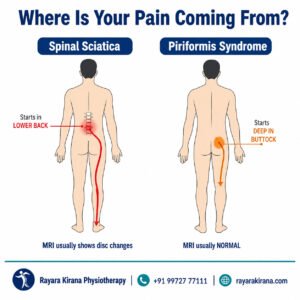
Important: Two Different Causes of Sciatica-Like Pain
✔ SPINAL SCIATICA: Caused by disc herniation, spinal stenosis, or spondylolisthesis
→ Pain usually starts in the LOWER BACK and radiates down the leg
→ Covered in our blog: Sciatica Pain: Physiotherapy vs. Surgery
✔ PIRIFORMIS SYNDROME SCIATICA: Caused by the piriformis muscle compressing the sciatic nerve
→ Pain starts DEEP IN THE BUTTOCK and radiates down the leg
→ Normal or near-normal MRI of the spine
→ This is what THIS blog covers
What Is the Piriformis Muscle and Why Does It Matter?
The piriformis is a small but powerful muscle located deep in the buttock, running from the sacrum (the triangular bone at the base of the spine) to the greater trochanter of the femur (the outer hip bone). Its primary function is to externally rotate and abduct the hip — the same motion you make when you turn your foot outward or cross your legs.
Here is what makes the piriformis unique and clinically significant: the sciatic nerve — the largest nerve in the human body — passes directly beneath the piriformis muscle as it exits the pelvis through the greater sciatic notch. In approximately 17% of the population, the sciatic nerve passes through the piriformis muscle itself (a normal anatomical variant) rather than underneath it. This variation significantly increases susceptibility to nerve compression when the piriformis becomes tight, inflamed, or goes into spasm.
According to StatPearls (NIH/NCBI, 2026), piriformis syndrome accounts for 0.3% to 6% of all low back pain and sciatica presentations — which translates to approximately 2.4 million people affected annually worldwide. The condition is more common in women than men, with a female-to-male ratio of approximately 6:1, and peaks in middle-aged adults between 40 and 60 years.
What Causes Piriformis Syndrome?
Piriformis syndrome develops when the piriformis muscle becomes tight, hypertrophied, inflamed, or goes into spasm — in any of these states, it can compress or irritate the adjacent sciatic nerve. The underlying triggers vary:
Traumatic Causes
- Direct fall or blow to the buttock — most common traumatic cause
- Road traffic accidents involving impact to the hip or pelvis
- Sports injuries involving sudden pivoting, twisting, or overloading of the hip
- Prolonged sitting on a hard surface (wallet sciatica — from a thick wallet pressing on the buttock)
Overuse and Biomechanical Causes
- Runners and cyclists— repetitive hip rotation loads the piriformis heavily; distance runners are particularly vulnerable
- Leg length discrepancy— one leg shorter than the other causes the piriformis on the shorter side to work harder to compensate
- Overpronation of the foot— excessive inward rolling of the foot during walking or running increases internal hip rotation demand, causing the piriformis to chronically overwork
- Weak hip abductors and glutes— when the gluteus medius and maximus are weak, the piriformis compensates by taking on load it was not designed to sustain
- Prolonged sitting— desk workers and drivers who sit for extended periods develop shortening and tightening of the piriformis from sustained hip flexion
Postural and Structural Causes
- Scoliosis or pelvic asymmetry — abnormal spinal curves change how load is distributed through the hip rotator muscles
- Sacroiliac joint dysfunction — SI joint instability frequently co-exists with piriformis tightness
- Hip osteoarthritis — changes in hip joint mechanics alter piriformis loading patterns
“Piriformis syndrome is one of the most under-diagnosed conditions in our clinic. Patients arrive after months of being told their sciatica is from the spine, having had normal or near-normal MRIs, and having tried treatments that haven’t worked. When we test the piriformis specifically — the FAIR test, Freiberg’s sign, direct palpation — the picture becomes clear immediately. The pain is not coming from the spine. It is coming from a muscle deep in the buttock that nobody has assessed yet.”
— Dr. Kiran S. Murthy, PT, Founder & Lead Physiotherapist, Rayara Kirana Physiotherapy Clinic, Bangalore
Piriformis Syndrome Symptoms: How This Sciatica Is Different
Understanding the symptom pattern of piriformis syndrome is the key to distinguishing it from spinal causes of sciatica. The differences are clinically meaningful and change the entire treatment approach.
Classic Piriformis Syndrome Symptoms
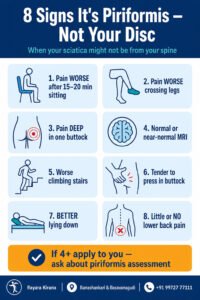
- Deep, aching pain in the buttock on one side — the primary and most consistent symptom
- Pain that radiates from the buttock down the back of the thigh, sometimes reaching the calf — following the sciatic nerve path
- Pain that is WORSE with sitting, especially after 15–20 minutes — sitting compresses the piriformis against the sciatic nerve
- Pain that is WORSE when crossing the legs (placing ankle on opposite knee)
- Pain that is WORSE climbing stairs, walking up inclines, or squatting
- Tenderness to direct pressure on the buttock, approximately halfway between the sacrum and the greater trochanter
- The pain is typically BETTER with lying down and WORSE with activity
- Possible tingling or numbness down the leg when the sciatic nerve is significantly compressed
What Is Usually ABSENT in Piriformis Syndrome
- Significant lower back pain — the lumbar spine is NOT the primary pain source
- Positive straight leg raise test at low angles (less than 60 degrees) — this test stresses the spinal nerve roots, not the piriformis
- Neurological deficit signs like absent reflexes or specific dermatomal sensory loss — unless the condition is severe
- MRI findings of significant disc herniation or nerve root compression at the level that matches symptoms
Piriformis Syndrome vs Spinal Sciatica: Key Differences
FEATURE PIRIFORMIS SYNDROME SPINAL SCIATICA
──────────────────────────────────────────────────
Pain origin Deep buttock Lower back
MRI findings Usually normal Disc/nerve changes
Worse with sitting YES — hallmark sign Sometimes
Worse crossing legs YES — diagnostic clue Rarely
Back pain prominent No Usually yes
Straight leg raise Negative or mild Often positive
Responds to back physio No Yes
Responds to glute physio YES No
If you are experiencing significant lower back pain alongside leg pain, or if your MRI shows relevant disc changes, you may have spinal sciatica rather than piriformis syndrome — or a combination of both. Read our detailed guide on Sciatica Pain: Physiotherapy vs. Surgery to understand spinal sciatica, its causes, and when surgery may be appropriate.
How Is Piriformis Syndrome Diagnosed?
Diagnosis of piriformis syndrome is primarily clinical. There is no single definitive imaging test — in fact, MRI of the lumbar spine is often normal or shows only incidental changes unrelated to the actual cause of pain. This is exactly why the condition is so frequently misdiagnosed.
Clinical Diagnostic Tests
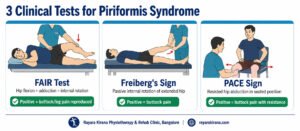
- FAIR Test (Flexion, Adduction, Internal Rotation)
The patient lies on their side with the affected hip upward. The physiotherapist flexes the hip to approximately 60 degrees, then applies gentle downward pressure to the knee to add adduction and internal rotation. Reproduction of the patient’s characteristic buttock and leg pain is a positive test. This is the most sensitive clinical test for piriformis syndrome.
- Freiberg’s Sign
The patient lies on their back. The examiner passively internally rotates the extended hip. Reproduction of buttock pain indicates piriformis irritation. The theory is that internal rotation stretches the externally rotating piriformis, irritating the underlying sciatic nerve.
- PACE Sign (Piriformis Active Contraction Entrapment)
The patient sits with hips and knees at 90 degrees. The examiner applies resistance to the patient’s knees as they try to abduct (push knees outward) against the resistance. Reproduction of buttock pain with resisted hip abduction is positive. This tests the piriformis in its active contraction role.
- Direct Palpation
Deep palpation of the buttock along the line of the piriformis muscle — approximately midway between the sacrum and the greater trochanter — reproduces the characteristic buttock tenderness in piriformis syndrome. This is one of the most reliable and simple clinical findings.
Imaging — When Is It Useful?
- MRI of the hip (not the lumbar spine) — may show enlargement, asymmetry, or signal change in the piriformis muscle in some cases
- MRI neurography — specialised nerve imaging that can show sciatic nerve compression at the level of the piriformis; most accurate but not always available
- Diagnostic ultrasound-guided injection — if a local anaesthetic injection into the piriformis muscle relieves symptoms, this confirms the muscle as the pain source
- EMG / nerve conduction study — used to rule out spinal nerve root compression and confirm peripheral nerve involvement
At Rayara Kirana, our assessment process for buttock and leg pain always includes a comprehensive screen of both the lumbar spine and the hip — because double crush syndrome (where both spinal and peripheral nerve compression coexist) is more common than either diagnosis alone in some patient groups.
Physiotherapy Treatment for Piriformis Syndrome: A Stage-Based Approach
A 2026 systematic review published in JMIR Research Protocols identified physiotherapy — including stretching, strengthening, manual therapy, nerve mobilisation, and electrotherapy — as the most effective conservative treatment for low back pain and sciatica associated with piriformis syndrome. Here is exactly what each component involves:
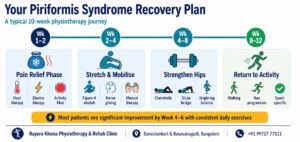
Phase 1: Pain Relief and Muscle Relaxation (Weeks 1–3)
The priority in the initial phase is reducing piriformis muscle spasm, managing sciatic nerve irritation, and restoring enough pain-free range to begin rehabilitation exercises.
- Heat therapy— moist heat applied to the buttock for 15–20 minutes before stretching reduces muscle spasm and improves tissue extensibility. Unlike acute disc sciatica (where ice is often preferred early), piriformis-related pain typically responds better to heat
- Therapeutic ultrasound— applied directly over the piriformis muscle, ultrasound increases deep tissue circulation, reduces inflammation, and has been shown in clinical studies to reduce pain and improve hip range of motion in piriformis syndrome
- IFT (Interferential Therapy)— deep electrical stimulation reduces muscle spasm and provides meaningful analgesia, allowing the patient to participate more fully in stretching and exercise
- TENS— used for ongoing pain modulation, particularly for the radiating sciatic component
- Activity modification— avoid prolonged sitting, crossing legs, and any activity that consistently reproduces the buttock pain
Phase 2: Piriformis Stretching and Sciatic Nerve Mobilisation (Weeks 2–6)
Targeted stretching of the piriformis muscle is the cornerstone of conservative management. The goal is to reduce the chronic tightness that is compressing the sciatic nerve.
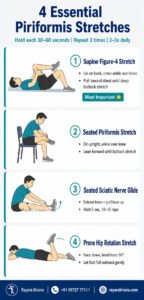
Exercise 1: Supine Piriformis Stretch (Figure-4 Stretch)
- Lie on your back with knees bent, feet flat on the floor
- Cross the affected leg over the other, placing the ankle just above the opposite knee (figure-4 position)
- Gently pull the uncrossed leg toward your chest until you feel a deep stretch in the buttock of the crossed leg
- Hold 30–60 seconds. Repeat 3 times, 2–3 times daily
- This is the most important and evidence-backed stretch for piriformis syndrome
Exercise 2: Seated Piriformis Stretch
- Sit upright in a chair with the affected ankle crossed over the opposite knee
- Gently lean forward with a straight back until you feel the stretch deep in the buttock
- Hold 30 seconds. Repeat 3 times
- Particularly useful for patients who find lying on the floor difficult
Exercise 3: Sciatic Nerve Gliding (Seated)
- Sit upright in a chair with feet flat on the floor
- Extend the affected knee to straighten the leg while simultaneously bending the ankle (pulling toes toward you)
- Hold 5 seconds, then relax back to starting position
- Perform 10–15 repetitions, 2–3 times daily
- Purpose: mobilises the sciatic nerve through its path, reduces adhesions and nerve sensitivity
Exercise 4: Hip External Rotation Stretch (Prone)
- Lie face down with a pillow under your abdomen for comfort
- Bend the knee of the affected leg to 90 degrees
- Slowly allow the foot to fall outward (external rotation) — you will feel a stretch deep in the buttock
- Hold 20–30 seconds. Repeat 3 times
- Purpose: stretches the piriformis from a different angle, targeting the deeper fibres
Phase 3: Hip Strengthening and Biomechanical Correction (Weeks 4–10)
Research published in the Journal of Orthopaedic & Sports Physical Therapy (Tonley et al., 2010) demonstrated that strengthening the hip abductor and extensor muscles — not just stretching the piriformis — is essential for lasting recovery. When the gluteus medius and maximus are strong, the piriformis no longer needs to overwork as a compensator.
Exercise 5: Side-Lying Hip Abduction
- Lie on your unaffected side with legs straight and stacked
- Slowly raise the top (affected) leg to approximately 30–40 degrees, keeping toes pointing forward
- Hold 3 seconds at the top, lower slowly
- 3 sets of 15 repetitions, daily
- Purpose: strengthens gluteus medius — the primary hip abductor that shares piriformis’ stabilising role
Exercise 6: Clamshell Exercise
- Lie on your side with hips bent to 45 degrees and knees bent to 90 degrees (feet together)
- Keep feet together and raise the top knee as high as possible without rotating the pelvis
- Lower slowly. 3 sets of 20 repetitions, daily
- Progress with a resistance band around the knees
- Purpose: targets both gluteus medius and piriformis in a controlled range
Exercise 7: Glute Bridge
- Lie on your back, knees bent, feet flat on floor hip-width apart
- Press through your heels to lift your hips off the floor until your body forms a straight line from shoulders to knees
- Hold 5 seconds at the top, lower slowly
- 3 sets of 15 repetitions, daily
- Purpose: strengthens gluteus maximus and hamstrings, reducing piriformis compensatory overload
Exercise 8: Single-Leg Balance (Proprioceptive Training)
- Stand on the affected leg with a slight bend in the knee (not locked)
- Hold for 30–60 seconds, focusing on keeping the knee tracking over the second toe
- Progress by adding small arm movements or closing eyes
- Purpose: restores hip stability and neuromuscular control — prevents recurrence
Manual Therapy for Piriformis Syndrome at Rayara Kirana
Hands-on manual therapy by a skilled physiotherapist is significantly more effective than self-directed stretching alone for piriformis syndrome, particularly in the early phases when muscle spasm is severe.
Deep Tissue Release and Myofascial Techniques
Direct manual pressure applied to the piriformis muscle in a sustained, gradual manner — known as ischaemic compression or trigger point release — reduces muscle hypertonicity and referred pain patterns along the sciatic nerve. This technique is performed with the patient in a prone or sidelying position and requires precise anatomical knowledge of the deep buttock musculature.
Active Release Technique (ART)
ART combines specific tension applied by the therapist to the piriformis with active movement by the patient. This technique breaks down adhesions between the piriformis muscle and the sciatic nerve, restoring normal nerve mobility and reducing entrapment. Published research supports ART as an effective technique for piriformis syndrome-related sciatica.
Sacroiliac Joint Mobilisation
Sacroiliac joint dysfunction frequently coexists with piriformis syndrome — the two conditions share similar buttock pain presentations and often perpetuate each other. Rayara Kirana’s advanced physiotherapy techniques include Mulligan and Maitland joint mobilisation for the SI joint, which reduces the biomechanical strain on the piriformis that an asymmetrical pelvis creates.
Dry Needling
Dry needling — inserting fine needles into the active trigger points within the piriformis muscle — is one of the most effective techniques for rapidly reducing severe piriformis spasm. The needle insertion produces a localised twitch response that releases the hypercontracted muscle fibres. Multiple case reports and clinical studies support dry needling for piriformis syndrome, including as a bridge to exercise-based rehabilitation when spasm is too severe for the patient to perform stretches effectively.
Shockwave Therapy
For chronic piriformis syndrome that has not responded to manual therapy and exercise after 6–8 weeks, extracorporeal shockwave therapy delivers focused acoustic waves deep into the piriformis and surrounding gluteal tissues, disrupting chronic trigger points, stimulating healing, and reducing pain sensitisation. Read our guide on Shockwave Therapy for Chronic Pain to understand how this technology works at Rayara Kirana.
“The difference between treating piriformis syndrome correctly and treating it like spinal sciatica is the difference between a patient recovering in 6 weeks and a patient suffering for 6 months. The muscle is deep, the nerve is adjacent, and the clinical tests to identify the condition are simple — but they have to be performed. Once we confirm piriformis involvement, the response to targeted manual therapy and specific stretching is often dramatic. Patients who have been in pain for months sometimes have significant relief within two or three sessions.”
— Dr. Rajesh Jain, PT, Senior Physiotherapist, Rayara Kirana Physiotherapy Clinic
Nutrition to Support Nerve Healing and Muscle Recovery in Piriformis Syndrome
Piriformis syndrome involves both muscle dysfunction and sciatic nerve irritation — both of which benefit from targeted nutritional support alongside physiotherapy.
- Magnesium (300–400mg daily)— reduces muscle spasm and hypertonicity. Chronically tight muscles like the piriformis are frequently associated with magnesium insufficiency. Sources: dark chocolate, almonds, spinach, pumpkin seeds
- Omega-3 Fatty Acids (EPA + DHA, 2–3g daily)— reduce sciatic nerve inflammation and support nerve membrane health. Sources: fatty fish, flaxseeds, fish oil supplementation
- Vitamin B12— essential for myelin sheath health and nerve conduction. Deficiency worsens nerve pain and slows recovery
- Vitamin D (check serum levels)— deficiency is associated with muscle pain, weakness, and impaired neuromuscular function. Extremely common in urban Indians despite year-round sunshine
- Curcumin with piperine— anti-inflammatory properties reduce both muscle and nerve inflammation in chronic pain conditions. Turmeric with black pepper in warm milk — a traditional remedy with genuine pharmacological basis
- Collagen peptides (10g daily with Vitamin C)— support connective tissue health in the piriformis and surrounding fascial structures, particularly relevant in post-traumatic cases
Rayara Kirana’s Nutrition and Wellness Support service provides individualised dietary guidance as part of musculoskeletal rehabilitation programmes including piriformis syndrome.
Conditions That Frequently Coexist with Piriformis Syndrome
Piriformis syndrome rarely occurs in complete isolation. Understanding and treating associated conditions is important for complete and lasting recovery.
Hip Osteoarthritis
Changes in hip joint mechanics from arthritis alter how forces are transmitted through the piriformis, often causing secondary muscle overload. Our blog on the Hip–Knee Connection: Why Hip Problems Cause Knee Pain explores how hip mechanics affect the entire lower limb chain.
Hamstring Tightness and Injury
The hamstring muscles share the same neurological territory as the piriformis — both are innervated by branches of the sciatic nerve. Hamstring tightness can sensitise the sciatic nerve and worsen piriformis syndrome symptoms. Our guide on Hamstring Rehabilitation vs Gym Training covers the clinical distinction between hamstring rehab and general gym training.
Knee Pain from Hip Dysfunction
Weakness in the hip abductors — the same muscles that when strengthened relieve piriformis syndrome — is a common upstream cause of knee pain. The Hip–Knee Connection blog explains this relationship in full.
Ligament Injuries and Pelvic Instability
Sacroiliac ligament laxity or previous ligament injuries around the hip and pelvis create the biomechanical asymmetry that overloads the piriformis. Our blog on Managing Ligament Injuries: A Rehab-Based Approach covers the rehabilitation principles for ligament injuries that often precede or coexist with piriformis syndrome.
Sports Injuries
Athletes — particularly runners, cyclists, footballers, and martial artists — are at elevated risk of piriformis syndrome. Our Sports Medicine and Physiotherapy service provides sport-specific piriformis rehabilitation programmes that address both the injury and the training errors that caused it.
When to Seek Medical Evaluation Beyond Physiotherapy
Physiotherapy resolves the vast majority of piriformis syndrome cases. However, certain presentations require medical assessment:
- Symptoms that have not improved after 8–12 weeks of consistent, targeted physiotherapy
- Significant or progressive weakness in the leg or foot
- Bladder or bowel changes — always require urgent medical assessment (these suggest spinal rather than piriformis pathology)
- Night pain that wakes you consistently from sleep
- History of cancer or unexplained weight loss alongside buttock and leg pain
- Symptoms following significant trauma that may indicate a structural injury around the hip or pelvis
When surgical assessment is needed — either for the rare case of piriformis syndrome requiring surgical decompression, or when spinal sciatica co-exists — our blog on Sciatica Pain: Physiotherapy vs. Surgery provides a comprehensive guide to the surgical decision-making process. At Rayara Kirana, our Pain Management and Post-Surgical Rehabilitation teams manage the full spectrum of outcomes.
Home Care Physiotherapy for Piriformis Syndrome in Bangalore
For patients who find it difficult to travel to the clinic due to severe buttock and leg pain, Rayara Kirana’s home care service brings specialist physiotherapy directly to your home.
Our Home Care Physiotherapy team covers Banashankari, Basavanagudi, JP Nagar, BTM Layout, Jayanagar, and surrounding areas of South Bangalore. Home visits for piriformis syndrome include: initial assessment and clinical testing, manual therapy and soft tissue release, guided stretching programme, exercise prescription with supervision, and ergonomic advice for your sitting environment.
For older adults where piriformis syndrome combines with age-related changes in hip stability and muscle strength, our Geriatric Physiotherapy team provides an integrated approach that addresses piriformis syndrome within a broader mobility and independence programme.