Are you struggling with persistent knee pain that doesn’t seem to get better, even after resting or using knee supports? Have you ever had a knee scan that came back “normal,” yet the aching persists every time you climb the stairs at your home in Bangalore?
At Rayara Kirana Physiotherapy & Rehab Clinic, we often see patients who are frustrated because they’ve been treating their knee for months without success. The secret often lies about ten inches higher: in the hip.
The human body does not function as a collection of isolated parts. Instead, it operates as a kinetic chain. In this article, we will explore the profound connection between the hip and the knee, why “referred pain” is more common than you think, and how expert physiotherapy at our Bangalore clinics can help you walk pain-free again.
Understanding the Hip–Knee Connection: The Kinetic Chain
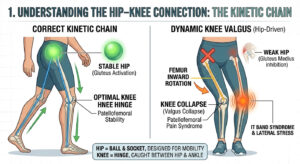
To understand why your hip affects your knee, we have to look at biomechanics. The hip is a ball-and-socket joint designed for a massive range of motion and stability. The knee, however, is primarily a hinge joint. It is “caught” between the hip above and the ankle below.
The Kinetic Chain Concept
In physiotherapy, the kinetic chain refers to the notion that joints and segments have an effect on one another during movement. When one is in motion, it creates a chain of events that affects the neighboring joints.
How Hip Weakness Changes Knee Movement
If your hip muscles—specifically the gluteus medius and maximus—are weak or not firing correctly, the femur (thigh bone) tends to rotate inward and collapse toward the midline of the body. This is known as dynamic knee valgus.
The Simple Equation:
Weak Hip Muscles → Poor Femur Control → Knee Collapse (Inward) → Excessive Stress on Knee Joint → Knee Pain.
When the hip fails to stabilize the leg, the knee is forced to take on loads it wasn’t designed to handle. This often results in conditions like Patellofemoral Pain Syndrome (Runner’s Knee) or IT Band Syndrome.
Can Hip Pain Be Ignored?
Many people in Bangalore lead busy lives, balancing careers in the tech hubs of Whitefield or Koramangala with family life in Banashankari. It is tempting to “walk off” a minor hip ache. However, ignoring hip dysfunction is a significant risk.
The Domino Effect of Untreated Hip Issues:
Secondary Knee Pain: As explained, the knee compensates for the hip, leading to ligament strains and meniscus wear.
Lower Back Pain: When the hips are stiff, the lower back (lumbar spine) over-moves to compensate, leading to disc issues.
Gait Problems: You may begin to limp or change your stride, which eventually affects your ankles and even your neck.
Early Arthritis: Abnormal loading on the knee joint accelerates the wear and tear of cartilage, leading to premature osteoarthritis.
Early intervention at a specialized physiotherapy clinic in Bangalore can stop this “domino effect” before it requires surgical intervention.
Common Types of Hip Pain
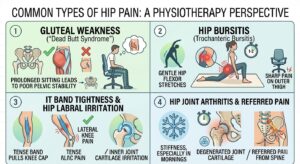
At Rayara Kirana Physiotherapy, led by Dr. Kiran S. Murthy, we categorize hip pain based on the underlying mechanical cause. Here are the most common culprits:
Gluteal Weakness: Perhaps the most common issue. “Dead Butt Syndrome” occurs when the glutes become inhibited due to prolonged sitting, leading to poor pelvic stability.
Hip Bursitis (Trochanteric Bursitis): Inflammation of the fluid-filled sacs that cushion the hip joint, causing sharp pain on the outer thigh.
IT Band Tightness: The Iliotibial band runs from the hip to the knee. If it’s too tight, it pulls on the knee cap, causing “lateral knee pain.”
Hip Joint Arthritis: Degeneration of the hip cartilage which leads to stiffness, especially in the mornings.
Muscle Strains: Overstretching the hip flexors or adductors (groin muscles).
Hip Labral Irritation: A tear or irritation in the ring of cartilage (labrum) that follows the outside rim of the hip joint socket.
Referred Pain from the Spine: Sometimes, a pinched nerve in the lower back (sciatica) manifests as hip pain.
Warning Signs: When You Need Professional Help
Self-diagnosis can be dangerous. You should seek an evaluation at Rayara Kirana Physiotherapy & Rehab Clinic if you experience:
Pain that persists for more than a week despite rest.
A “clicking,” “snapping,” or “locking” sensation in the hip or knee.
Pain that radiates from the hip down to the knee or calf.
Difficulty standing up from a low chair or getting out of a car.
Swelling or tenderness around the bony part of the hip.
A noticeable limp when walking through the parks of Basavanagudi.
What Can Be Managed Safely at Home?
While chronic pain needs a professional eye, minor aches can be managed with conservative care:
Activity Modification: If running hurts, switch to swimming or cycling temporarily.
Basic Stretching: Gentle hip flexor stretches can relieve tension from long hours of sitting.
Posture Correction: Ensure your workstation is ergonomically sound. Avoid crossing your legs for long periods.
Contrast Therapy: Use ice packs for acute inflammation (redness/swelling) and heat packs for chronic muscle stiffness.
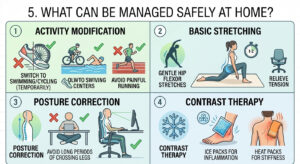
Note: If these steps don’t provide relief within 72 hours, it’s time for a professional physiotherapy assessment.
Physiotherapy Treatment: The Rayara Kirana Approach
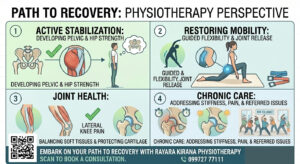
In our rehab centre in Bangalore, we don’t just “treat the spot that hurts.” We treat the movement pattern. Our 25+ years of experience has taught us that lasting relief comes from a comprehensive approach:
Movement & Gait Assessment
We analyze how you walk and move. Using clinical observation, we identify if your knee pain is a result of a “trendelenburg gait” (hip dropping) or poor foot biomechanics.
Muscle Imbalance Correction
We use manual therapy to release overactive muscles (like the TFL) and specific activation exercises to wake up underactive ones (like the Glute Medius).
Strengthening and Mobility
We design personalized programs that include:
Manual Therapy: Joint mobilizations to improve hip “glide.”
Strengthening: Targeted resistance training to bulletproof the kinetic chain.
Gait Correction: Re-training your brain and muscles to walk with the correct alignment.
5 Key Exercises to Strengthen the Hip and Protect the Knee
Always perform these under the guidance of a physiotherapist initially to ensure correct form.
Glute Bridges: Lie on your back, knees bent, and lift your hips. This activates the posterior chain.
Clamshells: Lie on your side with knees bent. Lift the top knee while keeping feet together. This targets the hip rotators.
Hip Abduction: Lying on your side, lift your top leg straight up. This strengthens the lateral stabilizers that prevent knee collapse.
Mini Squats: Focus on keeping your knees tracking over your toes, not letting them cave inward.
Step-Ups: A functional movement that builds single-leg stability, essential for Bangalore’s uneven footpaths and stairs.
About Rayara Kirana Physiotherapy & Rehab Clinic
With over 25 years of trusted care, Rayara Kirana is a cornerstone of health in South Bangalore. Founded by Dr. Kiran S. Murthy, our clinic is built on the philosophy of personalized, evidence-based rehabilitation.
We don’t believe in “one-size-fits-all” treatments. Whether you are an athlete looking to return to the field or a senior citizen wanting to walk comfortably in Krishna Rao Park, we collaborate with leading doctors to provide a multidisciplinary recovery path.
Our deep roots in Banashankari and Basavanagudi mean we treat generations of families—from grandparents managing arthritis to grandchildren recovering from sports injuries.
Finding Us in Bangalore
If you are searching for a physiotherapy clinic in Banashankari or a rehabilitation centre in Bangalore, look no further. We are conveniently located to serve residents across:
Basavanagudi: Near the iconic Shankar Mutt Road.
Banashankari: Easily accessible from the 27th Cross Rd and 23rd Main.
Frequently Asked Questions
1. Can hip problems really cause knee pain?
Yes. Due to the kinetic chain, hip weakness causes the thigh bone to rotate incorrectly, putting immense pressure on the knee joint.
2. Why does my knee hurt when my hip is stiff?
Stiffness in the hip limits its range of motion. To compensate, the knee often “over-moves” or moves in planes it isn’t designed for, leading to pain.
3. What are the symptoms of hip-related knee pain?
Usually, it’s a dull ache in the knee that worsens with activity, despite no direct injury to the knee itself.
4. Can physiotherapy treat hip pain effectively?
Absolutely. Physiotherapy is the gold standard for non-surgical hip and knee management through strengthening and manual therapy.
5. When should I see a physiotherapist for hip pain?
If the pain lasts more than a week, affects your sleep, or causes you to limp, you should book an assessment immediately.
6. What exercises help strengthen the hip?
Glute bridges, clamshells, and lateral leg raises are excellent starting points for hip stability.
7. Is walking good for hip pain?
In moderation, yes. However, if your gait is faulty, walking long distances can actually worsen the strain on your knees.
8. Can hip pain go away without treatment?
Minor strains might, but mechanical issues (like weakness or structural shifts) usually require targeted intervention to prevent recurrence.
9. What is the hip–knee kinetic chain?
It is the functional relationship where the hip, knee, and ankle work together to distribute weight and movement forces.
10. How long does physiotherapy take for hip pain recovery?
Minor issues improve in 2-4 weeks. Chronic conditions may take 8-12 weeks of consistent rehab for long-term stability.
11. Can poor posture cause hip pain?
Yes. Sitting with a “slumped” pelvis or standing with your weight shifted to one side creates muscle imbalances.
12. Are older adults more prone to hip problems?
Yes, due to natural bone density changes and wear on the joints (osteoarthritis), but physiotherapy can significantly improve quality of life.
13. What lifestyle changes reduce hip pain?
Maintaining a healthy weight, wearing supportive footwear, and taking “movement breaks” every 30 minutes of sitting.
14. Can hip strengthening reduce knee pain?
In many cases, yes. Strengthening the hip stabilizers often resolves “unexplained” knee pain completely.
15. Where can I get physiotherapy treatment in Bangalore?
Rayara Kirana Physiotherapy has premier branches in Banashankari and Basavanagudi, Bangalore.