Medically Reviewed by Dr. Kiran S. Murthy, Founder & Lead Physiotherapist at Rayara Kirana (25+ years of experience) Last Updated: September 2026
If you’re researching knee replacement recovery timeline, you’ve probably already come across the standard answer: 4 to 6 weeks for basic mobility, 3 months for most daily activities, up to a year for full recovery. That’s still broadly true — but what’s changed significantly in the last few years is how physiotherapists get patients through that timeline. The techniques used before and after knee replacement surgery today are meaningfully different from what patients experienced even five years ago, and the difference shows up directly in how much strength, function, and confidence patients regain — and how quickly.
This guide walks through what’s actually new in knee replacement rehabilitation, what the research shows about these techniques, and what a realistic recovery timeline looks like when modern physiotherapy is done right.
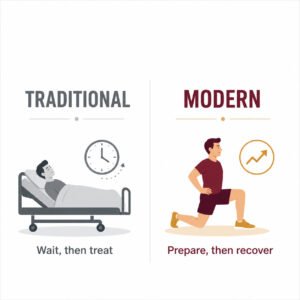
What’s Changed: Old vs New Approach to Knee Replacement Recovery
The traditional model of knee replacement recovery was almost entirely reactive — patients had surgery, then physiotherapy began afterward to address whatever muscle weakness and stiffness had developed. The modern model treats recovery as something that starts before the operation, not after.
This matters because of a specific, well-documented problem: knee arthroplasty often leads to marked postoperative muscle weakness, with quadriceps strength losses of up to 62% in the first month after surgery. That weakness is a major reason recovery feels so much harder than patients expect — and it’s exactly what the newer techniques below are designed to prevent, not just treat.
Before Surgery: The Rise of Prehabilitation
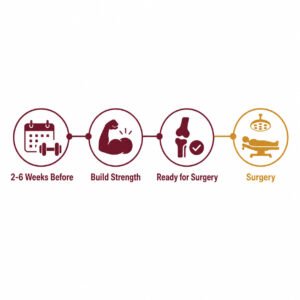
Prehabilitation (“prehab”) is one of the most significant shifts in how knee replacement recovery is now managed. Instead of waiting until after surgery to start physiotherapy, patients begin a structured strengthening programme in the weeks before their operation.
The logic is straightforward: a stronger knee and stronger surrounding muscles going into surgery recover faster and more completely coming out of it. This is sometimes summarised by physiotherapists as a “better in, better out” approach.
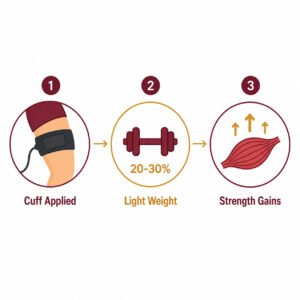
Blood Flow Restriction (BFR) Training — A Genuinely New Technique
The most notable advance within prehabilitation is Blood Flow Restriction (BFR) training. BFR involves using specialised cuffs (similar to a blood pressure cuff) around the upper thigh during exercise, partially restricting blood flow to the muscle while the patient performs low-load exercises — often using weights as light as 20–30% of what they’d normally lift.
This might sound counterintuitive, but the science behind it is well-established: the partial restriction creates a metabolic stress response in the muscle that triggers strength and mass gains similar to much heavier traditional resistance training — without requiring the heavy loading that a painful, arthritic knee often cannot tolerate before surgery.
A 2026 study evaluating six weeks of BFR-based prehabilitation before total knee arthroplasty found that patients in the BFR group showed significantly better pain scores and knee function scores compared to standard prehabilitation, and that these benefits continued to compound during long-term recovery after surgery. Systematic reviews of BFR training in knee arthroplasty patients have similarly found improvements in postoperative quadriceps strength and functional mobility compared to standard physiotherapy alone, with no significant safety concerns reported.
Why this matters for you: If you’re scheduled for knee replacement surgery, asking whether BFR-based prehabilitation is available to you in the weeks before your operation is one of the most evidence-backed questions you can raise with your surgical and physiotherapy team.
After Surgery: Modern Rehabilitation Techniques
1. Continued Blood Flow Restriction Training
BFR training isn’t only useful before surgery — it continues to show benefit afterward, particularly in the first few weeks when pain and swelling make traditional heavy-load strengthening difficult or impossible. Research on passive BFR (applied without active muscle contraction, useful during the earliest, most painful days after surgery) has shown it can help reduce muscle atrophy during periods when patients simply cannot yet tolerate active exercise.
2. Early, Structured Mobilisation
Rather than extended bed rest, current best practice emphasises getting patients moving — carefully and progressively — within the first day after surgery. Early mobilisation reduces the risk of stiffness, blood clots, and the secondary complications that prolonged inactivity causes, while setting the tone for the rest of the recovery timeline.
3. Telerehabilitation
One of the most well-supported recent developments is telerehabilitation — physiotherapy delivered remotely via video consultation, particularly for the middle and later phases of recovery. A systematic review of telerehabilitation after orthopedic surgery found strong evidence specifically supporting its use following knee and hip replacement, with knee and hip arthroplasty patients making up 75% of all studies reviewed and showing outcomes comparable to conventional in-person physiotherapy delivery.
This is particularly relevant for Bangalore patients managing the practical difficulty of frequent travel during recovery — a consideration we discuss further below.
4. Manual Therapy for Range of Motion
Hands-on manual therapy techniques — soft tissue mobilisation, joint mobilisation, and guided stretching — remain a core part of restoring full knee bend and extension after surgery. What’s evolved is how precisely these techniques are now sequenced alongside strength work, rather than treated as a separate, later phase of rehabilitation.
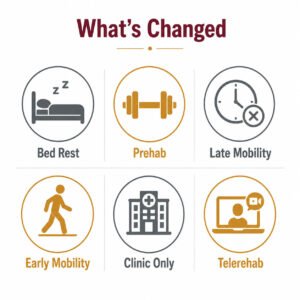
Knee Replacement Recovery Timeline: What Modern Physiotherapy Changes
| Timeframe | Traditional Approach | With Modern Techniques (Prehab + BFR + Telerehab) |
|---|---|---|
| 2–6 weeks before surgery | Minimal or no structured preparation | Prehabilitation programme, potentially including BFR training, to build strength before surgery |
| Day 1–3 after surgery | Bed rest emphasised, mobilisation delayed | Early, supervised mobilisation begins within 24 hours where appropriate |
| Week 1–2 | Basic range-of-motion exercises only | Range-of-motion work plus passive/low-load BFR to counter early muscle atrophy |
| Week 3–6 | Gradual strengthening as pain allows | Structured strengthening, often accelerated by earlier BFR-supported foundation |
| Week 6–12 | Continued in-clinic visits | Hybrid of in-clinic and telerehabilitation sessions, reducing travel burden |
| 3–12 months | Slow return to full function, often incomplete quadriceps recovery | More complete strength recovery, supported by consistent, less physically demanding follow-up options |
It’s worth being clear: modern techniques are not a shortcut that skips the recovery process — knee replacement remains a significant surgery requiring months of dedicated rehabilitation. What these techniques change is the quality and completeness of the strength and function patients regain along that timeline, particularly the persistent quadriceps weakness that has traditionally been one of the most common reasons patients feel dissatisfied with their knee even a year after surgery.
Why Home Care Physiotherapy Fits Naturally Into This Model
Modern knee replacement rehabilitation, especially in the first few weeks, benefits significantly from consistency — and consistency is exactly what’s hardest to maintain when a patient with a healing knee has to travel to a clinic for every session.
This is where home care physiotherapy becomes particularly valuable in the early recovery phase: a physiotherapist can deliver early mobilisation, guided exercises, and even BFR-based protocols directly at home, before transitioning the patient toward clinic visits or telerehabilitation as mobility improves. You can read more about how this works in our Home Care Physiotherapy in Bangalore guide.
For the full picture of what post-surgical rehabilitation at Rayara Kirana covers — including joint replacement recovery for the hip, knee, shoulder, and elbow — see our Post-Surgical Rehabilitation in Bangalore page.
Why Choose Rayara Kirana for Knee Replacement Recovery
Rayara Kirana has served the Banashankari and Basavanagudi communities for over 25 years, led by Dr. Kiran S. Murthy. Our approach to post-surgical knee rehabilitation is built around matching the right technique to the right stage of recovery — not applying a single fixed protocol to every patient regardless of how their knee is actually healing.
Our team’s broader physiotherapy techniques and technologies — including electrotherapy modalities, strengthening and balance tools, and functional training methods — are described in more detail in our Physiotherapy Techniques & Technologies guide. As with any technique, including BFR and telerehabilitation, the right tool depends on clinical assessment — not on using the newest option simply because it’s available.
Rayara Kirana is rated 4.8 out of 5 based on 409+ reviews on Justdial, with patients frequently highlighting the clarity of communication and the team’s structured, patient-first approach to rehabilitation.
Our Services
- Post-Surgical Rehabilitation (Knee, Hip, Shoulder, Elbow)
- Pre-Surgical Prehabilitation Programmes
- Home Care Physiotherapy
- Orthopedic & Sports Physiotherapy
- Neurological Physiotherapy
- Women’s Health & Postnatal Physiotherapy
Frequently Asked Questions