
Medically Reviewed by Dr. Kiran S. Murthy, Founder & Lead Physiotherapist at Rayara Kirana (25+ years of experience) Last Updated: September 2026
Thoracic spine pain — the dull ache, stiffness, or sharp discomfort you feel between your shoulder blades and mid-back — is one of the most under-discussed pain conditions we see at Rayara Kirana. Ask most people about back pain and they’ll talk about their lower back. Ask about neck pain and everyone has an opinion. But the section in between — the thoracic spine — rarely gets mentioned, even though it’s often the actual source of problems that show up elsewhere in your body.
This guide explains why thoracic spine pain is so commonly overlooked, what actually causes it, and why ignoring it tends to make everything around it — your neck, your posture, even your breathing — quietly worse over time.
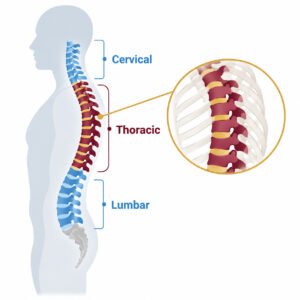
What Is Thoracic Spine Pain?
The thoracic spine consists of twelve vertebrae (T1 through T12), connecting your cervical spine (neck) above to your lumbar spine (lower back) below. It’s also the part of your spine attached to your rib cage, which makes it structurally different from the neck and lower back — and part of why it behaves differently when things go wrong.
Thoracic spine pain is estimated to affect roughly 15% to 35% of the general population, depending on how it’s defined and studied. Most cases are non-specific and mechanical in nature — meaning no serious structural problem is found, similar to common lower back pain.
Why Thoracic Spine Pain Is the Most Ignored Part of Your Back
Physiotherapy researchers have actually given the thoracic spine a nickname: the “Cinderella region” of the spine — because unlike the neck and lower back, it has received comparatively little dedicated research attention, and clinical assessment of this region is often overlooked or treated as an afterthought during a standard back examination.
There are a few reasons this happens in everyday practice:
- It’s sandwiched between two “louder” regions. Neck pain and lower back pain are more common complaints, so thoracic pain often gets bundled into one or the other rather than assessed on its own terms.
- It’s frequently referred pain. Pain felt between the shoulder blades is often actually referred from the lower cervical spine, so patients — and sometimes clinicians — chase the wrong location.
- It’s rarely dramatic. Thoracic pain is usually a dull, nagging ache rather than a sharp, alarming symptom, so people tolerate it far longer before seeking help.
What Causes Thoracic Spine Pain?
Prolonged Sitting and Poor Posture
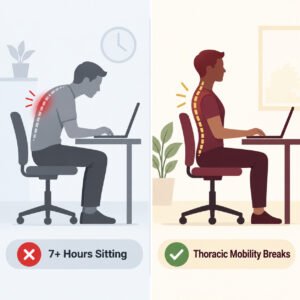
This is, by far, the most common contributor in our patients. Research has found that people who sit more than 7 hours a day and get less than 150 minutes of physical activity per week show measurably reduced thoracic mobility. Add a forward-reaching posture toward a keyboard or phone, and the mid-back muscles and joints absorb hours of sustained strain every single day.
Forward Head Posture and Increased Kyphosis
Research has also found a clear correlation between increased thoracic kyphosis (the natural forward curve of the upper back becoming exaggerated) and forward head posture — the posture most desk and phone use gradually creates. One feeds the other: as the thoracic spine rounds forward, the head compensates by pushing further forward to keep your eyes level, straining the neck as well.
Facet Joint and Rib Involvement
Because the thoracic spine is directly connected to your rib cage, pain here can originate from the small facet joints between vertebrae or from the ribs themselves — which is part of why thoracic pain can sometimes worsen with deep breathing or twisting, in a way that lower back pain typically does not.
Trauma or Injury
Falls, road accidents, and sports injuries can affect thoracic structures directly, sometimes causing rib fractures or ligament sprains that heal more slowly in this region due to its constant involvement in breathing movement.
Why Ignoring Thoracic Spine Pain Makes Everything Else Worse
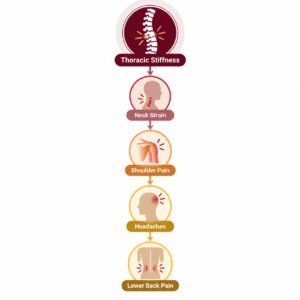
This is the part most people don’t realize: thoracic spine dysfunction rarely stays contained to the mid-back. Because the thoracic spine sits at the center of your body’s movement chain, restrictions here commonly cascade into problems elsewhere.
| Where the Problem Shows Up | How Thoracic Dysfunction Contributes |
|---|---|
| Neck pain | Reduced thoracic mobility forces the neck to compensate for movements the mid-back should be handling, increasing cervical strain |
| Shoulder pain | Poor thoracic posture alters shoulder blade positioning, contributing to impingement-type shoulder problems over time |
| Lower back pain | A stiff thoracic spine can shift excess movement demand down onto the lumbar spine, which wasn’t designed to compensate for it |
| Headaches | Forward head posture driven by thoracic kyphosis is a well-recognized contributor to tension-type headaches |
| Breathing efficiency | Since the thoracic spine and rib cage move together, restricted thoracic mobility can subtly limit full, efficient breathing mechanics |
“Patients often come to us saying their neck or shoulder is the problem, and in a genuine number of cases, the actual root cause is sitting quietly in the thoracic spine, never assessed on its own. Treating the neck without addressing thoracic mobility is often why symptoms keep returning.”
— Dr. Kiran S. Murthy, Founder & Lead Physiotherapist, Rayara Kirana
Warning Signs That Need Medical Evaluation
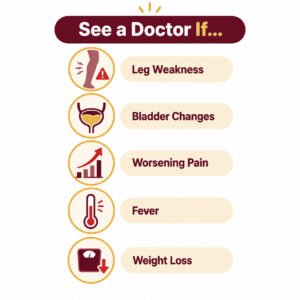
Most thoracic spine pain is mechanical and responds well to physiotherapy. However, certain symptoms require prompt medical evaluation rather than home management:
- Weakness in the legs or changes in bladder or bowel control
- Pain following a significant fall, accident, or trauma
- Pain that worsens progressively rather than fluctuating with activity
- Fever accompanying the back pain
- Unexplained weight loss alongside persistent thoracic pain
These can indicate a more serious underlying cause and should be assessed by a doctor promptly.
How Physiotherapy Treats Thoracic Spine Pain
Because complete rest actually weakens the muscles supporting the spine and increases stiffness, current best practice favors staying appropriately active rather than prolonged bed rest. A structured physiotherapy approach typically includes:
- Manual therapy — soft tissue release, joint mobilization, and trigger point therapy to address the muscular and joint components of thoracic pain
- Thoracic mobility exercises — specific movements to restore rotation and extension that prolonged sitting gradually removes
- Postural correction training — addressing the forward head and rounded shoulder pattern that both causes and results from thoracic dysfunction
- Ergonomic guidance — practical changes to desk setup, screen height, and sitting habits that address the root behavioral cause, not just the symptom
- Progressive strengthening — building the postural muscles that support the thoracic spine so the improvement holds beyond the treatment room
“The exercises matter, but what actually changes long-term outcomes is whether someone changes how they sit for eight hours a day. We spend as much time on posture and desk setup as we do on hands-on treatment, because otherwise the pain simply returns once therapy ends.”
— Dr. Kiran S. Murthy, Founder & Lead Physiotherapist, Rayara Kirana
Nutrition & Supplements: Supporting Spine and Muscle Health
Physiotherapy and regular movement are the foundation of recovery from thoracic spine pain, but nutrition also plays an important supporting role in maintaining healthy muscles and bones. Adequate protein, calcium, and vitamin D are particularly important for musculoskeletal health.
Protein for Muscle Support
Protein provides the building blocks needed to maintain and repair muscle tissue. This is especially relevant when a rehabilitation programme includes progressive strengthening, as adequate protein intake supports the muscles that help stabilize and move the spine. Good sources include eggs, dairy products, fish, poultry, pulses, soy, nuts, and seeds.
Calcium for Bone Health
Calcium is an important structural component of bone. Getting enough calcium through food—such as dairy products, calcium-set tofu, almonds, and certain green vegetables—supports normal bone health. Calcium supplements are generally more appropriate when dietary intake is inadequate or when a person has a specific risk of osteoporosis, rather than as a routine treatment for ordinary thoracic spine pain.
Vitamin D for Bones and Muscles
Vitamin D helps the body absorb calcium and supports normal bone mineralization and muscle function. If vitamin D deficiency is suspected or confirmed, supplementation may be recommended by a healthcare professional based on individual needs.
What About Magnesium and Other Supplements?
Magnesium contributes to normal muscle and bone function, but current evidence is not strong enough to position magnesium supplements as a treatment for thoracic spine pain itself. A balanced diet should remain the first priority, with supplements considered when there is a documented deficiency or a specific clinical indication.
The key point: supplements should support—not replace—physiotherapy, movement, strengthening, posture correction, and appropriate medical assessment. For persistent pain, suspected osteoporosis, a history of fracture, or nutritional deficiency, speak with a doctor or qualified healthcare professional before starting supplements.
Why I prefer this approach
It fits the existing article without changing its main message. The blog currently says that progressive strengthening builds the postural muscles supporting the thoracic spine. Nutrition can therefore be positioned as supportive care for muscle and bone health, rather than claiming that a supplement cures thoracic spine pain.
The Connection to Text Neck and Desk-Related Pain
Thoracic spine pain rarely exists in isolation from the broader postural problems created by prolonged screen use. Our guide on Text Neck Syndrome and Mobile Usage covers the related cervical spine consequences of the same forward-head, hunched-shoulder posture that drives thoracic pain — the two conditions are closely connected and often need to be addressed together for lasting relief.
Why Home Care Physiotherapy Works Well for Thoracic Pain
Since ergonomic and postural correction is such a central part of treating thoracic spine pain, there’s a genuine advantage to a physiotherapist assessing your actual desk setup, chair, and daily sitting environment directly — rather than trying to recreate it in a clinic. Our Home Care Physiotherapy in Bangalore service allows exactly this kind of practical, environment-specific assessment and correction.
Why Choose Rayara Kirana for Thoracic Spine Pain
Rayara Kirana has served the Banashankari and Basavanagudi communities for over 25 years, led by Dr. Kiran S. Murthy. Our approach to thoracic spine pain starts with a proper assessment of this frequently overlooked region — rather than treating it as a footnote to neck or lower back complaints — using our full range of manual therapy and rehabilitation techniques described in our Physiotherapy Techniques & Technologies guide.
Rayara Kirana is rated 4.8 out of 5 based on 409+ reviews on Justdial, with patients frequently highlighting the clarity of our team’s explanations and structured approach to treatment.
Our Services
- Orthopedic & Spine Physiotherapy
- Home Care Physiotherapy
- Postural Correction & Ergonomic Guidance
- Post-Surgical Rehabilitation
- Neurological Physiotherapy
- Sports Injury Rehabilitation