Medically Reviewed by: Dr. Kiran S. Murthy, Founder & Lead Physiotherapist at Rayara Kirana (25+ years of clinical experience)The Unspoken Symptom of Menopause
You wake up on a chilly morning in Bangalore, swing your legs out of bed, and stand up. But before you can take your first step toward the kitchen, a sharp, aching stiffness grips your knees. Your fingers feel rigid, almost swollen, making it frustratingly hard to grip your morning cup of filter coffee or open a glass jar.
For millions of women entering their mid-to-late 40s, this scenario becomes a daily reality. The immediate assumption is usually: “I’m just getting old,” or “I must be deficient in calcium.”
However, there is a distinct biological engine behind this sudden, widespread joint discomfort that rarely gets enough attention in routine doctor visits: menopause-induced musculoskeletal changes.
While hot flashes, night sweats, brain fog, and mood swings dominate the conversation around menopause, chronic joint pain and stiffness affect over 50% of women transitioning through perimenopause and post-menopause. Medical research refers to this clinical phenomenon as arthralgia of menopause—or more casually, menopausal arthritis.
This comprehensive, step-by-step guide breaks down the science of why your joints start hurting after age 45, how hormone loss strips away your body’s natural joint lubricants, which joints are most vulnerable, and how evidence-based Women’s Health Physiotherapy provides direct, drug-free relief to help you move freely again.
2. The Science: Why Estrogen Drop Causes Joint Stiffness
To understand why your joints feel stiff and painful, you first have to look at what estrogen actually does in a woman’s body. Most people think of estrogen purely as a reproductive hormone responsible for menstrual cycles. In reality, estrogen acts as a master regulator for your entire musculoskeletal system—including your bones, muscles, tendons, ligaments, and cartilage.
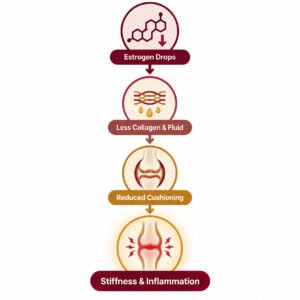
Estrogen Level Drops ➡️ Decreased Collagen & Synovial Fluid ➡️ Reduced Joint Cushioning ➡️ Systemic Inflammation & Stiffness
When perimenopause begins (typically between ages 45 and 51), ovarian production of estrogen drops rapidly. This decline triggers four major destructive changes inside your joints:
A. Depletion of Joint Cartilage
Cartilage is the smooth, rubbery tissue that coats the ends of your bones inside a joint, allowing them to glide smoothly against each other without friction. Cartilage cells contain high concentrations of estrogen receptors. Estrogen actively stimulates these cells to produce collagen and keep cartilage hydrated, bouncy, and resilient.
When estrogen levels drop, cartilage loses its ability to repair itself. Over time, it thins out, dries up, and loses its shock-absorbing capacity. Without adequate cartilage cushioning, bones begin to press against each other, causing deep joint pain during simple weight-bearing activities like walking or standing.
B. Loss of Synovial Fluid (“Joint Lubrication”)
Inside every healthy joint is a capsule filled with a thick, slippery fluid called synovial fluid. Think of synovial fluid as the engine oil of your human body. It delivers nutrients to cartilage and lubricates joint movement.
Estrogen plays a key role in maintaining fluid secretion within the joint capsule. As estrogen wanes, synovial fluid production slows down. This creates what many women describe as a “dry, grinding” feeling in their knees, hips, or knuckles—especially after sitting still for long periods or upon waking in the morning.
C. Surging Systemic Inflammation
Estrogen acts as a natural, built-in anti-inflammatory mechanism. It actively keeps pro-inflammatory chemicals (called cytokines) in check. When estrogen drops during menopause, these inflammatory cytokines run rampant through the bloodstream. This systemic inflammation attacks vulnerable connective tissues, leading to generalized joint tenderness, tendonitis, and morning stiffness across multiple joints simultaneously.
D. Accelerated Loss of Muscle Mass (Sarcopenia)
Estrogen helps maintain muscle mass and connective tissue elasticity. Beyond age 45, women experience accelerated muscle loss, known as sarcopenia. When the muscles surrounding your joints (such as the quadriceps around the knee or the glutes around the hip) lose strength, they can no longer support your body weight properly. As a result, heavy physical loads shift away from the muscles and dump directly onto your vulnerable, under-lubricated joint structures.
3. Which Joints Are Affected Most (And What It Feels Like)
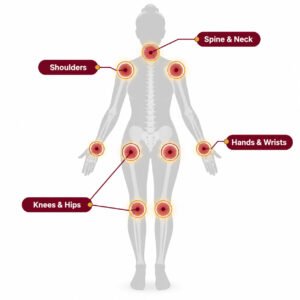
Menopausal joint pain rarely affects just one spot; it frequently presents as symmetrical discomfort across several regions of the body. Here are the primary areas women over 45 report:
| Body Region | Clinical Presentation | Daily Impact |
|---|---|---|
| Knees & Hips | Weight-bearing cartilage wear | Difficulty climbing stairs, standing up |
| Hands & Wrists | Symmetrical small-joint stiffness | Weakened grip, trouble opening jars |
| Shoulders | Connective tissue tightness | Adhesive Capsulitis (Frozen Shoulder) |
| Spine & Neck | Postural strain & spinal stiffness | Lower back aching, desk fatigue |
1. Knees and Hips (Weight-Bearing Joints)
Your knees and hips bear the brunt of your entire body weight with every step you take. When estrogen drops, the cartilage loss in these high-impact joints becomes immediately noticeable. Women often report a deep, dull ache behind the kneecap or deep in the groin/hip socket after walking down stairs, getting out of a low chair, or squatting down.
2. Hands, Wrists, and Knuckles (Small Joints)
Unlike mechanical wear-and-tear arthritis which usually targets one heavy-use hand, menopausal joint pain in the hands is typically symmetrical—affecting both hands equally. You may notice your knuckles feeling thick, stiff, and rigid in the morning, making it hard to make a tight fist, write comfortably, or perform delicate kitchen tasks like chopping vegetables.
3. Shoulders (Frozen Shoulder / Adhesive Capsulitis)
There is a massive surge in the incidence of Frozen Shoulder (Adhesive Capsulitis) among women aged 45 to 60. Estrogen loss causes the collagen fibers in the shoulder capsule to become tight, thick, and inflamed. What starts as a mild ache when reaching behind your back to hook a bra or grab something from the back seat of a car can quickly progress into severe joint locking and restricted arm elevation. To learn more about shoulder pathologies, read our guide on Shoulder Pain Types, Causes, Home Remedies, and When to See a Physiotherapist.
4. Spine and Neck
Lower back aching and neck stiffness are extremely common during menopause. Estrogen loss affects the intervertebral discs (the gel-filled cushions between your spinal bones), causing them to lose water content and compress. When combined with poor desk ergonomics or postural slumping, this leads to chronic spinal stiffness. For an in-depth breakdown of neck issues, see our dedicated post on Cervical Spondylosis vs Neck Pain: How to Tell the Difference.
4. Menopausal Arthritis vs. Osteoarthritis vs. Rheumatoid Arthritis
Because joint pain after 45 can stem from multiple conditions, getting an accurate clinical diagnosis is critical. Treating menopausal joint stiffness like standard wear-and-tear often yields poor results because it misses the underlying hormonal and structural dynamics.
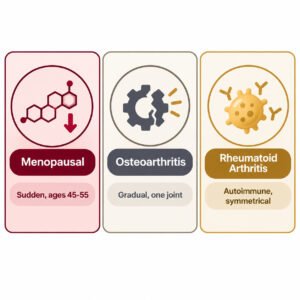
Menopausal Joint Pain vs Osteoarthritis vs Rheumatoid Arthritis
| Feature | Menopausal Joint Pain | Osteoarthritis (OA) | Rheumatoid Arthritis (RA) |
|---|---|---|---|
| Primary Cause | Rapid drop in estrogen levels | Mechanical wear-and-tear of cartilage over decades | Autoimmune attack on the synovial joint lining |
| Onset Speed | Sudden onset, typically between ages 45–55 | Gradual development over many years | Variable; can occur at any age, often between 30–50 |
| Joint Pattern | Often symmetrical, affecting the knees, hands, shoulders, and spine | Often asymmetrical, commonly affecting one knee or hip | Highly symmetrical, especially affecting the small joints of the hands and feet |
| Morning Stiffness | Usually lasts 20–45 minutes and may improve with gentle movement | Usually short, often less than 15–20 minutes | Often prolonged, potentially lasting several hours or most of the day |
| X-Ray Findings | May be normal or show mild age-related changes | Bone spurs and joint-space narrowing may be present | Bone erosions and joint-space destruction may occur |
| Systemic Features | May occur alongside hot flashes, mood changes, or brain fog | Typically no systemic symptoms | May include fatigue, fever, or inflammation affecting other organs |
5. Why Painkillers Are Not a Long-Term Solution
When joint pain first appears, many women turn to over-the-counter painkillers like non-steroidal anti-inflammatory drugs (NSAIDs) or paracetamol. While these medications can offer temporary relief for acute flare-ups, relying on them daily carries significant risks:
- Gastrointestinal Distress: Chronic use of NSAIDs can irritate the stomach lining, leading to acidity, ulcers, and internal bleeding.
- Kidney and Liver Strain: Processing daily pain medications places an unnecessary metabolic burden on your liver and kidneys.
- Ignoring the Root Cause: Painkillers mask the pain signal without restoring lost muscle strength, improving joint range of motion, or stimulating natural synovial fluid flow.
Once the medication wears off, the underlying friction, muscle weakness, and joint tightness remain completely unchanged. To achieve true, lasting relief, you must address the physical biomechanics of the joint itself.
6. How Physiotherapy Treats Menopause-Related Joint Pain
Targeted physiotherapy is one of the most effective, evidence-based, non-invasive treatments available for managing menopausal joint discomfort. Instead of just masking symptoms, structured physical rehabilitation restructures how load is distributed across your skeleton, restores lost joint range of motion, and strengthens surrounding protective muscles.
Physiotherapy Targets & Solutions
| Clinical Target | Physiotherapy Solution |
|---|---|
| Decreased Joint Lubrication | Targeted manual mobilization and joint traction |
| Muscle Mass Loss (Sarcopenia) | Progressive resistance and strength training |
| Balance & Proprioception Deficits | Dynamic neuromuscular coordination exercises |
| Postural Strain & Increased Joint Load | Ergonomic alignment and core stabilization |
1. Manual Therapy and Joint Mobilization
Senior physiotherapists use specialized hands-on techniques—such as passive joint glides, traction, and soft tissue release—to gently stretch tight joint capsules. These precise physical movements encourage the remaining synovial fluid to circulate evenly across the joint cartilage, flushing out inflammatory waste products and improving mobility almost immediately.
2. Progressive Resistance and Strength Training
To protect a degrading joint, you must build a “muscular armor” around it.
- For Knee Pain: Strengthening the quadriceps, hamstrings, and calf muscles creates a natural shock-absorber that lifts weight off the knee joint.
- For Hip Pain: Targeted gluteus medius and core strengthening stabilizes the pelvis during walking, eliminating painful hip swaying.
- For Hand Pain: Specific hand and forearm resistance exercises restore grip strength and reduce stress on small knuckle joints.
3. Targeted Flexibility and Capsule Stretching
Targeted stretching protocols prevent connective tissues from shortening and stiffening. For women experiencing early-stage frozen shoulder, specialized physical therapy stretches prevent full capsule freezing and maintain arm mobility.
4. Low-Impact Aerobic and Hydrotherapy Guidance
High-impact running or jump training can aggravate inflamed joints. Physiotherapists design low-impact cardiovascular routines—such as stationary cycling, aquatic therapy (hydrotherapy), or clinical treadmill protocols—that boost cardiovascular health and burn calories without compressing sensitive joint cartilage. To understand how low-impact modalities prevent injury, read our guide on Yoga for Injury Prevention in Athletes: The Role of Physiotherapy, Aquatic Therapy, and Nutrition.
7. Step-by-Step Home Exercises to Relieve Joint Stiffness
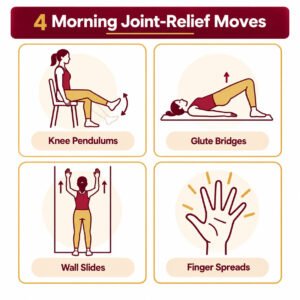
While clinical evaluation is essential, incorporating gentle daily movement at home can significantly ease morning stiffness. Perform these four safe exercises every morning before starting your day:
- Gentle Knee Pendulums (For Stiff Knees):
- Reps: 10–12 per leg
- Sit on the edge of a sturdy table or high bed so your feet dangle freely above the floor. Gently swing your lower legs forward and backward in a smooth, rhythmic pendulum motion. This unweighted movement gently circulates synovial fluid inside the knee joint without bearing body weight.
- Seated Glute and Pelvic Bridges (For Hips & Lower Back):
- Reps: 10 reps with a 3-second hold
- Lie flat on your back on a firm mattress or exercise mat with your knees bent and feet flat on the floor, hip-width apart. Exhale, squeeze your glutes, and lift your hips up toward the ceiling until your body forms a straight line from shoulders to knees. Hold for 3 seconds, then lower down slowly.
- Wall Slides (For Shoulder Stiffness & Frozen Shoulder):
- Reps: 8–10 slides
- Stand facing a smooth wall, about six inches away. Place both palms flat against the wall at chest height. Slowly slide your hands up the wall as high as comfortable without arching your lower back. Hold at the top for 2 seconds, then slowly slide back down.
- Finger Spreads and Wrist Rolls (For Hand Stiffness):
- Reps: 10 reps each direction
- Extend both hands forward. Spread your fingers apart as wide as possible, hold for 3 seconds, then make a gentle fist. Follow this by rolling your wrists in slow, controlled circles clockwise and counterclockwise to relieve small-joint tightness.
8. Lifestyle and Nutrition Hacks for Healthy Joints After 45
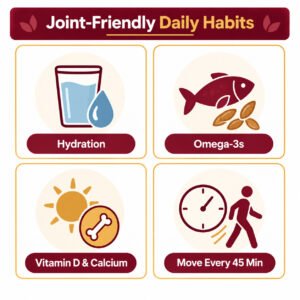
Physical therapy works best when paired with joint-friendly daily habits. Here are four essential lifestyle tweaks to protect your joints from the inside out:
- Prioritize Hydration: Cartilage is made up of nearly 80% water. When you are dehydrated, your body pulls moisture from joint tissue, making cartilage stiffer and more brittle. Aim for 2.5 to 3 liters of water daily.
- Incorporate Omega-3 Fatty Acids: Omega-3s possess potent anti-inflammatory properties that help calm inflamed joint membranes. Include flaxseeds, chia seeds, walnuts, or high-quality fish oil supplements in your diet.
- Optimize Vitamin D3 and Calcium Levels: Estrogen decline impairs calcium absorption, weakening underlying bone structures. Get regular early morning sunlight exposure and consult your physician about checking your Serum Vitamin D3 and Calcium levels.
- Follow the 45-Minute Movement Rule: Avoid sitting in one position at your desk or on the couch for longer than 45 minutes at a stretch. Prolonged static sitting drains synovial fluid out of weight-bearing joints, leading to sharp stiffness when you finally stand up.