Understanding a Weak, Loose or Unstable Knee
Have you ever felt that your knee might suddenly give way while walking downstairs, stepping onto a wet bathroom floor or getting off a bus? Perhaps you feel uncertain when standing inside a moving train, walking around a swimming pool or getting up after sitting in a car for a long time.
These experiences can make ordinary activities unexpectedly difficult.
People often describe this sensation as a weak knee, a loose knee, knee buckling or knee instability. Some experience a sudden loss of support, while others notice that their knee feels unreliable, shaky or unable to support their body confidently.
Knee weakness can affect people of different ages. Older adults may experience it alongside age-related changes in muscle strength and joint health. Active individuals may notice it after an injury or a period of reduced activity. Others may experience it because of knee pain, previous surgery or problems affecting the muscles and structures around the joint.
It is important to understand that a weak or unstable knee is a symptom, not a diagnosis. The underlying reason may involve muscle weakness, pain, ligament injury, meniscus problems, joint conditions or reduced balance and movement coordination.
This article explores why your knee may feel weak during everyday activities, what could be contributing to the problem and how an individualised physiotherapy programme may help improve strength, movement control and confidence.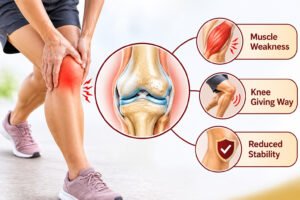 F
What Does It Mean When Your Knee Feels Weak or Gives Way?
The terms weak knee, knee buckling and knee instability are often used interchangeably, but they do not always describe the same problem.
Understanding the differences can help explain why people experience different symptoms.
1. Muscle-related knee weakness
The muscles around the knee help support the body during standing, walking, climbing stairs and changing direction.
The quadriceps at the front of the thigh, hamstrings at the back, calf muscles and muscles around the hip all contribute to lower-limb movement and control.
If these muscles lose strength or endurance, activities that were previously comfortable may become difficult. The knee may feel tired, shaky or less reliable, particularly after prolonged walking or repeated movements.
2. Pain-related knee buckling
Sometimes, knee pain interferes with normal muscle activation. The person may suddenly feel that the knee is giving way, even without a ligament tear.
This can happen in conditions involving the kneecap, knee joint or surrounding soft tissues.
3. Mechanical knee instability
The knee contains ligaments and other structures that help control joint movement.
An injury involving the anterior cruciate ligament (ACL), posterior cruciate ligament (PCL), collateral ligaments or certain meniscus injuries may affect joint stability.
Some people notice the knee shifting or feeling unreliable during turning, pivoting or sudden changes in direction.
The important distinction: Not every weak knee indicates ligament damage, and not every episode of knee buckling is caused by weak muscles. A clinical assessment is necessary to identify the likely cause.
Why Does Your Knee Feel Weak While Walking Downstairs?
Walking downstairs is one of the situations in which knee weakness becomes noticeable.
When descending stairs, one leg supports the body’s weight while the other moves towards the next step. The supporting knee must bend gradually while controlling the body’s downward movement.
The quadriceps muscles play an important role in this process. They produce force while lengthening, a type of muscle action known as eccentric contraction.
If the quadriceps are weak, painful or unable to coordinate effectively, the knee may feel as though it could collapse.
Other contributing factors may include:
Reduced hip and lower-limb strength.
Poor balance during single-leg support.
Knee pain or stiffness.
Previous ligament or meniscus injuries.
Reduced confidence during weight transfer.
A person may walk comfortably on level ground but struggle when descending stairs because the activity places different demands on the knee.
If your knee repeatedly gives way on stairs, avoid repeatedly testing it or attempting difficult step-down exercises without guidance. Use a handrail and arrange an appropriate assessment.
Knee Weakness on Slippery Floors and in Bathrooms
Bathrooms are common places where people experience uncertainty while walking.
Wet tiles, soap residue and uneven floor surfaces can reduce traction. Even someone with normally functioning knees may need to adjust their steps to avoid slipping.
However, a person with an already weak or unstable knee may find these situations particularly challenging.
Why does a weak knee feel less reliable on wet floors?
Walking on a slippery surface requires the body to respond quickly to small changes in balance.
The muscles around the hip, knee and ankle work together to maintain stability. The nervous system also helps coordinate these adjustments.
If the knee is painful, weak or affected by an injury, the person may find it harder to maintain confident weight transfer.
For example:
Standing on one leg while stepping into a bathroom may feel difficult.
Turning around in a narrow bathroom may create uncertainty.
Getting in and out of a shower may require additional support.
A sudden slip may be harder to control if the affected leg cannot support the body confidently.
Practical precautions
If you experience knee weakness:
Use non-slip bathroom mats designed to stay securely in place.
Keep the floor as dry as possible.
Consider properly installed grab bars where needed.
Avoid rushing while entering or leaving the bathroom.
Use stable support when changing position.
Do not use unstable stools, loose mats or movable furniture as support.
If your knee frequently buckles, the priority should be identifying the cause rather than simply trying to improve your balance on slippery surfaces.
Why Does Your Knee Feel Unstable Around Swimming Pools?
Swimming is often considered a low-impact activity, but moving around a swimming pool can still be challenging for someone with knee weakness.
Poolside areas are frequently wet. Water splashes, smooth tiles and changing floor surfaces can make walking less predictable.
The difficulty may be more noticeable when:
Walking from the changing room to the pool.
Stepping down into the swimming pool.
Climbing pool steps or ladders.
Standing on one leg while changing footwear.
Getting out of the pool using steps.
Is swimming always suitable for a weak knee?
Not necessarily.
Swimming and water-based exercise may be appropriate for some people because buoyancy reduces the amount of body weight supported by the joints. However, the suitability of an activity depends on the underlying condition, pain level, mobility and ability to enter and leave the pool safely.
A person with repeated knee buckling should not assume that poolside walking or climbing pool steps is safe simply because swimming itself is low impact.
A physiotherapist can help determine which activities are appropriate and whether additional support or modifications are needed.
Knee Weakness While Cycling
Cycling involves repeated bending and straightening of the knee. The quadriceps, hamstrings, calf muscles and hip muscles work together throughout the pedalling movement.
Some people with a weak knee notice discomfort or fatigue after cycling for a short period. Others may feel uncertain when starting, stopping or getting off the bicycle.
Possible contributing factors include:
Reduced quadriceps strength.
Knee pain during repeated bending.
Poor cycling posture or unsuitable seat height.
Previous knee injuries.
Reduced muscle endurance.
Limited confidence when supporting body weight on one leg.
Why getting on and off a bicycle can be difficult
Cycling itself is a repetitive movement, but mounting and dismounting require a different type of control.
The person may need to balance on one leg, move the other leg over the bicycle and transfer body weight while maintaining stability.
For someone with knee instability, this transition may be more difficult than the pedalling movement.
If cycling causes repeated knee buckling, significant pain or swelling, stop the activity and seek professional advice before continuing.
Why Is Walking Inside a Moving Train Difficult With a Weak Knee?
Train travel presents a different challenge because the supporting surface is constantly moving.
Walking inside a moving train requires the body to respond to acceleration, braking, turning and changes in direction.
Even when a train is moving smoothly, passengers may experience sudden changes in balance when it slows down, starts moving or travels around a curve.
Common situations that challenge knee stability
A person with a weak knee may experience difficulty when:
Walking from one coach to another.
Moving through a crowded aisle.
Reaching for a seat or luggage.
Standing while the train is moving.
Walking towards the toilet.
Turning around in a narrow space.
Maintaining balance when the train suddenly brakes.
Why can using a train toilet become difficult?
Train toilets often have limited floor space. The passenger may need to turn, change direction, stand up and sit down while managing a moving environment.
These movements require coordination, lower-limb strength and balance.
A person with knee instability may feel particularly uncomfortable when there is limited space to hold a stable position.
Practical precautions during train travel
If your knee feels unreliable:
Prefer a seat where you can sit comfortably and access the aisle safely.
Avoid walking through the coach when the train is accelerating or braking.
Hold securely installed handrails while moving.
Avoid carrying heavy luggage while walking.
Ask for assistance if you feel unsteady.
Do not walk between coaches unnecessarily.
Repeated difficulty walking inside a moving train may indicate that your knee needs assessment, particularly if similar symptoms occur during ordinary walking.
Knee Weakness While Travelling by Bus
Bus travel can also challenge a weak knee.
Unlike a train, buses frequently accelerate, brake and turn through traffic. Passengers may need to maintain balance while the vehicle is moving, especially when standing.
Situations that may cause difficulty
Getting on and off the bus: Climbing steps requires the knee and hip muscles to support body weight. A person with reduced strength may struggle to lift the body onto a higher step.
Standing during the journey: The body must continuously adjust to changes in vehicle movement. This may be difficult when balance or knee control is reduced.
Sudden braking: A sudden stop can shift body weight forwards. The legs must respond quickly to maintain balance.
Walking through the bus: Moving towards a seat while the vehicle is in motion requires controlled weight transfer and the ability to respond to sudden movement.
What can help?
Whenever possible, choose a seat rather than standing during the journey. Use the handrails when entering or leaving the bus and avoid rushing.
If you regularly struggle with bus steps or feel that your knee may collapse when the vehicle moves, discuss these symptoms with a healthcare professional.
Knee Stiffness and Weakness During Long Car Journeys
Long car journeys can make the knees feel stiff, uncomfortable or difficult to move.
When sitting for extended periods, the knees remain bent and the surrounding muscles are relatively inactive. Some people experience stiffness when they first stand up after a long journey.
This can be more noticeable in individuals with existing knee pain, osteoarthritis, previous injuries or reduced muscle strength.
Why does the knee feel weak after sitting?
After prolonged sitting, the knee may feel stiff or uncomfortable during the first few steps.
The person may notice:
Difficulty straightening the knee fully.
Discomfort when getting out of the car.
A feeling of tightness around the knee.
Reduced confidence while taking the first few steps.
Increased discomfort after repeated long journeys.
These symptoms do not automatically indicate structural instability. Stiffness, pain and reduced movement tolerance can also affect how confidently a person walks.
Ways to make long journeys more comfortable
Adjust the seat so that the knees are not excessively bent.
Take appropriate breaks during long journeys.
Walk gently during breaks if it is safe and comfortable.
Avoid suddenly standing and rushing immediately after prolonged sitting.
Follow any movement restrictions advised after surgery or injury.
If stiffness is persistent, accompanied by swelling or associated with repeated buckling, arrange a clinical assessment.
Why Does Your Knee Feel Unstable While Riding a Scooter?
Scooter riding involves more than simply sitting and controlling the vehicle.
The rider may need to place one or both feet on the ground, support the scooter while stationary, move the vehicle into position and get on or off safely.
These movements can challenge people with knee weakness.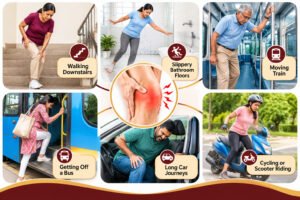
Common situations
Supporting the scooter at a traffic signal: The rider may need to support part of the vehicle’s weight through one leg while the other remains positioned near the footrest.
Getting on and off: This requires coordinated movement of the hip and knee, especially when lifting a leg over the scooter.
Moving the scooter while parked: Pushing or reversing a scooter may require controlled weight transfer and lower-limb strength.
Stopping on an uneven surface: Uneven roads or sloping surfaces can make it harder to place the foot securely on the ground.
A weak or painful knee may make these movements uncomfortable or unpredictable.
Safety considerations
If your knee repeatedly gives way, avoid riding until you have been assessed and can safely control the vehicle. Do not rely on the other leg alone to compensate for an unstable knee.
Common Medical Causes of a Weak Knee
Several conditions may contribute to knee weakness, buckling or instability. The symptoms alone cannot confirm which condition is present.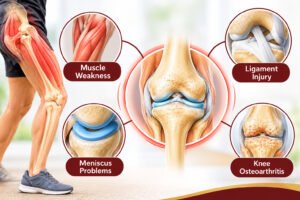
1. Quadriceps weakness
The quadriceps help straighten the knee and control movements such as standing up, climbing stairs and lowering the body.
Muscle weakness may develop after injury, surgery, prolonged inactivity or painful knee conditions.
2. ACL and other ligament injuries
The ACL helps control forward movement and rotation of the knee. Other ligaments also contribute to joint stability.
Ligament injuries may cause the knee to feel unreliable during turning, pivoting or sudden changes in direction.
For more information, read Rayara Kirana’s guide on Managing Ligament Injuries.
3. Meniscus injuries
The menisci are two crescent-shaped pieces of cartilage that help distribute load within the knee joint.
Certain meniscus injuries may cause pain, swelling, catching, locking or difficulty moving the knee.
Some people also describe a sensation of giving way.
4. Knee osteoarthritis
Knee osteoarthritis involves changes in the joint that may contribute to pain, stiffness and reduced movement.
Pain and reduced activity can also contribute to muscle weakness and difficulty performing everyday tasks.
Read more in Rayara Kirana’s Guide to Overcoming Knee Arthritis.
5. Patellofemoral pain
Patellofemoral pain involves discomfort around or behind the kneecap.
It may become noticeable during activities such as climbing stairs, squatting, getting up from a chair or prolonged sitting.
Pain can affect how comfortably a person loads and controls the knee.
6. Reduced hip and lower-limb strength
The hip, knee and ankle work together during walking and other weight-bearing activities.
Reduced hip strength or coordination may contribute to changes in lower-limb movement in some individuals.
The relationship between hip and knee movement is discussed in Rayara Kirana’s article on the Hip–Knee Connection.
7. Reduced balance and neuromuscular control
The nervous system continuously receives information about body position and movement.
This information helps the muscles respond to changes in the supporting surface, body position and direction of movement.
Reduced balance or coordination may make activities such as walking on uneven surfaces, standing on one leg or moving inside a vehicle more challenging.
How Do Physiotherapists Assess Knee Weakness?
A proper assessment helps identify why the knee feels weak and which activities are affected.
The assessment may include several stages.
1. Understanding your symptoms
The physiotherapist may ask:
When did the knee weakness begin?
Did it start after an injury or surgery?
Does the knee give way while walking, turning or using stairs?
Is there pain, swelling or stiffness?
Does the knee feel unstable during travel?
Do symptoms occur in one knee or both?
Have you experienced falls or near-falls?
Your answers help establish the pattern of symptoms and identify situations that need further investigation.
2. Assessing knee movement
The physiotherapist may examine knee bending and straightening, movement restrictions, discomfort and swelling.
3. Checking muscle strength
The quadriceps, hamstrings, calf muscles and hip muscles may be assessed to identify strength differences and reduced endurance.
4. Assessing joint stability
When indicated, specific clinical tests may be performed to evaluate possible ligament or meniscus involvement.
These tests must be interpreted alongside the patient’s history and other examination findings.
5. Evaluating everyday movements
Depending on safety and the individual’s condition, the physiotherapist may observe walking, sit-to-stand movement, weight transfer, balance and controlled stair movements.
The assessment should consider the activities that actually cause difficulty. For example, a person who struggles while getting off a bus may need a different functional assessment from someone whose symptoms mainly occur during sports.
Physiotherapy Techniques and Equipment That May Help Improve Knee Strength and Stability
Physiotherapy for a weak knee is not limited to performing a few strengthening exercises.
A suitable programme may combine muscle strengthening, balance training, movement re-education and functional rehabilitation. The exact approach depends on the underlying condition and the person’s physical abilities.
Rayara Kirana Physiotherapy & Rehab Clinic lists several physiotherapy techniques, technologies and training tools on its Physiotherapy Techniques and Technologies page.
The following are examples of approaches that may be considered where clinically appropriate.
1. Strength and balance training tools
BOSU Ball: A BOSU Ball may be used for selected balance and proprioceptive activities. These exercises are appropriate only when the person can perform them safely under suitable supervision.
Swiss Ball: A Swiss Ball may be incorporated into selected strengthening and movement-control exercises.
Suspension Trainers: Suspension training can provide adjustable support during certain strengthening and functional exercises.
Stick Mobility: Stick Mobility may be used in selected mobility, movement-control and exercise activities.
These tools are not automatically suitable for every person with knee weakness. A patient with repeated buckling may initially require stable, supported exercises rather than challenging balance equipment.
2. Functional training
Functional training focuses on movements that people perform in everyday life.
Rayara Kirana lists the following approaches:
Proprioceptive Training: Activities designed to develop awareness of joint position and movement.
Muscle Re-education: Exercises intended to improve appropriate muscle activation and movement coordination.
Kinetic Chain Correction: Assessment and training of how the hip, knee, ankle and other body segments work together during movement.
These approaches may be relevant when a person struggles with activities such as walking, changing direction, standing up or managing steps.
3. Manual therapy
The clinic’s techniques page lists Mulligan, Maitland, Dry Needling and Visceral Mobilization under manual therapy approaches.
The relevance of a particular technique depends on the clinical findings. Manual therapy should not be presented as a replacement for appropriate strengthening and functional rehabilitation.
4. Electrotherapy modalities
The clinic also lists:
Ultrasound
TENS
IFT
LASER
Shockwave Therapy
These modalities may be considered for selected symptoms or conditions where clinically indicated. They do not directly replace the strength, balance and movement training needed to improve functional knee control.
The main objective is to select the right combination of assessment, exercise and treatment for the individual’s condition—not to use every available machine or technique.
Physiotherapy Exercises That May Help With Knee Weakness
Exercise selection depends on the underlying cause, pain level, muscle strength and ability to move safely.
The following are examples of exercises that a physiotherapist may consider as part of an individualised programme.
1. Quadriceps Setting
Purpose: Encourages quadriceps muscle activation.
Sit or lie with the affected leg comfortably straight.
Gently tighten the muscles at the front of the thigh.
Hold the contraction briefly.
Relax and repeat as advised.
2. Straight-Leg Raises
Purpose: Develops quadriceps activation and hip flexor strength.
Lie on your back.
Bend the opposite knee.
Keep the affected leg straight.
Tighten the thigh muscles.
Raise the leg slowly within a comfortable range.
Lower it with control.
3. Sit-to-Stand
Purpose: Develops lower-limb strength for an everyday movement.
Sit on a stable chair.
Place both feet firmly on the floor.
Lean forward slightly.
Stand up using controlled movement.
Slowly return to sitting.
A higher chair or arm support may be useful initially.
4. Supported Step-Ups
Purpose: Develops lower-limb strength and coordination.
This exercise may be introduced only when the person can safely manage the movement.
Stand beside a stable support.
Place one foot on a low step.
Transfer weight gradually.
Step up only if comfortable.
Return to the starting position with control.
5. Supported Balance Training
Purpose: Develops balance and lower-limb coordination.
A physiotherapist may introduce supported weight-transfer exercises and progress them according to the patient’s ability.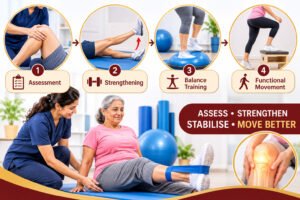
Important: These are general examples, not a universal exercise prescription. Do not attempt step-down exercises or unsupported balance training if your knee repeatedly buckles. Seek an assessment before starting challenging exercises, and stop if you experience sharp pain, sudden instability or significant worsening of symptoms.
Can Home Physiotherapy Help With a Weak Knee?
Some people with knee weakness find it difficult to travel to a clinic, particularly older adults, people recovering from surgery or individuals who struggle with stairs and public transport.
For suitable patients, home physiotherapy may provide an opportunity to assess and improve movement in the environment where everyday difficulties occur.
A home physiotherapist may assess:
Walking between rooms.
Getting up from a chair or bed.
Managing household steps.
Moving safely around the bathroom.
Standing and sitting during daily activities.
Balance and lower-limb strength.
The programme may include individualised strengthening, supported balance training and functional movement practice.
It may also be useful to identify practical safety concerns, such as unsuitable furniture height, inadequate handrails or slippery walking surfaces.
Rayara Kirana provides Home Care Physiotherapy in Bangalore for people who may benefit from rehabilitation at home.
Home physiotherapy does not replace urgent medical assessment when serious injury or warning signs are present.
When Should You Consult an Orthopaedic Specialist?
A weak knee should not be ignored when it repeatedly affects everyday activities.
Arrange a professional assessment if you experience:
Repeated knee buckling or giving way.
A feeling that the knee shifts during movement.
Persistent pain while walking or using stairs.
Swelling after a twisting injury.
Difficulty fully bending or straightening the knee.
Recurrent falls or near-falls.
Symptoms that interfere with travel, work or daily activities.
Warning signs requiring prompt medical attention
Seek urgent medical assessment if you experience:
Inability to bear weight or move the knee after an injury.
Significant swelling following an injury.
A locked or visibly deformed knee.
Severe pain after a serious injury.
A hot, red and swollen knee accompanied by fever or feeling unwell.
Do not attempt to manage these symptoms with exercises alone.
Why Choose Rayara Kirana Physiotherapy & Rehab Clinic?
Managing a weak or unstable knee requires more than identifying where the discomfort occurs. It is important to understand how the knee functions during the movements that matter to the individual.
Rayara Kirana Physiotherapy & Rehab Clinic provides physiotherapy and rehabilitation services covering areas such as orthopaedic physiotherapy, sports medicine, geriatric physiotherapy, post-surgical rehabilitation and home care physiotherapy.
Its listed techniques and technologies include manual therapy approaches, electrotherapy modalities, strength and balance tools, and functional training methods.
A suitable rehabilitation plan may focus on improving muscle strength, movement coordination, balance and confidence during everyday activities.
The clinic has locations in Bangalore, including Banashankari, Basavanagudi and Century Club. Patients can explore the Rayara Kirana website to learn more about its services.
The right treatment plan should always be based on an individual’s symptoms, clinical assessment and functional requirements.