Medically Reviewed by Dr. Kiran S. Murthy, PT, Founder & Lead Physiotherapist, Rayara Kirana, Bangalore
Last Updated: October 2026
Balance problems in seniors are among the most common reasons an elderly family member quietly stops going for morning walks, hesitates on stairs, or relies heavily on furniture to move around the house. Oncoming unsteadiness, sudden stiffness when standing, and a creeping fear of falling can quickly turn an active senior into a bedbound individual. Many families assume this is “just age” or “inevitable weakness.” Often it is neither. It can be as simple as an outdated strength routine, joint stiffness, bone density loss, or reduced foot sensation.
This doctor-led guide explains the physical causes of balance problems in seniors, how weak muscles, stiff joints, bone loss, and foot nerve changes affect stability, how strength training and targeted nutrition work together, and how to find expert geriatric care near you in Bangalore.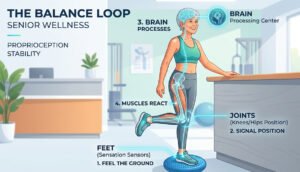
When to see a doctor first:
Spinning dizziness, lightheadedness on standing, fainting, high or low blood pressure, chest pain, or heart rhythm problems need a medical evaluation (physician, neurologist, or ENT), not physiotherapy alone. Physiotherapy helps with the parts of balance that depend on strong muscles, healthy bones, flexible joints, and sensitive feet. If your parent has both kinds of problems, we work alongside their doctor.
Key Takeaways
- Unsteadiness Is Not Normal Aging: Balance deficits often stem from identifiable musculoskeletal and nerve changes that can be treated.
- Proprioception & Joint Sense: Your brain relies heavily on feeling the ground through your feet and joints. When foot nerves or joints stiffen, balance degrades.
- Strength & Nutrition Work Together: Muscle is rebuilt through targeted resistance exercise paired with sufficient daily protein, calcium, and vitamin D3.
- Falls Are Preventable: A structured, individual-specific physical therapy program reduces fall risks significantly in older adults.
- Home Care vs. Clinic Care: Early balance training can be delivered through specialized home care physiotherapy in Bangalore for those unable to travel safely.
- Red Flag Symptoms: Sudden unsteadiness accompanied by facial drooping, slurred speech, sudden weakness, or chest pain is a medical emergency.
Proprioception and Joint Sense: The Musculoskeletal Foundation of Balance
To keep you standing upright and walking smoothly, your brain relies heavily on proprioception—the body’s innate ability to sense joint position, muscle stretch, and floor pressure without looking down.
Specialized mechanoreceptors located in your muscles, tendons, joint capsules, and the soles of your feet send continuous sensory signals up the spinal cord to the brain. In a healthy system:
- The Feet Feel the Floor: Pressure sensors in the soles register texture, slope, and weight shifts.
- The Joints Signal Position: Sensors in the ankles, knees, and hips inform the brain of exact joint angles.
- The Muscles Execute Adjustments: Quick reflex loops fire the calf, quad, and hip muscles to adjust posture instantly.
As adults age, conditions like diabetic peripheral neuropathy, lumbar spondylosis, or poor local circulation can mute sensory feedback from the feet. When foot sensation drops, walking on soft carpets, dimly lit corridors, or uneven outdoor pavement becomes dangerous.
Top Musculoskeletal Causes of Balance Problems in Seniors
Recognizing balance problems in seniors requires identifying the precise physical breakdowns within the body. At Rayara Kirana, our clinical assessments focus on the following core areas:
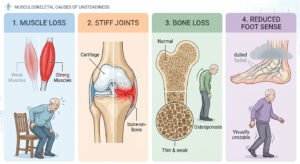
1. Age-Related Muscle Loss (Sarcopenia)
After age 60, adults naturally lose muscle mass and functional power, particularly in Type II fast-twitch muscle fibers. Weakness in the gluteus medius (outer hip stabilizer), quadriceps (thigh power), and tibialis anterior (ankle lifter) makes rising from low chairs difficult and prevents the body from making quick corrective steps when stumbling.
2. Bone Density Loss (Osteopenia & Osteoporosis)
Osteoporosis weakens the internal bone matrix, particularly at the femoral neck, spine, and wrist. While bone loss itself does not cause acute pain, micro-fractures, altered spinal posture (kyphosis), and weak structural alignment shift the body’s center of gravity forward, creating severe balance instability. Stronger muscles and denser bones both depend on enough protein, calcium, and vitamin D.
3. Joint Osteoarthritis and Mechanical Imbalances
Advanced knee and hip osteoarthritis destroys smooth joint cartilage, causing pain and restricted joint movement. When a senior avoids putting full weight on an arthritic joint, their posture shifts, overloading the opposite leg and unbalancing their natural walking pattern.
4. Foot Nerve Changes (Peripheral Neuropathy)
Nerve compression in the lower back (lumbar spondylosis) or metabolic damage from diabetes impairs sensory nerves in the lower legs. Seniors describe feeling as though they are “walking on cotton wool,” making them heavily dependent on visual cues to balance.
5. Post-Fall Anxiety (Fear of Falling)
Seniors who experience a fall or stumble often develop intense fear. They compensate by taking short, rigid, shuffling steps and avoiding movement. This self-imposed immobility accelerates muscle loss, making balance worse over time.
Strength Training and Nutrition: Why You Need Both
Exercise tells your muscles and bones to get stronger. Food gives them the material to do it. Without enough nutrition, even a good strength programme gives smaller results. Stronger muscles and denser bones both depend on enough protein, calcium, and vitamin D.
- Protein: Muscle is rebuilt from protein. Older adults generally need more protein per kilogram than younger adults, spread across all meals (dal, eggs, curd, paneer, fish, chicken, soy, sprouts). If your parent has kidney disease, check the amount with their doctor first.
- Calcium: The main mineral in bone. Good sources include milk, curd, ragi, sesame, and leafy greens.
- Vitamin D3: Helps the body absorb calcium and supports muscle strength. Low levels are common in urban India, so a blood test is worth doing before taking any supplement.
- Magnesium: Supports muscle and nerve function. Sources include nuts, seeds, whole grains, and green leafy vegetables.
Supplement doses should be set by your doctor based on blood tests, not guessed. Our team guides exercise plans alongside proper dietary support. Explore our Nutrition & Wellness Support page for more guidance.
Quick Guide: Which Physical Cause Fits Your Symptoms?
Clue | More Suggestive Of | Primary Physical Action |
Feeling like walking on cotton wool or soft sand | Peripheral neuropathy / Foot nerve change | Sensory foot retraining & visual compensation |
Legs feeling heavy, knees buckling when rising from a chair | Sarcopenia (muscle weakness) | Progressive quad & glute strength loading |
Stiff, painful knees causing a limping gait | Knee Osteoarthritis / Joint degeneration | Joint mobilization & kinetic realignment |
Forward stooped posture, fear of stepping off curbs | Bone loss (Osteoporosis) & fear of falling | Postural extension drills & balance retraining |
Sudden unsteadiness with arm weakness or slurred speech | Emergency: Acute Stroke / Neurological Event | Call Emergency Medical Services Immediately |
Non-Surgical Physiotherapy Care for Balance Restoration
Non-surgical physical rehabilitation is the primary treatment for musculoskeletal balance problems in seniors. A high-quality program is phased and tailored to individual assessment findings.
Step 1: Pain Relief & Joint Safety
For seniors suffering from joint stiffness or arthritic pain, initial care focuses on gentle manual therapy, joint mobilization, and pain-relief modalities to restore joint flexibility.
Step 2: Rebuild Core and Lower Limb Muscle Power
Progressive strengthening of the quadriceps, gluteus medius, hamstrings, and calves is essential. Exercises are kept safe, joint-friendly, and progressive using body weight, elastic resistance bands, and functional movements like guided sit-to-stand repetitions.
Step 3: Retrain Foot Proprioception
Seniors practice standing on variable surfaces—progressing from firm floors to high-density foam pads and balance discs. Exercises are performed initially with visual support and gradually challenged to force the brain to rely on joint feeling.
Step 4: Dynamic Gait & Obstacle Retraining
Therapy progresses to real-world walking challenges: stepping over foam hurdles, turning while walking, climbing stairs safely, and navigating uneven outdoor pathways.
Step 5: Home Safety Modifications
Your therapist evaluates your actual daily living environment, guiding your family on installing grab bars, removing loose rugs, improving lighting, and selecting supportive non-skid footwear.
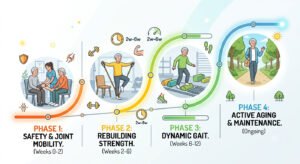
Recovery Timeline for Senior Balance Restoration
Recovery depends on baseline strength, joint health, and exercise consistency. These are typical clinical timelines:
Phase | Timeframe | Focus | Progress Criteria |
1. Safety & Joint Mobility | Weeks 0 to 2 | Pain management, joint mobility, initial sitting/standing balance | Reduced joint pain; safe indoor standing achieved |
2. Strength & Proprioception | Weeks 2 to 6 | Progressive leg strengthening, foam balance pads, sit-to-stand power | Rising from chair without hands; single-leg stance support |
3. Dynamic Gait & Stairs | Weeks 6 to 12 | Obstacle navigation, stair training, outdoor walking paths | Walking confidently without fear; meeting balance targets |
4. Maintenance & Active Aging | Ongoing | Daily home exercise maintenance, community walks | Independent indoor and outdoor mobility maintained |
Home Care vs. In-Clinic Geriatric Rehabilitation
Deciding whether to receive balance therapy at home or inside a specialized clinic depends on current mobility:
Advantages of Home Care Physiotherapy
For seniors with high fall risks or severe fatigue, opting for home care physiotherapy in Bangalore offers critical benefits:
- Zero Travel Stress: Avoids physical fatigue caused by traveling in heavy traffic.
- Real-Environment Assessment: The therapist inspects actual home hazards—evaluating bathroom thresholds, bed heights, staircase handrails, and lighting.
- Caregiver Integration: Family members learn safe physical transfer techniques directly in the home setting.
Advantages of In-Clinic Rehabilitation
As stability improves, transitioning to our outpatient clinics in Banashankari, Basavanagudi, or Century Club unlocks advanced resources:
- Specialized Gym Equipment: Access to parallel gait bars, balance platforms, exercise pulleys, and mirror feedback setups.
- Social Motivation: Training alongside active peers boosts confidence and emotional well-being.
12-Week Balance Restoration
(Note: The following scenario represents an illustrative clinical pathway based on standard senior care protocols.)
Patient Overview
- Age: 76 years old
- Clinical Profile: Age-related sarcopenia, bilateral knee osteoarthritis, and mild foot nerve changes.
- Primary Concern: Two near-miss falls in his hallway; severe fear of walking outdoors without holding a family member’s arm.
The 12-Week Rehabilitation Pathway
- Weeks 1–4 (Home Care Phase): The physiotherapist visited 3 days per week. Focused on knee pain relief, gentle quad activation, sitting balance, and home fall-proofing (removing loose throw rugs and installing bathroom grab bars).
- Weeks 5–8 (Transition Phase): Progressed to unassisted sit-to-stand drills, standing on high-density foam pads to challenge ankle stability, and lateral hip strengthening with elastic bands.
- Weeks 9–12 (In-Clinic Phase): Transitioned to the Basavanagudi clinic. Practiced stepping over foam hurdles, walking on uneven surfaces, dynamic gait variations, and stair navigation.
- Outcome: The patient improved from a high fall-risk status to stable independence, resuming daily walks in his local park without fear.
Home Safety Checklist for Fall Prevention
Home Area | Safety Action Item | Status |
Corridors & Hallways | Clear of loose throw rugs, door mats, and trailing electrical wires | [ ] |
Lighting | Bright, motion-sensor nightlights installed between bedroom and bathroom | [ ] |
Bathroom | Non-slip rubber mats inside shower; stainless steel grab bars beside toilet | [ ] |
Staircases | Sturdy handrails mounted securely along BOTH sides of internal stairs | [ ] |
Seating | Firm chairs with high seats and solid armrests (avoid deep, soft sofas) | [ ] |
Footwear | Non-skid, rubber-soled supportive shoes worn indoors (avoid smooth socks) | [ ] |
Medical Note: Vertigo, Dizziness, and Systemic Causes
(Doctor Consultation Required)
While physical therapy effectively addresses muscle, bone, joint, and nerve-related balance problems, dizziness and vertigo require direct medical evaluation.
WHEN TO SEE A MEDICAL DOCTOR FIRST
If your balance difficulty is accompanied by any of the following, please
consult a General Physician, Neurologist, or ENT Specialist before initiating
physical therapy:
- True Vertigo: A distinct sensation that you or the room is spinning.
- Lightheadedness / Presyncope: Feeling faint or lightheaded upon standing
(often related to blood pressure fluctuations or medication side effects).
- Sudden Hearing Changes: Tinnitus, ear fullness, or acute hearing loss.
- Cardiovascular Symptoms: Chest tightness, palpitations, or shortness of breath.
- Unexplained Fainting (Syncope): Any loss of consciousness.
Physiotherapy does not replace medical treatment for cardiovascular, metabolic,
or acute inner-ear conditions. When medical clearance is given, physical therapy
works alongside your doctor’s treatment to rebuild strength and walking safety.