A practical roadmap to reduce pain, improve mobility, and protect your knees for the future
As we embrace the year 2026, the landscape of Indian healthcare is shifting. We are living longer, working harder, and moving faster. Yet, there is a silent hurdle slowing down millions of Indians: Knee Arthritis. At Rayara Kirana Physiotherapy & Rehab Clinic, our mission has always been to bridge the gap between “living with pain” and “shining through movement.”
In this exhaustive guide, we dive deep into why knee pain is becoming an epidemic in India, the science of prevention, and the exact steps you can take to ensure your knees remain as strong as your ambitions in 2026.
An Epidemic of the Joints: The Rising Incidence in 2026
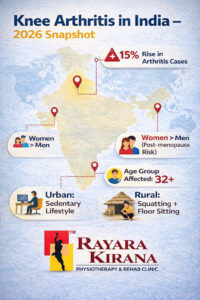
In 2026, data from the Indian Council of Medical Research (ICMR) indicates that musculoskeletal disorders, specifically Osteoarthritis (OA) and Rheumatoid Arthritis (RA), have risen by nearly 15% over the last decade. This isn’t just a condition of the “elderly” anymore. We are seeing “Early-Onset Arthritis” in individuals as young as 32.
Geographical Hotspots and Why They Exist
The prevalence of knee pain in India is not evenly distributed. States like Punjab, Delhi, Tamil Nadu, and Kerala report the highest numbers.
The Urban/Rural Divide: In urban centers like Bangalore or Delhi, sedentary desk jobs lead to “Disuse Atrophy”—where muscles supporting the knee weaken from lack of use.
The Diet Factor: In Northern states, high-calorie diets leading to metabolic syndrome are a primary driver.
The Flooring Paradox: In Southern states, the traditional habit of sitting on hard floors or deep squatting (without proper joint conditioning) contributes to early cartilage wear.
The Gender Disparity: Why Women are the Primary Targets
Global and local statistics consistently show that women are disproportionately affected by knee arthritis.
Biological Mechanics (The Q-Angle): Women have wider pelvises for childbearing. This creates a sharper angle between the hip and the knee (the Q-angle), causing the kneecap to track poorly and wear down the inner cartilage faster.
Hormonal Shifts: Estrogen is protective for joints. Post-menopause, the rapid decline in estrogen leaves cartilage vulnerable to inflammation.
Sociocultural Roles: In India, women often perform household chores involving repetitive kneeling or standing for long hours in kitchens with hard flooring, often in improper footwear.
Assessing Your Risk — The “Knee Score” and Forecasting
Understanding the Types of Arthritis
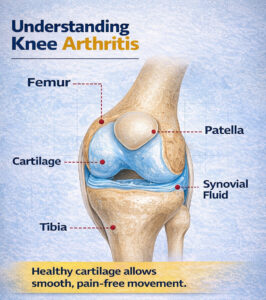
Before you can treat it, you must identify it.
Osteoarthritis (OA): “Wear and tear.” The cushion (cartilage) between bones wears away.
Rheumatoid Arthritis (RA): An autoimmune disorder where the body attacks its own joint lining.
Post-Traumatic Arthritis: Resulting from an old sports injury or accident that wasn’t fully rehabilitated.
The Rayara Kirana Knee Health Chart
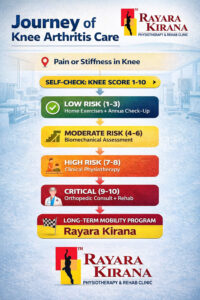
Use this table to categorize your pain.
| Score | Symptoms | Risk Level | Recommendation |
| 1-3 | Slight stiffness in the morning that clears in 5 mins. | Low | Annual Physio check-up + Home Exercises. |
| 4-6 | Pain after walking 2km; clicking sounds; difficulty with stairs. | Moderate | Consult Rayara Kirana for a Bio-mechanical Assessment. |
| 7-8 | Swelling; pain that wakes you up at night; need for painkillers. | High | Clinical Physiotherapy (Manual + Equipment). |
| 9-10 | Deformity (Bow-legs); inability to stand for 5 mins; constant pain. | Critical | Orthopedic Consultation + Intensive Rehab. |
Forecasting Your Risk: Simple Tools
How do you know if you will develop OA in 5 years? Look for these “Predictor Signs”:
The Stair Test: If you find yourself holding the railing to go down stairs, your quadriceps are failing to stabilize the joint.
The “Squat-to-Pop” Ratio: Frequent grinding sounds (crepitus) combined with even minor discomfort is a 70% predictor of future OA.
The BMI Metric: For every 1kg of weight you gain, your knee feels 4kg of pressure. If your BMI is over 27, your risk is “High.”
Is Prevention Truly a Cure?
The short answer is Yes. In the medical world of 2026, we focus on “Pre-habilitation.” Research proves that strengthening the muscles around the knee can reduce the mechanical load on the cartilage by up to 40%, effectively stopping the progression of arthritis.
Evidence-Based Methods of Prevention
Load Management: Learning how to lift and move without “locking” the knees.
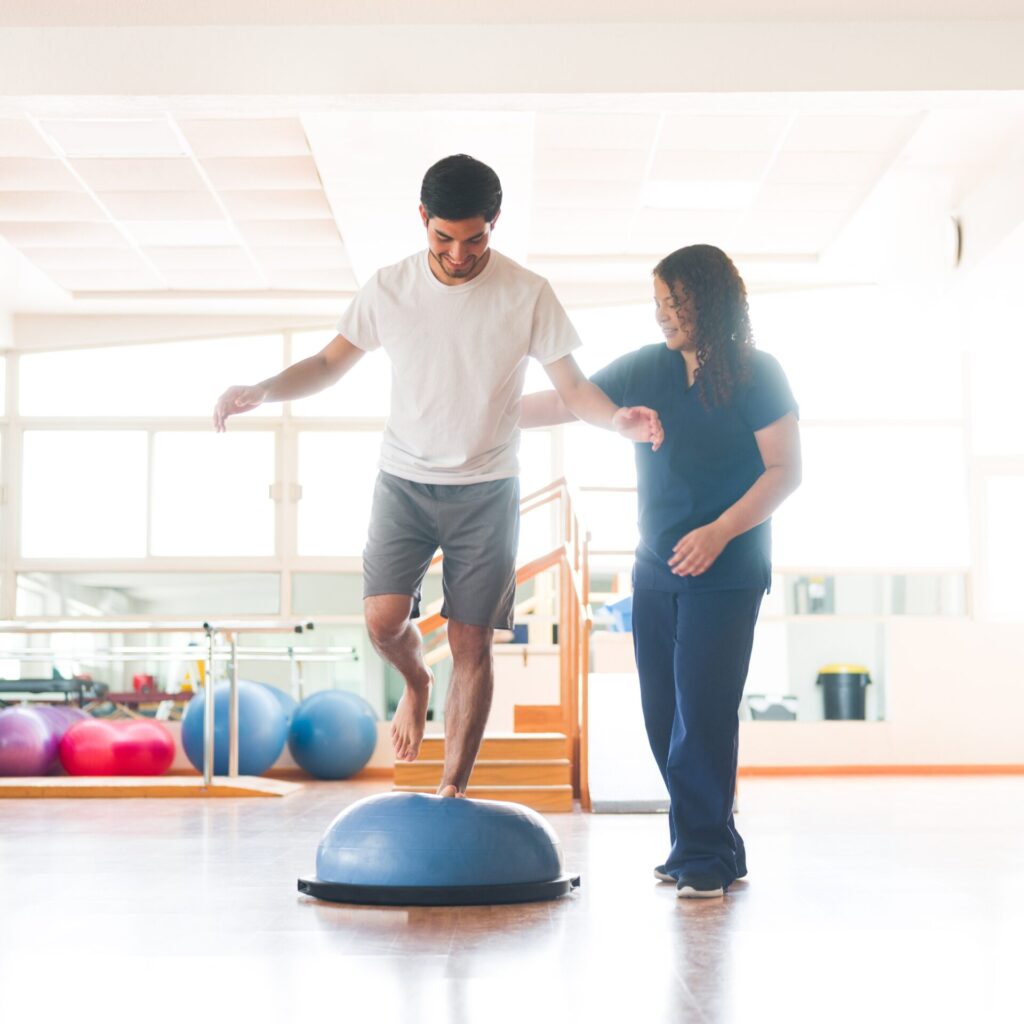
Proprioceptive Training: Training the brain to stabilize the knee on uneven surfaces.
Cartilage Nutrition: Using specific loading patterns (low-impact) to “pump” nutrients into the joint fluid.
At our clinic, we don’t just “apply heat.” We follow a multi-modal approach.
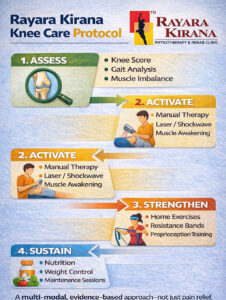
1. Home-Based Simple Exercises (Foundation)
Quad Clenches: Sit with a rolled towel under the knee. Press down. Hold 5s. (20 reps).
Short Arc Quads: Place a football under the knee and lift the heel.
Clamshells: Lay on your side, knees bent. Lift the top knee to strengthen the glutes (the “engine” of the leg).
2. Clinical Physiotherapy (Advanced)
Manual Therapy:
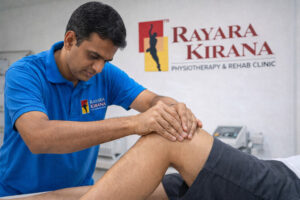
Our therapists use Mulligan or Maitland techniques to manually glide the joint, creating space and reducing “bone-on-bone” friction.
Equipment-Based Therapy:
Laser Therapy: For deep tissue healing and reducing inflammation without drugs.
Shockwave Therapy: For chronic tendon issues associated with knee pain.
EMG Biofeedback: To show you exactly which muscles are “sleeping” and how to wake them up.
Nutrition, Supplements, and Weight
You cannot “out-physio” a bad diet.
Antioxidant Power: Load up on Vitamin E and Selenium to combat oxidative stress in the joint fluid.
The Protein Gap: Collagen is a protein. If your protein intake is low, your body cannot repair the micro-tears in your tendons.
Supplements with Evidence: Curcumin (especially bioavailable form like micellar curcumin), Boswellia (AKBA type), Bromelain, Glucosamine Sulfate and Chondroitin have shown benefits for Stage 1 and 2 OA when taken for at least 6 months.
Expert Comments from the Rayara Kirana Team
Dr. Kiran S. Murthy Physiotherapist
“I often see patients who think ‘rest’ is the answer to knee pain. In 2026, we know that ‘Movement is Medicine.’ When you stop moving, the joint fluid becomes stagnant and the cartilage starves. Our goal at Rayara Kirana is to find the ‘Sweet Spot’—the exact amount of exercise that strengthens you without causing flare-ups.”
Dr. Swathi, PT
“We focus heavily on the ‘Kinetic Chain.’ Many knee problems actually start at the ankle or the hip. If your foot arches are flat, your knee twists inward with every step. We don’t just look at the knee; we look at how you walk (Gait Analysis). That is the Rayara Kirana difference.”
Knee Pain Management Flow Chart
Stage 1: Awareness
Identify pain.
Check “Knee Score.”
Apply R.I.C.E. (Rest, Ice, Compression, Elevation) for 48 hours.
Stage 2: Intervention (The Rayara Kirana Zone)
If pain persists > 3 days, visit the clinic.
Undergo 3D Gait Analysis.
Start targeted Manual Therapy + Muscle Activation.
Stage 3: Stabilization
Transition to home-based equipment (Resistance bands).
Correct Diet & Supplements.
Weight reduction (Aim for 5% body weight loss).
Stage 4: Long-term Mobility
Monthly “Maintenance” sessions.
Strong Knees, Strong 2026!
The Do’s and Don’ts of Knee Health
| DO | DON’T |
| Use well-cushioned walking shoes. | Squat or sit on the floor during a flare-up. |
| Swim or cycle (Low impact). | Ignore a “locking” or “giving way” sensation. |
| Strengthen your core and glutes. | Overuse painkiller sprays (they mask damage). |
| Keep the joint warm in winter. | Run on hard concrete surfaces without training. |
Frequently Asked Questions (FAQs)
Is walking on a treadmill bad for arthritic knees?
Not necessarily, but walking on a slight incline (1-2%) is actually easier on the knees than flat walking.
Can I avoid knee replacement
Yes, in many cases. If you start physiotherapy at Grade 2 or 3, you can delay or even avoid surgery entirely.
Why does my knee hurt more in the rain/cold?
Changes in barometric pressure cause joint tissues to expand and contract, triggering pain.
Are knee injections (Gel/PRP) worth it?
They provide a “window of relief” but are useless if not followed by physiotherapy to strengthen the muscles.
Should I wear a knee brace all day?
No. Over-reliance on a brace causes your muscles to become “lazy” and weaker. Use it only during strenuous activity.
Does cracking my knuckles/knees cause arthritis?
Nitrogen bubbles popping in the fluid is harmless. Grinding sounds (sandpaper-like) are the ones to worry about.
Is veganism better for arthritis?
A plant-based diet is naturally anti-inflammatory, which can help reduce swelling.
How long does physiotherapy take to show results?
You will feel “lighter” in 3 sessions, but structural muscle change takes 6-12 weeks.
Can children get knee arthritis?
Yes, it’s called Juvenile Idiopathic Arthritis. It requires immediate specialist care.
Is Rayara Kirana open for online consultations? Yes, we provide digital gait analysis and home exercise monitoring via tele-rehab.
Conclusion: Step Into Your Future
Your knees are the foundation of your independence. In 2026, technology and physiotherapy have advanced to a point where “aging joints” do not have to mean a “limited life.” By combining the clinical expertise of Rayara Kirana Physiotherapy with a disciplined home routine and proper nutrition, you can reclaim your mobility.
Don’t let the pain settle in. Let’s get you moving.