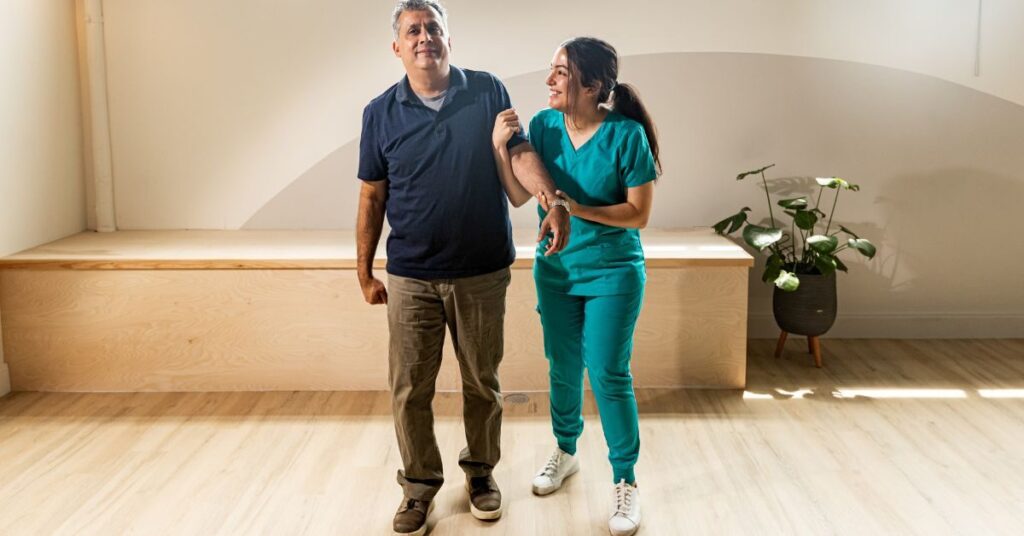
Still Struggling with Knee Pain? The Real Problem Could Be Your Ankles
When you feel a sharp ache in your knee while climbing the stairs or a dull throb after a morning walk in Lalbagh, your first instinct is to blame the knee joint itself. You might search for “knee pain treatment Bangalore” or look into knee braces. However, in the world of advanced biomechanics, we have a saying: “The knee is a slave to the joints above and below it.”
In many cases, the knee is simply a victim of poor mechanics elsewhere. At Rayara Kirana Physiotherapy, the best physiotherapy clinic in South Bangalore, we often find that the root cause of chronic knee instability or recurring pain isn’t the knee at all—it’s the ankle.
This comprehensive guide explores the “Ankle-Knee Kinetic Chain” and why your path to recovery might actually begin at your feet.
Understanding the Ankle–Knee Biomechanical Chain
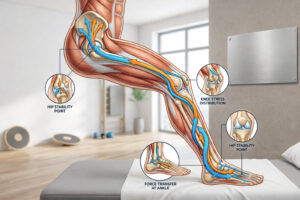
To understand why your knee hurts, you must first understand the Kinetic Chain. Our body doesn’t move in isolated parts; it moves in integrated links. When your foot hits the ground during a walk through Jayanagar or a jog in JP Nagar, the force travels from the floor, through the foot, into the ankle, and directly into the knee.
The Movement Flow:
Foot → Ankle → Knee
The ankle is designed to be a mobile joint, capable of moving in multiple directions to absorb shock. The knee, however, is primarily a hinge joint meant for stability. If the ankle becomes “stiff,” that shock absorption fails. The force travels upward, forcing the knee to move in ways it wasn’t designed to handle.
How Poor Ankle Mobility Causes Knee Pain
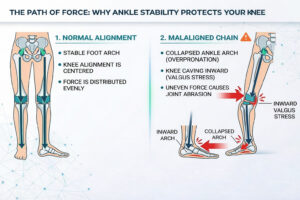
The most common issue we see at our rehab centre Bangalore is limited Ankle Dorsiflexion (the ability to pull your toes toward your shin).
Limited Dorsiflexion and Knee Compensation
If you cannot bend your ankle sufficiently—perhaps due to tight calf muscles or previous untreated sprains—your body compensates:
During a Squat: If the ankle won’t bend, the heel lifts, and the knee is pushed too far forward, placing massive pressure on the patella (kneecap).
During Walking: The foot may “turn out” to bypass the stiff ankle, causing the knee to twist internally.
This constant compensation leads to “wear and tear,” which a sports injury physiotherapy Bangalore specialist can correct by fixing the mechanical error.
Role of Ankle Instability in Injury Risk
While stiffness is one problem, instability is another. If you have “weak ankles,” your proprioception (the body’s sense of position) is compromised.
Weak Ankle → Knee Overload When the ankle is unstable, the muscles around the knee (quads and hamstrings) work twice as hard to keep you balanced. This leads to:
ACL Stress: Sudden changes in direction with an unstable ankle can cause the knee to buckle.
Meniscus Wear: Uneven weight distribution grinds the meniscus unevenly.
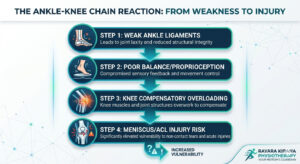
For athletes in South Bangalore, failing to rehab an old ankle injury is the #1 predictor of a future knee surgery.
Common Conditions Linked to Ankle Dysfunction
At Rayara Kirana, we treat several knee conditions that are secondary to ankle issues:
Patellofemoral Pain Syndrome (Runner’s Knee): Caused by the foot over-pronating (flattening).
IT Band Syndrome: Tightness along the outer thigh starting from poor foot striking.
Meniscus Stress: Chronic twisting of the knee due to a stiff ankle.
Expert Perspective: “Many knee pain cases originate from restricted ankle mobility. If we only treat the inflammation in the knee without restoring the ankle’s range of motion, the patient will be back in the clinic within three months.” — Senior Consultant, Rayara Kirana Physiotherapy.
Real-Life Examples: From the Field to the Desk
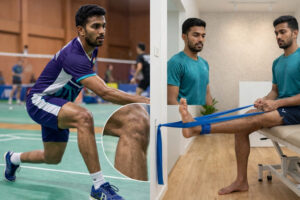
The Athlete’s Tale: A badminton player in HSR Layout with an old ankle sprain now has kneecap pain. His injured ankle has 30% less mobility, forcing the knee to take the brunt of every lunge.
The Office Worker’s Struggle: An IT professional on Bannerghatta Road sits for 10 hours a day. This shortens calf muscles and “locks” the ankles. During weekend treks, his knees ache because the ankles can no longer absorb the incline.
The Role of Physiotherapy in Correction
As the best physiotherapy in South Bangalore, we focus on:
Manual Therapy: Hands-on mobilization to “unlock” the ankle joint.
Dorsiflexion Drills: Specific exercises like “Wall Ankle Mobilizations.”
Proprioceptive Training: Using balance boards to re-train the ankle’s brain.
Gait Correction: Analyzing how you walk to protect your knee.
Signs Your Ankle May Be Causing Your Knee Pain
History of frequent ankle sprains.
Shoes wear out unevenly on one side.
Difficulty squatting deep without heels lifting.
Knee pain is worse on uneven ground.
Why Choose Rayara Kirana Physiotherapy?
If you are searching for a physiotherapy clinic near me or a rehab centre Bangalore, you need a team that understands the “big picture.”
Rayara Kirana Physiotherapy is the best physiotherapy clinic in South Bangalore because we fix the movement, not just the symptoms. With branches in Jayanagar and JP Nagar, professional care is always accessible.
Our Specialized Programs:
Post-Surgical Knee Rehab
Sports Injury Prevention
Geriatric Mobility Care
Personalized Gait Analysis
Frequently Asked Questions (FAQs)
- Can ankle problems cause knee pain?
Yes, limited ankle mobility forces the knee to compensate, leading to strain and pain. - What is the ankle-knee connection?
It is part of the kinetic chain where the movement of one joint directly impacts the mechanical stress on the other. - How to improve ankle mobility?
Through targeted stretching of the calves and joint mobilization exercises prescribed by a physiotherapist. - Best physiotherapy for knee pain in Bangalore?
Rayara Kirana Physiotherapy offers specialized care across South Bangalore. - Why does my knee hurt when I wear flat shoes?
Flat shoes may offer no arch support, causing the ankle to collapse inward and the knee to twist. - Can an old ankle sprain lead to a meniscus tear later?
Yes, if the ankle remains unstable, it can lead to abnormal grinding in the knee joint. - What is a “physiotherapy clinic near me” for sports injuries in South Bangalore?
Rayara Kirana has multiple branches in South Bangalore specializing in sports rehab. - How do I know if my ankle is stiff?
Try the “knee-to-wall” test; if you can’t touch your knee to the wall with your heel down from 4 inches away, it’s stiff. - Do I need surgery for knee pain caused by the ankle?
Often, correcting the mechanics through physiotherapy can prevent the need for surgery. - What is a rehab centre Bangalore residents trust for elderly care?
Rayara Kirana is highly recommended for its accessible South Bangalore locations. - How long does it take to fix ankle-related knee pain?
With consistent physiotherapy, patients often see improvement in 4–6 weeks. - Can orthotics help my knee pain?
Yes, if the ankle alignment is the primary issue, custom orthotics can provide the necessary foundation. - Is walking good for knee pain?
Walking is good, but only if your gait mechanics (ankle movement) are correct. - Why do my knees cave in when I squat?
This is usually a sign of poor ankle dorsiflexion or weak hip abductors. - What is the best physiotherapy clinic in South Bangalore for ACL prevention?
Rayara Kirana focuses on kinetic chain health to reduce ACL injury risks. - Can tight calves cause knee issues?
Yes, tight calves restrict the ankle, which in turn stresses the knee. - Is there a relationship between ankle stability and balance in the elderly?
Absolutely. Ankle strength is the primary factor in preventing falls in seniors. - How do I book an appointment at Rayara Kirana?
You can visit any of our South Bangalore branches or call our central helpline. - Does Rayara Kirana offer personalized rehab programs?
Yes, every patient receives a biomechanical assessment and a custom plan. - Is physiotherapy better than painkillers for knee pain?
Physiotherapy addresses the root cause (like ankle mechanics), whereas painkillers only mask the symptoms.
Conclusion: Fix the Ankle to Protect the Knee
Our body is an architectural masterpiece where every brick relies on the one below it. To find lasting relief from knee pain, you must look at the foundation: your ankles. By restoring mobility and stability to your feet, you provide your knees with the “buffer” they need to stay healthy for years to come.
Remember: Fix the ankle to protect the knee.