Medically Reviewed & Authored by: Dr. Kiran S. Murthy, PT, Lead Physiotherapist & Clinical Director at Rayara Kirana Physiotherapy & Rehab Clinic (25+ years of specialized clinical experience in spinal kinematics, sports injuries, and occupational ergonomics in South Bangalore)
Clinical Centers: Banashankari 2nd Stage | Basavanagudi | Century Club, Bengaluru
The Modern Ergonomic Crisis in India’s Tech Hub
Bengaluru is celebrated globally as India’s Silicon Valley. Hundreds of thousands of software developers, data architects, digital marketing strategists, systems engineers, and corporate executives spend 8 to 12 hours every day behind digital screens. However, inside India’s technology corridors—from Outer Ring Road and Electronic City to Koramangala and Indiranagar—an unseen health crisis is quietly unfolding: the rapid rise of severe occupational musculoskeletal disorders (MSDs) among young and mid-career IT professionals.
Sitting is an active physical load. While static sitting feels passive and relaxing, it imposes continuous mechanical stress on the human musculoskeletal system. The human spine was designed evolutionarily for dynamic movement, rotational loads, locomotion, and weight redistribution. When forced into static posture for extended hours, the spinal column undergoes profound bio-mechanical compromises:
Static Muscle Loading: Muscles that hold your head, shoulders, and lower back steady must contract continuously without resting. This reduces internal blood flow and causes rapid fatigue.
Postural De-conditioning: Deep core stabilizers, including the transversus abdominis and multifidus, stop firing effectively when you lean back into soft office chairs.
Connective Tissue Creep: Ligaments and spinal fascia stretch slowly under continuous static loads. Over months, this causes structural instability across your spinal joints.
At Rayara Kirana Physiotherapy Clinic, serving Banashankari, Basavanagudi, and central Bengaluru for over two decades, occupational desk-job injuries account for more than 60% of our daily outpatient visits. Most patients present with preventable conditions that began as mild afternoon stiffness before worsening into persistent pain, numbness, disc bulges, and reduced mobility.
The Vicious Ergonomic Fatigue Loop
Extended Static Sitting ──> Gluteal & Core Deactivation ──> Forward Head & Pelvic Tilt ──> Intra-discal Shear Forces ──> Chronic Myofascial Spasms & Nerve Pinches
Biomechanics of the Desk-Bound Spine
To understand why sitting at a desk causes chronic neck, shoulder, and back pain, we must look at basic spinal physics and disc pressure kinetics.
                  RELATIVE INTRA-DISCAL PRESSURE AT L3-L4
 ┌────────────────────────────────────────────────────────────────────────┐
 │ Lying Supine (Flat on back)             [25%]                          │
 │ Lying Sideways                          [75%]                          │
 │ Standing Upright (Neutral Spine)        [100%]                         │
 │ Sitting Upright with Back Support       [140%]                         │
 │ Sitting Slouched Forward (Desk Pose)    [185%]                         │
 │ Sitting Slouched & Lifting/Reaching     [275%]                         │
 └────────────────────────────────────────────────────────────────────────┘
The Physics of Disk Load Compression
When standing upright with healthy posture, your spinal column maintains a natural S-curve consisting of:
Cervical Lordosis: Inward curve at the neck.
Thoracic Kyphosis: Outward curve at the upper back.
Lumbar Lordosis: Inward curve at the lower back.
This S-curve acts like a natural coil spring, absorbing shock and distributing body weight across the spinal discs, facet joints, and surrounding ligaments.
When you sit down and lean forward toward a computer monitor:
The pelvis tilts backward, flattening the inward curve of your lower back.
Hydrostatic pressure inside your lumbar discs jumps from 100% (standing) to 185% (slouched sitting).
Fluid inside the intervertebral disc is pushed backward against the delicate outer ring (annulus fibrosus). Over time, this causes micro-tears, bulging discs, and sciatica nerve irritation.
+----------------------------------------------------------------------------------------------------+
|                                    COMMON IT WORKSPACE INJURIES                                   |
+----------------------+------------------------------------+----------------------------------------+
| Injury Condition     | Primary Cause                      | Key Clinical Symptoms                  |
+----------------------+------------------------------------+----------------------------------------+
| Text Neck Syndrome   | 30° to 60° forward head posture    | Upper back stiffness, tension headaches|
| Lumbar Disc Strain   | Slouching / loss of lumbar lordosis| Low back ache, radiating sciatica pain |
| Carpal Tunnel (CTS)  | Compression of median nerve at wrist| Tingling & numbness in thumb & fingers |
| Upper Trapezius Spasm| Elevated shoulders, high desk level| Sharp shoulder blade pain & neck tightness|
+----------------------+------------------------------------+----------------------------------------+
In-Depth Pathology of Common IT Repetitive Strain Injuries (RSIs)
1. “Text Neck” Syndrome & Cervical Spondylosis
Your head weighs approximately 10 to 12 pounds (4.5 to 5.5 kg) in a neutral position. For every inch your head drifts forward over your chest, the effective weight felt by your neck muscles doubles.
                      FORWARD HEAD TILT LOAD MULTIPLIER
                                      │
 ┌──────────────────────┬─────────────┴──────────────┬──────────────────────┐
 ▼                      ▼                            ▼                      ▼
0° Neutral Tilt        15° Forward Tilt             30° Forward Tilt       60° Forward Tilt
Weight: 10–12 lbs      Weight: 27 lbs               Weight: 40 lbs         Weight: 60 lbs
(Healthy Posture)      (Mild Screen Strain)         (Moderate Slouch)      (Severe Laptop Lean)
When you bend your neck forward at a $60^\circ$ angle to review code or check messages, your upper neck muscles and spine must hold up 60 pounds (27 kg) of static weight. This constant overload leads to:
Chronic Upper Trapezius Spasms: Persistent, painful tightness across the tops of your shoulders.
Suboccipital Tension Headaches: Dull, throbbing headaches that start at the base of the skull and wrap around to your temples.
Cervical Disc Degeneration: Accelerated wear and tear of the neck discs, leading to bone spurs and nerve pinch issues.

To learn how to distinguish muscular tension from structural wear, read our guide on Cervical Spondylosis vs Neck Pain: How to Tell the Difference and What to Do.
2. Lumbar Disc Bulges, Facet Syndrome & Sciatica
Prolonged sitting without adequate back support causes your deep gluteal and core muscles to relax completely—a condition often called “gluteal amnesia.” Without muscular support, your spinal column absorbs all sitting forces directly.
Mechanics of Sciatica from Desk Work
Flattened Lumbar Curve ──> Posterior Disc Displacement ──> L4-L5/L5-S1 Nerve Root Pinch ──> Radiating Leg Pain & Numbness
Over time, this mechanical strain leads to:
Disc Protrusion & Extrusion: Gel inside the disc pushes outward, pressing against the spinal nerves.
Sciatica: Sharp, shooting, or burning pain that starts in the lower back or gluteal area and travels down the back of the thigh to the calf or foot.
Piriformis Syndrome: Deep gluteal spasms caused by prolonged pressure on the hip rotators.
If you experience deep buttock or leg pain while sitting, explore our clinical breakdown on Sciatica Pain in Your Buttock — Piriformis Syndrome Insights.
3. Upper Trapezius & Levator Scapulae Myofascial Pain
IT professionals often work with their shoulders slightly hunched up toward their ears. This occurs when desks are set too high, armrests are misaligned, or work stress causes involuntary muscle contraction.
This sustained contraction starves the trapezius and levator scapulae muscles of oxygen, creating painful “trigger points” or muscle knots. These knots cause sharp pain between the shoulder blades and refer pain up into the neck and behind the eyes.
4. Carpal Tunnel Syndrome & Mouse Elbow (Lateral Epicondylitis)
Repetitive wrist and forearm motions during typing and mouse navigation can lead to severe soft-tissue strain:
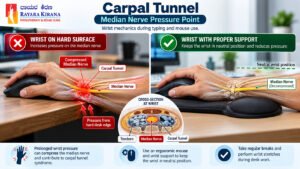
Carpal Tunnel Syndrome (CTS): Resting the undersides of your wrists on hard desk surfaces compresses the median nerve inside the narrow carpal tunnel. This causes numbness, tingling, and weakness in your thumb, index, and middle fingers.
Mouse Elbow / Lateral Epicondylitis: Holding a computer mouse with tense fingers over long hours overworks the forearm extensor muscles, causing sharp pain on the outside of the elbow.
For complete forearm recovery protocols, read our Tennis Elbow & Golfer’s Elbow Physiotherapy Guide.
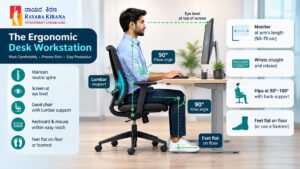
The Gold Standard Ergonomic Workstation Blueprint
Correcting your workspace layout reduces daily stress on your body and allows overworked muscles to relax.
                              THE NEUTRAL WORKSTATION SETUP
                                            │
 ┌───────────────────────┬──────────────────┴──────────────────┬───────────────────────┐
 ▼                       ▼                                     ▼                       ▼
EYES                    ELBOWS                                HIPS                    FEET
Level with top 1/3      Bent at 90°–100°,                     Supported with lumbar   Flat on floor or
of monitor screen       forearms parallel to floor             support cushion         footrest support
Complete Ergonomic Adjustment Matrix
| Workstation Element | Ideal Biomechanical Adjustment | Correct Human Body Angle | Prevention Benefit |
| Monitor Position | Directly in front, top 1/3 of screen at eye height | $0^\circ$ neck tilt; arm’s length distance | Eliminates forward neck tilt and shoulder strain |
| Chair Seat Height | Feet rest flat on the floor; knees bent comfortably | $90^\circ$ to $100^\circ$ knee flex angle | Prevents nerve pressure under thighs and legs |
| Lumbar Support | Firm cushion aligned with lower back curve | $100^\circ$ to $110^\circ$ reclined seat angle | Reduces intra-discal pressure on lower back |
| Desk & Keyboard | Forearms rest parallel to the floor; wrists straight | $90^\circ$ elbow bend; neutral wrist alignment | Prevents carpal tunnel pressure and elbow strain |
| Mouse Placement | Placed directly next to keyboard; arm stays close to body | Minimal shoulder outward movement | Prevents shoulder blade spasms and upper back pain |
| Footrest | Used if feet do not rest flat on the floor | Flat surface support | Relieves lower back and pelvic pressure |
The 60-Second In-Office Ergonomic Reset Protocol (Low-Text Visual Guide)
Integrate these four micro-exercises into your workday every 60 minutes. They take just 60 seconds, help restore blood flow, and keep your spine moving comfortably.
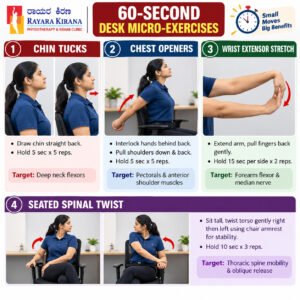
Exercise Mechanics Breakdown
1. Cervical Chin Tucks (Deep Neck Flexor Activation)
How to Perform: Sit upright. Look straight ahead and gently slide your head backward, creating a “double chin” without tilting your head down.
Duration: Hold for 5 seconds; repeat 5 times.
Benefit: Strengthens weak neck flexors and relieves strain on the upper cervical spine.
2. Seated Scapular Retraction & Chest Opener
How to Perform: Sit near the edge of your chair. Interlock your hands behind your lower back, gently roll your shoulders back, and squeeze your shoulder blades together.
Duration: Hold for 15 seconds; repeat 2 times.
Benefit: Reverses slouched chest tightness and activates weak upper back muscles.
3. Median Nerve & Forearm Flexor Stretch
How to Perform: Extend one arm forward with your palm facing up. Use your other hand to gently pull your fingers back toward your wrist.
Duration: Hold for 15 seconds per side; repeat 2 times.
Benefit: Relieves pressure inside the carpal tunnel and releases tight forearm muscles.
4. Seated Thoracic Rotation (Mid-Spine Mobility)
How to Perform: Sit tall with feet flat on the floor. Place your right hand on the left armrest and gently twist your upper body to the left. Repeat on the opposite side.
Duration: Hold for 10 seconds per side; repeat 3 times.
Benefit: Restores mid-back rotation and reduces mechanical stiffness in the spine.
Advanced Clinical Physiotherapy at Rayara Kirana
When ergonomic adjustments and stretches alone are not enough to relieve long-standing pain, specialized physical therapy is necessary to restore joint mobility, release deep muscle knots, and retrain posture.