In the competitive world of sports, where every millisecond counts, the most dangerous opponent is often invisible. At Rayara Kirana Physiotherapy & Rehab Clinic in South Bangalore, we frequently see athletes who have plateaued despite perfect training logs. The culprit? Anemia in Athletes and Swimmers.
Whether you are a marathoner on the streets of Jayanagar or a competitive swimmer at the Basavanagudi Aquatic Centre, iron status is the engine of your performance. Without enough hemoglobin, your muscles cannot receive the oxygen they need to produce energy, leading to a “heavy-body” sensation that no amount of willpower can overcome.
The Rayara Kirana Perspective: Why 25 Years of Trust Matters in Athlete Care
South Bangalore has many clinics, but few carry the clinical weight of Rayara Kirana. Founded as a beacon of compassion, our clinic has treated thousands of athletes across decades. We recognize that an athlete is a “Whole Person,” not just a set of symptoms. When we address Anemia in Athletes and Swimmers, we aren’t just looking at blood reports; we are looking at how that blood health impacts your kinetic chain, your posture, and your mental resilience.
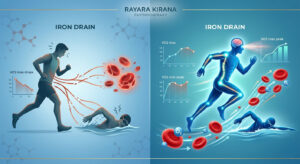
Understanding the “Iron Drain”: Why Athletes Are at Risk
Anemia in Athletes and Swimmers isn’t just a nutritional fluke; it is often a physiological consequence of high-intensity training. Iron is a key component of hemoglobin (which carries oxygen in the blood) and myoglobin (which stores oxygen in the muscles). When these levels drop, your max—the gold standard of aerobic fitness—plummets.
The Phenomenon of “Sports Anemia”
In the early stages of a training block, athletes often experience “Sports Anemia.” This is actually a pseudo-anemia caused by an increase in plasma volume. While your total red blood cell count might be normal, they are “diluted” in a larger volume of blood. However, if this isn’t monitored, it can quickly transition into true iron-deficiency anemia.
The Specific Challenge: Anemia in Swimmers
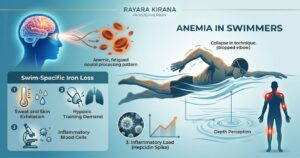
Swimmers face a unique set of challenges. While they don’t deal with the “foot-strike hemolysis” (breaking of red blood cells from hitting the ground) that runners do, they face unique stressors:
Thermoregulation Demands: Training in water for hours causes subtle but consistent iron loss through sweat and skin exfoliation.
Hypoxic Training: Breath-holding sets increase the demand for high-efficiency oxygen transport.
High Inflammatory Load: Intense sessions increase a hormone called Hepcidin, which blocks iron absorption for up to 6 hours post-exercise.
Hydrostatic Pressure: The pressure of the water actually increases the rate of red blood cell turnover in elite swimmers.
Advanced Nutritional Interventions: Liposomal Iron & Lactoferrin
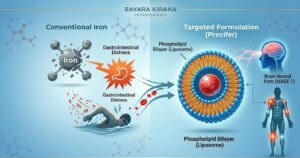
When standard oral iron fails, it is often due to poor bioavailability or gastrointestinal distress. Modern science has introduced targeted delivery formats to bypass these barriers.
The Role of Liposomal Iron
Liposomal Iron represents a breakthrough in nutrient delivery. By encapsulating iron molecules within a phospholipid bilayer (liposome), the iron is protected from stomach acid and absorbed directly through the intestinal lining. This “targeted formulation” significantly reduces the metallic taste and gastric irritation often associated with conventional iron tablets, making it an innovative option for athletes with sensitive digestive systems.
Lactoferrin and the Absorption Window
Another critical component in the management of Anemia in Athletes and Swimmers is Lactoferrin, found in formulations. Lactoferrin is a multifunctional protein that helps regulate how iron is absorbed and transported in the body.
By combining Liposomal Lactoferrin with an iron protocol, athletes may experience better iron utilization and immune support, which is often compromised during heavy training cycles. These evidence-based targeted nutraceuticals help manage the “Hepcidin block” that typically prevents iron from entering the bloodstream after a hard swim.
Biomechanical Breakdown: How Anemia Destroys Your Technique
As physiotherapists at Rayara Kirana, we observe that Anemia in Athletes and Swimmers manifests as technical collapse:
The Freestyle Pull: When local muscle oxygen is low, the “lat” muscles fatigue, causing the elbow to drop during the catch phase.
The Running Gait: Anemic runners often experience “heavy legs,” leading to a lower cadence and increased ground contact time, which significantly increases the risk of stress fractures.
Shoulder Stability: General fatigue leads to a lack of “scapular pinning,” forcing the rotator cuff to work overtime and leading to Swimmer’s Shoulder.
The 3-Stage Iron Deficiency Scale for Athletes
| Stage | Name | Ferritin Levels (Typical) | Performance Impact |
| Stage 1 | Iron Depletion | < 35 ng/mL | Subtle fatigue, longer recovery times. |
| Stage 2 | Iron-Deficient Erythropoiesis | < 20 ng/mL | Reduced max, high heart rate during easy sets. |
| Stage 3 | Iron Deficiency Anemia (IDA) | < 12 ng/mL | Clinical exhaustion, inability to finish sessions. |
Advanced Diagnostic Markers: Looking Beyond Hemoglobin
If you visit a general GP in Bangalore, they might only check your Hemoglobin. However, for athletes, we insist on a “Full Iron Panel”:
Serum Ferritin: Your iron “bank account.” This must be above 35ng/mL for athletes to feel “strong.”
Transferrin Saturation: How much iron is actually being transported to your bone marrow.
TIBC (Total Iron Binding Capacity): If this is high, your body is “screaming” for more iron.
Nutrition & Supplementation: The Evidence-Based Approach
Correcting iron levels is a marathon, not a sprint.
Heme vs. Non-Heme Iron
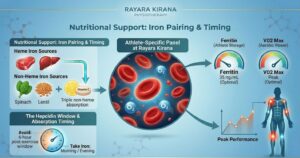
Heme Iron: Found in animal products (red meat, liver). It has a 15-35% absorption rate.
Non-Heme Iron: Found in plant sources (spinach, lentils, ragi). It only has a 2-20% absorption rate.
Pro-Tip for South Bangalore Athletes:
If you are vegetarian, always pair your iron-rich “Palak” or “Dal” with Vitamin C (lemon juice or oranges) to triple the absorption. Avoid tea or coffee with meals, as tannins block iron uptake.
The “Hepcidin Window”: Timing is Everything
Recent research shows that iron absorption is lowest immediately after a hard swim or run. We recommend taking iron supplements either first thing in the morning (on an empty stomach) or at least 6 hours after your last training session to avoid the “Hepcidin Spike.”
12-Week Iron Restoration Protocol
| Phase | Focus Area | Weekly Goal | Formulations Mentioned |
| Weeks 1-4 | Absorption | Overcoming “Hepcidin Block” | Liposomal Iron |
| Weeks 5-8 | Storage | Rebuilding Ferritin Stores | Lactoferrin |
| Weeks 9-12 | Performance | Returning to Peak Max | Balanced Micronutrients |
The Rayara Kirana Recovery Protocol
When an athlete comes to us with Anemia in Athletes and Swimmers, our physiotherapy approach changes:
Load Management: We reduce high-intensity interval training (HIIT) to prevent further hemolysis and Hepcidin spikes.
Vascularization Sets: We focus on low-intensity, high-repetition movements to improve blood flow without taxing the oxygen system.
Manual Therapy: We use specialized joint mobilizations (Mulligan Concept) to ensure the ribcage is mobile, allowing for maximum lung expansion.
Cold LASER Therapy: At our South Bangalore clinic, we use Cold LASER to stimulate cellular ATP production, helping fatigued muscles “recharge” while the blood levels recover.
Dr. Yoginder Balaji, PT
“In post-operative or post-injury recovery, anemia is a silent wall. If an athlete’s blood isn’t healthy, the tissue repair process is 50% slower. We focus on Early Controlled Loading paired with nutritional monitoring to ensure the ‘shutdown’ of muscles doesn’t occur.”
FAQs: Anemia in Athletes and Swimmers in 2026
Can I be anemic even if my Hemoglobin is normal?
Yes. You can have Non-anemic Iron Deficiency (NAID).What is the benefit of Liposomal delivery?
It mimics cell membranes, allowing iron to pass into the blood without stomach upset.Can Lactoferrin help with my immunity too?
Yes, Liposomal Lactoferrin supports both iron and immune health.How often should an athlete in Bangalore get a blood test?
Every 3 months, especially before peak season at clubs like the Century Club.Can iron supplements cause stomach issues?
Conventional ones do. (Liposomal) is designed to avoid this.Does “Foot-strike Hemolysis” happen in swimming?
No, but swimmers lose iron via skin turnover and intense sweating.Is red meat necessary for recovery?
No. Vegetarian athletes can succeed with proper “Iron Pairing” and Vitamin C.Can physiotherapy help with anemia?
It manages the muscular and postural consequences while levels recover.Why do female athletes have higher rates of anemia?
Due to menstrual blood loss and typically lower iron intake.How long does it take to see performance improvements?
Usually 4–6 weeks of consistent supplementation.Is “Beetroot Juice” a cure for anemia?
No. It helps blood flow but lacks sufficient elemental iron.Can overtraining cause anemia?
Yes, by keeping Hepcidin levels chronically high.What are the best iron-rich foods in a local South Indian diet?
Ragi, Curry leaves, Jaggery, and Pomegranate.Should I stop training if I am anemic?
Reduce intensity but maintain light “Active Recovery.”Does Rayara Kirana offer blood testing?
We partner with top labs in South Bangalore for athlete-specific profiling.What is the role of Vitamin B12 in athlete anemia?
B12 works with iron; without it, red blood cells become inefficient.Can “Tech Neck” worsen the symptoms of anemia?
Yes, by restricting the diaphragm and reducing oxygen intake.Are there “Robotic” tools for monitoring recovery?
We use computerized strength assessment tools at our clinic.Can I visit Rayara Kirana just for performance “Pre-hab”?
Absolutely. We check metabolic health before heavy training blocks.What is the most important part of the rehab journey?
Consistency in the 23 hours you spend outside the clinic.
Conclusion: Don’t Let Iron Deficiency Be Your Anchor
Anemia in Athletes and Swimmers is a manageable barrier. By combining the 25-year legacy of Rayara Kirana Physiotherapy with modern, evidence-based targeted nutraceuticals like Liposomal Iron and Lactoferrin, you can move from “muddy” performance back to peak strength.
If you feel like you are “swimming through mud” or your running times have stalled on the streets of Bangalore, it’s time to look deeper. Let our experts in South Bangalore help you rebuild your iron stores and reclaim your strength.