Medically Reviewed by Dr. Kiran S. Murthy, PT, Founder & Lead Physiotherapist, Rayara Kirana (25+ Years Experience)
Last Updated: October 2026
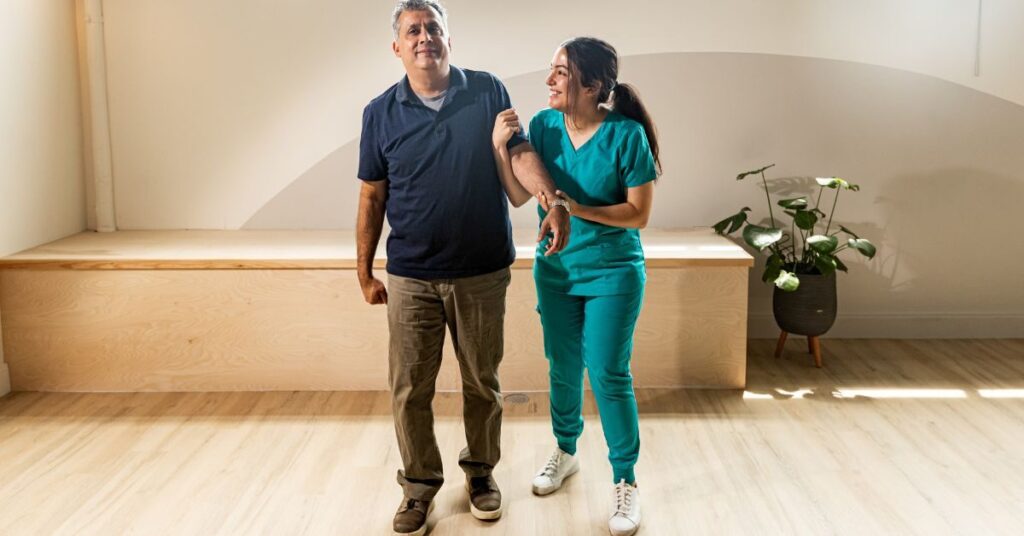
As our loved ones age, maintaining physical independence, managing chronic joint degeneration, and recovering safely from surgeries or sudden neurological incidents become paramount. For senior citizens, traveling across busy urban traffic to visit an outpatient clinic can be physically exhausting, stressful, and fraught with fall risks. This is why specialized physiotherapy for elderly people at home has transformed senior healthcare across Bangalore.
At Rayara Kirana Physiotherapy & Rehab Center, our dedicated home-care division brings hospital-grade clinical expertise directly to your doorstep. Operating across South Bangalore neighborhoods—including Banashankari, Basavanagudi, Jayanagar, JP Nagar, and Century Club networks—our team delivers personalized geriatric rehabilitation.
This comprehensive, exhaustive, doctor-led guide explores the wide spectrum of conditions we treat at home, the advanced portable equipment and evidence-based services we utilize, extensive clinical case insights, environmental safety modifications, and why families across Bangalore trust our multidisciplinary team for senior care.
The Physiological Realities of Aging: Why Seniors Require Specialized Care
To fully appreciate the necessity of physiotherapy for elderly people at home, one must examine the complex physiological transitions that occur within the human body as individuals cross into their sixth, seventh, and eighth decades of life. Aging is not merely a chronological milestone; it is accompanied by progressive alterations across every major organ system, with the musculoskeletal and neurological systems experiencing the most profound impacts.
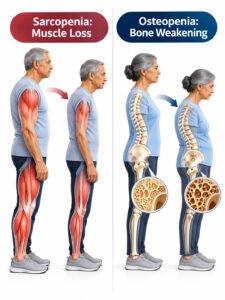
1. Sarcopenia and Age-Related Muscle Loss
Beginning around the fourth decade of life, humans experience a gradual, natural decline in skeletal muscle mass and function, a condition known as sarcopenia. After age 60, this decline accelerates significantly, leading to a loss of Type II (fast-twitch) muscle fibers. Without structured physical loading and adequate protein synthesis, seniors lose explosive strength, functional power, and endurance, making simple tasks like rising from a low sofa or climbing stairs exceedingly difficult.
2. Osteopenia, Osteoporosis, and Bone Mineral Decline
Simultaneously, bone remodeling dynamics shift. Osteoclast activity (bone resorption) outpaces osteoblast activity (bone formation), resulting in a net loss of bone mineral density (BMD). This systemic weakening leads to osteopenia and osteoporosis, leaving skeletal structures vulnerable to low-impact fragility fractures—particularly at the femoral neck (hip), lumbar spine, and distal radius.
3. Articular Cartilage Degeneration and Joint Stiffness
Joint cartilage (hyaline cartilage) loses its water content, elasticity, and proteoglycan matrix over time. As the cartilage thins, underlying subchondral bone experiences increased mechanical friction, manifesting as osteoarthritis. Joint capsules tighten, and synovial fluid production decreases, causing pronounced morning stiffness and joint locking after periods of inactivity.
4. Neurological and Proprioceptive Declines
Proprioception—the body’s unconscious awareness of joint position in space—gradually diminishes with age. Concurrently, vestibular system sensitivity and visual acuity decline, delaying neuromuscular reflex loops. When an elderly person trips or stumbles, their reflex reaction time is slower, drastically escalating the risk of injurious falls.
Given these multi-system vulnerabilities, exposing an aging senior to the physical stress of traveling through traffic to an outpatient clinic can be counterproductive. Delivering expert rehabilitation directly in the living room eliminates travel barriers and places therapy in the exact environment where safety matters most.
Why Home Care Physiotherapy is Essential for Senior Citizens

Opting for professional physiotherapy for elderly people at home offers unmatched clinical and psychological benefits compared to traditional clinic-based visits:
- Elimination of Commuting Stress and Fatigue: Traveling in Bangalore’s heavy traffic causes physical exhaustion, spikes blood pressure, and induces anxiety, completely counteracting the therapeutic relaxation and energy required for effective rehabilitation.
- Real-Environment Assessment and Modification: Therapists evaluate the patient’s actual living space—assessing bathroom thresholds, hallway lighting, staircases, kitchen layouts, and mattress firmness to eliminate domestic fall hazards.
- Customized Family Integration and Caregiver Training: Caregivers and family members are trained directly in the home environment on safe transfer techniques (bed-to-wheelchair, toilet transfers) and daily stretching routines, ensuring continuous care between therapist visits.
- Enhanced Psychological Comfort and Compliance: Seniors feel significantly more secure, relaxed, and cooperative in familiar surroundings, which reduces cortisol levels and accelerates emotional and physical recovery.
For a comprehensive overview of how our domiciliary services operate, explore our dedicated home care physiotherapy in Bangalore portal.
Comprehensive Conditions We Treat Through Elderly Home Care Physiotherapy
At Rayara Kirana, our home-care programs are never generic. Under the clinical direction of Dr. Kiran S. Murthy, PT (with over 25 years of clinical experience), every senior patient is matched with a specialist suited to their precise medical history. Below is an exhaustive breakdown of the conditions we treat through our physiotherapy for elderly people at home services:
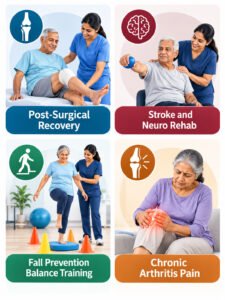
1. Post-Surgical and Joint Replacement Rehabilitation
Major orthopedic surgeries—such as total knee replacement (TKR), total hip replacement (THR), and lumbar spinal decompression—require immediate, structured mobilization to prevent deep vein thrombosis (DVT), joint stiffness, and scar tissue adhesions.
- Home Care Advantage: Our therapists visit patients during the critical first two weeks post-discharge, ensuring safe early range-of-motion exercises, edema management, and gradual weight-bearing without the painful strain of travel.
2. Stroke, Hemiplegia, and Neurological Rehabilitation
Cerebrovascular accidents (strokes), Parkinson’s disease, multiple sclerosis, and age-related balance disorders impair motor control, coordination, and independent mobility.
- Home Care Advantage: Utilizing task-oriented motor learning, neuro-developmental treatment (NDT), and gait re-education, our neuro-physiotherapists help stroke survivors regain functional movement, trunk stability, and walking confidence right inside their homes.
3. Fall Prevention and Balance Restoration
Falls among seniors frequently result in hip fractures, long-term hospitalization, and a profound psychological fear of falling that restricts daily activity.
- Home Care Advantage: We implement targeted vestibular and proprioceptive balance training, strengthening weak core and lower limb stabilizers to drastically reduce fall risks in everyday living spaces.
4. Chronic Osteoarthritis and Spinal Degeneration
Advanced knee osteoarthritis, lumbar spondylosis, cervical spondylosis, and chronic back pain can make independent standing and walking agonizing.
- Home Care Advantage: We deliver targeted manual therapy, gentle joint mobilizations, and customized strengthening regimens that relieve pain and improve joint lubrication.
5. Fracture Recovery and Immobility Management
Recovery from hip fractures, vertebral compression fractures, or wrist breaks often leaves seniors bedridden or wheelchair-bound.
- Home Care Advantage: We prevent pressure ulcers (bedsores), muscle atrophy, and joint contractures through structured passive and active-assisted range-of-motion protocols.
Advanced Equipment & Services We Bring to Your Home
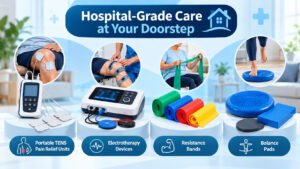
Many families assume that home physiotherapy is limited to simple verbal instructions. At Rayara Kirana, we bring hospital-grade portable technology and evidence-based modalities directly to your living room. When you book our physiotherapy for elderly people at home, our therapists utilize the following specialized equipment and clinical services:
Portable Electrotherapy & Pain Relief Devices
- Transcutaneous Electrical Nerve Stimulation (TENS): Lightweight, battery-operated units that block pain signals to the brain, providing drug-free relief for chronic arthritic joints and back pain.
- Interferential Therapy (IFT) Units: Portable medium-frequency current devices that penetrate deep into soft tissues to reduce swelling, relax muscle spasms, and accelerate tissue healing.
- Therapeutic Ultrasound Devices: Used for localized deep-heat therapy to break down scar tissue, increase blood circulation, and relieve tendon inflammation.
Mobility and Assessment Tools
- Gait Training Aids & Portable Parallel Bars: Assisting seniors safely through initial walking drills and stepping patterns.
- Resistance Bands and Tubing: Progressive elasticity tools used for safe, joint-friendly muscle strengthening without heavy gym weights.
- Balance Pads and Stability Disc Systems: Portable foam surfaces used to challenge proprioceptive reflexes and improve postural stability.
- Precision Measurement Instruments: Portable goniometers for measuring joint range of motion, handgrip dynamometers, and functional scales to track real data progress across every visit.
Our Structured Home Care Process: What to Expect
To ensure seamless, transparent, and effective care, Rayara Kirana follows a rigorous clinical workflow for every home-care patient:
- Initial Inquiry & Scheduling: You contact our care coordinators at +91-99727 77111. We discuss the patient’s medical background, current mobility constraints, and location.
- Comprehensive Home Assessment: A senior physiotherapist visits your home to conduct a full clinical evaluation, reviewing past medical records, examining joint range and strength, and auditing home safety hazards.
- Personalized Therapy Plan Formulation: We design a tailored rehabilitation roadmap detailing session frequencies, target milestones, and expected recovery timelines.
- Consistent Execution & Tracking: Sessions are delivered on schedule, with continuous tele-support between visits and periodic re-assessments to measure objective functional gains.
To explore our broader clinical capabilities or plan a hybrid recovery schedule combining home visits with outpatient treatments at our Banashankari and Basavanagudi centers, visit our main Rayara Kirana Physiotherapy Clinic page.
Real-World Case Insight: Geriatric Home Rehabilitation in South Bangalore
To illustrate the profound impact of domiciliary senior care, consider the following clinical case managed by our team:
- Patient Profile: Mrs. Lalitha K., 72 years old, resident of Basavanagudi, Bangalore.
- Clinical Presentation: Post-operative recovery following a left dynamic hip screw (DHS) fixation for an intertrochanteric femur fracture sustained after a bathroom slip.
- Challenges: Patient experienced severe postoperative pain, high anxiety regarding standing, and extreme fatigue, making clinic transport impossible.
- The Rayara Kirana Home Care Protocol:
- Weeks 1–2: Home visits focused on gentle active-assisted range of motion, isometric quadriceps strengthening, ankle pumps to prevent DVT, and bed-to-chair transfer training.
- Weeks 3–5: Introduction of standing weight-bearing exercises utilizing a walker, pelvic stabilization drills, and core strengthening.
- Weeks 6–8: Progressive gait retraining across indoor hallways, stair negotiation practice, and independent bathroom transfer training.
- Outcome: By Week 8, Mrs. Lalitha achieved independent indoor ambulation using a quad-cane, successfully climbed her home staircase, and regained complete confidence in managing daily activities.
Practical Home Safety & Fall Prevention Audit for Seniors
Because the majority of senior falls occur within the home environment, our home-care physiotherapists conduct a thorough safety audit during initial visits. Families should review the following critical checklist:
- Lighting: Ensure hallways, staircases, and bathrooms are illuminated with high-wattage or motion-sensor nightlights.
- Flooring: Remove all loose throw rugs, mats, and trailing electrical cords that present tripping hazards.
- Bathroom Safety: Install wall-mounted grab bars next to toilets and inside shower stalls. Use non-slip rubber mats on wet bathroom floors.
- Seating: Avoid deep, soft sofas that make standing up difficult. Ensure chairs have firm cushions and sturdy armrests.
- Footwear: Discourage walking barefoot or in slippery socks indoors; encourage supportive footwear with non-skid rubber soles.