Medically Reviewed by Dr. Kiran S. Murthy, PT, Founder & Lead Physiotherapist, Rayara Kirana (25+ Years Experience)
Last Updated: October 2026
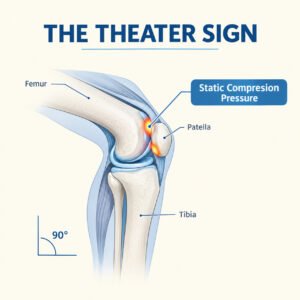
It starts as a subtle, dull ache inside or around your kneecap after sitting through a long desk shift, driving across Bangalore’s heavy traffic, or enjoying a movie at the cinema. When you finally stand up to stretch, your knee feels stiff, catching or aching sharply until you take a few cautious steps to loosen it up. If this scenario sounds familiar, you are not alone. Knee pain while sitting—often medically referred to in clinical orthopedics as the movie sign or theater sign—is one of the most frequent complaints brought to orthopedic and physiotherapy clinics.
Many people assume that because the knee is not actively bearing weight while seated, it should be resting comfortably. In reality, sustained flexion (bending) places continuous contact pressure on the joint surfaces, tightens surrounding soft tissues, and unmasks underlying biomechanical imbalances.
At Rayara Kirana Physiotherapy & Rehab Center, our clinical team across Banashankari, Basavanagudi, and home-care networks throughout South Bangalore specializes in diagnosing the root causes of joint discomfort. This comprehensive, exhaustive, doctor-led guide explores why your knees hurt while sitting, critical warning signs, deep biomechanical explanations, extensive self-management strategies, professional clinical interventions, and how to find trusted physiotherapy near me in Bangalore.
Why Does Sitting Cause Knee Pain? The Deep Biomechanical Mechanics
When you sit—whether at an office desk, inside a car, or on a sofa—your knee is typically bent at a 90-degree angle or sharper for prolonged intervals. This sustained posture creates several distinct physical pressures on the joint:
Patellofemoral Joint Compression: As the knee bends, the patella (kneecap) presses tightly against the trochlear groove of the femur (thigh bone). When sitting lasts for hours, this constant static contact pressure irritates the articular cartilage beneath the kneecap, leading to localized metabolic stress.
Soft Tissue Ischemia and Microvascular Restrictions: Prolonged immobility reduces local blood flow and microvascular perfusion to the tendons and ligaments surrounding the joint. The quadriceps tendon, patellar tendon, and joint capsule adapt to the bent position by tightening up, causing a sharp ache when you first try to straighten your leg.
Intra-Articular Fluid Pressure Changes: Sustained static flexion alters the hydrostatic pressure of the synovial fluid within the joint capsule. Without the rhythmic pumping action of walking, fluid stagnation increases intra-capsular pressure, triggering dull, aching discomfort.
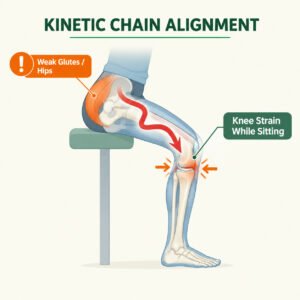
The Kinetic Chain Breakdown: Pain felt at the front or side of the knee during sitting is frequently a downstream symptom of weak hips or poor pelvic stability. When your hip abductors and rotators fail to control femur rotation, abnormal pulling forces are transmitted directly across the knee joint. This dynamic misalignment mirrors patterns we analyze in our clinical review of the hip–knee connection and why hip problems cause knee pain.
The Pathophysiology of Patellofemoral Contact Pressures During Prolonged Flexion
To fully grasp why knee pain while sitting occurs, one must examine the engineering of the knee joint under load. The patella acts as a mechanical pulley, increasing the leverage of the quadriceps muscle as it extends the lower leg.
When the knee is fully extended, the patella sits above the femoral groove with minimal contact. However, as flexion increases toward 90 degrees and beyond:
Contact Area Shift: The contact area between the patella and the femur shifts proximally and widens, distributing forces across the articular surface.
Static Loading Stress: In active movement, this force is transient. In static sitting, however, the quadriceps tendon and patellar tendon maintain continuous tension, pressing the patella like a clamp against the femoral trochlea.
Chondrocyte Starvation: Articular cartilage lacks a direct blood supply; it relies on cyclical loading and unloading—like a sponge—to absorb synovial fluid nutrients and expel waste products. Static sitting halts this fluid exchange, starving chondrocytes of vital nutrition and triggering local inflammatory responses.
Top Clinical Causes of Knee Pain While Sitting
Understanding the exact nature of your knee pain while sitting requires looking at how and where the discomfort manifests. Here are the most frequent medical conditions diagnosed at our Bangalore clinics:
1. Patellofemoral Pain Syndrome (PFPS) / “Runner’s Knee”
PFPS is the leading cause of knee pain while sitting for extended periods, desk workers, and active adults. It occurs when the kneecap tracks improperly within its groove due to muscular imbalances.
The Sitting Clue: Pain typically worsens after sitting with bent knees for a long time (the classic “theater sign”) and eases slightly once you begin walking, only to return during squats, stairs, or running.
2. Early Knee Osteoarthritis (OA)
Cartilage thinning inside the joint compartment can cause deep, aching discomfort during inactivity.
The Sitting Clue: Joint stiffness and aching set in after resting, accompanied by a noticeable “gel phenomenon”—where the knee feels locked or stiff for a few minutes upon standing up. For comprehensive management strategies regarding joint degeneration, explore our orthopedic physiotherapy treatments for knee arthritis.
3. Patellar Tendonitis (Jumper’s Knee) or Quad Tendonitis
Inflammation or micro-tearing in the tendons connecting your kneecap to your shin or thigh muscle.
The Sitting Clue: A localized, tender ache at the front of the knee that flares up when the leg has been bent in a cramped position for too long.
4. Meniscal Irritation or Tears
The meniscus acts as the shock absorber of the knee. When a tear or degenerative fraying is present, certain static angles pinch the damaged tissue.
The Sitting Clue: Deep aching accompanied by mechanical symptoms like clicking, catching, or a sensation that the knee is “locked” when you attempt to straighten it.
5. Plica Syndrome
The plica is a fold of embryonic membrane lining the knee joint capsule. When irritated by overuse or prolonged bending, it becomes inflamed.
The Sitting Clue: Sharp or catching pain felt specifically along the inner side of the kneecap after sitting still.
6. Baker’s Cyst (Popliteal Cyst)
Fluid accumulation at the back of the knee joint can cause tension and aching when the knee is bent for prolonged periods, as the fluid is squeezed within the popliteal space.
Warning Signs: When Knee Pain Requires Professional Evaluation
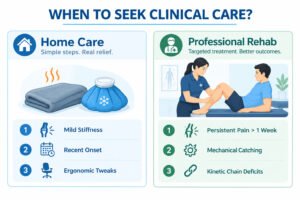
While mild stiffness from a cramped seating position can occasionally happen to anyone, persistent joint discomfort requires professional clinical assessment. Do not ignore these critical warning signs:
Pain Persisting Past One Week: Discomfort that continues daily despite rest, OTC gels, and activity modification.
Mechanical Locking or Catching: Inability to fully straighten or bend your knee smoothly due to a physical obstruction inside the joint.
Sudden Joint Swelling (Effusion): Visible puffiness or fluid accumulation around the kneecap following sitting or light activity.
Buckling or Giving Way: The knee feeling unstable or untrustworthy when you stand up, indicating possible ligamentous or meniscal laxity.
Severe Night Pain: A deep, throbbing ache that wakes you up from sleep even when your leg is fully extended.
Numbness or Radiating Tingling: Nerve compression or referred pain traveling down the shin or foot.
Clinical Expert Insight:
“When patients visit our clinic complaining of knee pain while sitting, they often blame an old injury or think their cartilage is entirely worn out. In our 25+ years of practice at Rayara Kirana, we find that more than 60% of these cases stem from muscle imbalances around the hips and tight quadriceps caused by prolonged sedentary work. Treating the whole kinetic chain changes everything.”
— Dr. Kiran S. Murthy, PT (Founder & Lead Physiotherapist)
Comprehensive Home Management & Ergonomic Adjustments
If your knee pain while sitting is mild and newly onset, conservative self-care and ergonomic corrections can help manage symptoms while you arrange a professional evaluation:
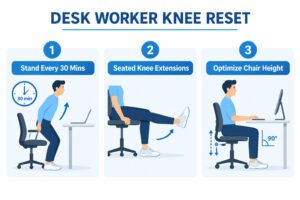
The 30-Minute Movement Rule: Avoid sitting continuously for hours. Set a reminder to stand up, walk around your workspace, and perform gentle knee extensions every 30 minutes to restore circulation and synovial fluid movement.
Optimize Your Workstation Ergonomics: Adjust your office chair height so your feet rest flat on the floor and your hips sit slightly higher than your knees, reducing sharp joint angles and patellofemoral compression.
Avoid Crossing Your Legs: Crossing your knees or tucking your feet backward under your chair compresses joint structures, restricts venous blood return, and increases torsional ligament strain.
Contrast Therapy: Apply an ice pack for 10–15 minutes if you notice acute inflammation or swelling, or use a warm compress to relax stiff quadriceps muscles before attempting gentle stretches.
Gentle Seated Extensions: While sitting safely on a chair, slowly straighten one leg out in front of you, hold for 5 seconds to engage the quadriceps, and lower it gently. Repeat 10 times per leg.
Hydration and Nutrition: Maintain adequate daily water intake to support joint lubrication, and include anti-inflammatory foods rich in Omega-3 fatty acids.
Professional Physiotherapy Approach at Rayara Kirana
When conservative home care is no longer enough, targeted clinical rehabilitation provides lasting relief. At Rayara Kirana Physiotherapy & Rehab Center, our approach to treating knee pain while sitting goes far beyond temporary symptom masking:
1. Comprehensive Biomechanical Assessment
Our specialists analyze your gait, posture, hip mobility, and single-leg stability to identify exactly why abnormal loads are transferring to your knees. We evaluate whether your pain originates from local joint inflammation or poor pelvic control.
2. Advanced Pain Relief Modalities
To calm acute discomfort, we utilize evidence-based electrotherapy modalities including Therapeutic Ultrasound, Transcutaneous Electrical Nerve Stimulation (TENS), and Interferential Therapy (IFT), alongside expert manual therapy and soft-tissue release.
3. Kinetic Chain Strengthening & Mobility
We prescribe targeted exercises to bulletproof your joints against future flare-ups:
Glute Bridges & Clamshells: To strengthen weak hip abductors and external rotators, correcting inward knee collapse.
Quad & Hamstring Lengthening: Specialized stretching protocols to relieve chronic tension pulling on the kneecap.
Closed-Chain Functional Training: Controlled mini-squats and step-ups that retrain proper lower-limb alignment.
For patients who find traveling difficult due to stiffness or severe discomfort, we also provide specialized home physiotherapy services across Bangalore, bringing expert clinical care directly to your doorstep.