As we mark the dual significance of World Obesity Day 2026 and International Women’s Day, we stand at a critical crossroads in public health. At Rayara Kirana Physiotherapy & Rehab Clinic, we see the intersection of these two global observances every day in our examination rooms. Obesity is no longer merely a cosmetic concern or a “lifestyle choice”; it is a complex, multi-systemic disease that acts as a profound biomechanical burden, particularly for the women of India.
In 2026, the narrative around weight must shift. We are moving beyond the bathroom scale to look at the foundation of human independence: mobility. When excess weight accumulates, it doesn’t just affect metabolic markers like blood sugar and cholesterol; it wages a silent war on the cartilage of your knees, the discs of your spine, and the alignment of your hips.
The Double Awareness Moment – India’s Growing Burden
The theme for World Obesity Day 2026 emphasizes “Changing Perspectives,” and nowhere is this more urgent than in India. Once a nation struggling primarily with undernutrition, India is now among the fastest-growing nations in terms of the overweight and obese population.
The shift toward urban sedentary life, the omnipresence of ultra-processed foods, and the chronic stress of modern professional life have created a perfect storm. We are seeing a disturbing trend: individuals in their early 30s and 40s presenting with joint degeneration that was previously reserved for those in their 60s.
The Female Perspective: A Unique Vulnerability
On World Women’s Day, we must address why women bear a disproportionate share of this burden.
Post-Pregnancy Retention: Hormonal shifts and lifestyle changes after childbirth often lead to “weight creep” that remains unaddressed for years.
Perimenopausal Redistribution: As estrogen levels fluctuate and eventually decline, fat often redistributes from the hips to the abdomen (visceral fat), increasing systemic inflammation.
The Muscle Gap: Biologically, women generally possess lower baseline muscle mass than men. When weight increases, the ratio of “load-to-motor” becomes skewed, leaving joints unsupported.
Knee Osteoarthritis (OA): Statistics show women have a significantly higher prevalence of knee OA, often linked to wider pelvic structures and hormonal influences on ligament laxity.
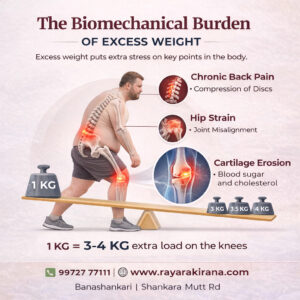
Obesity is not just a number; it is a biomechanical crisis.
The Current Scenario – India & The Global Context
According to recent WHO data, global obesity rates have tripled since the late 20th century. In India, the “urbanization of the waistline” has reached rural corridors. However, the Indian context presents a unique medical phenomenon known as the “Thin-Fat Phenotype.”
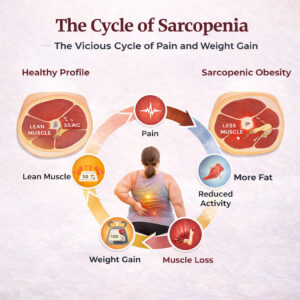
Many Indians may appear relatively lean but possess high percentages of visceral fat (fat around internal organs) and dangerously low muscle mass (sarcopenia). This “Sarcopenic Obesity” is a silent killer of joints.
Lower Muscle Quality: Even at a lower BMI, Indians often have higher metabolic inflammation.
Early Onset OA: We are seeing symptomatic Knee Osteoarthritis in the Indian population as early as ages 40–55, nearly a decade earlier than Western counterparts.
The Biomechanics of Pain – How Weight Damages Joints
To understand why physiotherapy is essential, one must understand the physics of the human body.
1. The Knee: The Primary Shock Absorber
The knee is a hinge joint that bears the brunt of every step. Research indicates that each 1 kg increase in body weight translates to 3–4 kg of extra load on the knees during normal walking. If you are 10 kg overweight, your knees feel an extra 30–40 kg of pressure with every single step you take. This chronic overload leads to:
Cartilage Erosion: The protective cushioning wears thin.
The Vicious Cycle: Pain leads to less movement, which leads to metabolic slowdown, resulting in more weight gain and, subsequently, more pain.
2. The Spine: The Pillar of Support
Excess abdominal fat shifts the body’s center of gravity forward. This creates an “anterior pelvic tilt,” pulling the lower back into an exaggerated curve (hyperlordosis). This causes:
Chronic Lower Back Pain: Overworked spinal muscles and compressed discs.
Sciatica: Nerve impingement due to structural shifts.
3. The Inflammatory Angle
It’s not just about weight; it’s about chemistry. Adipose (fat) tissue is an active endocrine organ. It produces pro-inflammatory cytokines (like CRP and IL-6). These chemicals circulate through the blood and actively “melt” joint cartilage, accelerating degeneration even in non-weight-bearing joints like the hands.
Women, Hormones, and the Metabolic Shift
For the women we celebrate this month, the struggle with weight is often tied to biological milestones. During menopause, the loss of estrogen—which is naturally cardioprotective and bone-protective—leads to a decrease in bone mineral density.
When you combine decreased bone density with increased weight, the risk of fractures and debilitating joint pain skyrockets. Furthermore, cultural barriers in India often prevent women from prioritizing “gym time” or outdoor exercise. At Rayara Kirana, we advocate for home-based, clinically-supervised movement that fits into a woman’s busy life.
GLP-1 Analogues – Magic Pill or Tool?
2026 has seen the explosion of GLP-1 receptor agonists (like Semaglutide) in the Indian market. While these are effective tools for appetite suppression and glycemic control, they are not “cures” for obesity.
The Balanced View:
Muscle Loss Risk: Rapid weight loss via medication often includes significant loss of lean muscle mass. Without muscle, your joints lose their active stabilizers.
The Rebound: Clinical data shows that weight often returns if the underlying lifestyle and movement patterns aren’t corrected.
The Mobility Gap: Losing weight doesn’t automatically teach your brain how to move correctly again after years of compensation.
As we say at our clinic: There is no magic injection that replaces the necessity of movement.
Principles of Sustainable Weight Reduction
At Rayara Kirana, we believe weight loss must be science-led, not fad-driven.
Protein Sovereignty: To protect your joints, you must protect your muscles. High protein intake is non-negotiable during weight loss to prevent muscle wasting.
Calorie Awareness vs. Starvation: We promote “nutritional density.” Eating 1500 calories of whole foods vs. 1500 calories of processed snacks has a vastly different effect on systemic inflammation.
Metabolic Screening: Before starting any journey, we recommend screening for Thyroid dysfunction, Vitamin D/B12 deficiencies, and HbA1c levels.
The Role of Structured Meal Replacements
For many patients, “decision fatigue” is the biggest hurdle. Structured meal replacements (SMRs) can be a powerful bridge. They provide:
Portion Control: Eliminating guesswork.
Nutrient Certainty: Ensuring you get vitamins and minerals even while in a calorie deficit.
Convenience: Helping busy professionals stay on track.
Note: SMRs should be used as part of a transition to whole foods, not a permanent substitute.
Physiotherapy – The “Missing Link” in Weight Loss
Why come to a physiotherapist for weight loss? Because pain is the greatest barrier to exercise. If you try to run or walk 10,000 steps with a misaligned pelvis or weak quads, you will injure yourself and stop.
Physiotherapy at Rayara Kirana focuses on:
Pain Mapping: Identifying exactly which structure is hurting and why.
Unloading Joints: Using manual therapy and taping to provide immediate relief.
Core & Hip Stabilization: Building the “internal corset” that protects the spine.
Movement Correction: Re-learning how to sit, stand, and walk to minimize joint stress.
Insights from Dr. Kiran S. Murthy
“Many patients believe they must lose weight before they can move. At Rayara Kirana, we help them move safely first — and that movement becomes the foundation for sustainable weight loss.”
“Obesity is not only a metabolic issue. It is a biomechanical stress problem. If we reduce joint pain and improve muscle strength, patients regain mobility and naturally become more active.”
“For women especially, structured physiotherapy combined with nutritional guidance dramatically improves quality of life. We focus not just on weight, but on function.”
The Rayara Kirana Integrated Framework
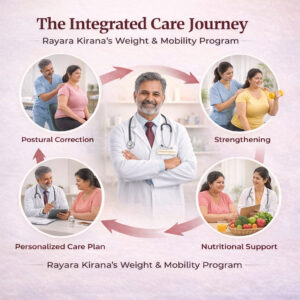
We don’t just give you a list of exercises. Our 2026 Weight & Mobility Program includes:
Comprehensive Assessment: Mobility scoring and Gait analysis.
Body Composition Analysis: Measuring fat vs. muscle mass (not just BMI).
Customized Loading: Exercises that burn calories without pounding your joints.
Gradual Progression: Ensuring your ligaments adapt as your weight drops.
Maintaining the Win – Consistency Over Intensity
The tragedy of “The Biggest Loser” style weight loss is the inevitable relapse. We focus on:
Muscle Preservation: Resistance training is the fountain of youth.
Periodic Re-assessment: Adjusting your plan as your body changes.
Realistic Goals: A 5-10% weight loss can reduce joint pain by up to 50%. You don’t need to be “thin” to be healthy; you need to be functional.
Move Toward Health
This World Obesity Day and Women’s Day, don’t just make a resolution to “eat less.” Make a commitment to live better. Whether you are struggling with a nagging knee ache, chronic back stiffness, or the metabolic risks of weight gain, we invite you to Rayara Kirana Physiotherapy & Rehab Clinic for an early screening.
Obesity is reversible. Joint degeneration is preventable. Movement is the most potent medicine we have.

FAQs: Obesity, Women’s Health, and Physiotherapy
1. Can I exercise if I already have severe knee pain?
Yes. In fact, total rest often makes joint pain worse. We use “low-impact” or “non-weight-bearing” exercises (like aquatic therapy or seated strengthening) to build muscle without stressing the joint.
2. Why do I gain weight specifically around my belly after 40?
This is often due to perimenopause and a drop in estrogen, which shifts fat storage to the visceral area. It requires a specific combination of strength training and metabolic nutrition.
3. Are GLP-1 injections safe for everyone?
They must be prescribed by a doctor. While effective, they carry side effects and risks of muscle loss, which is why they should always be paired with physiotherapy.
4. How much weight do I need to lose to feel a difference in my back?
Even a 5% reduction in body weight can significantly reduce the mechanical load on your lumbar spine and decrease systemic inflammation.
5. Is walking enough for weight loss?
Walking is great for cardiovascular health, but for sustainable weight loss and joint protection, you must add resistance training to keep your metabolism high.
6. Does Rayara Kirana provide diet plans?
We provide integrated nutritional guidance that complements your physical therapy, focusing on protein adequacy and inflammatory reduction.
7. Why are Indian women more prone to Osteoarthritis?
A combination of genetics, lower baseline muscle mass, vitamin D deficiency, and often, a delay in seeking medical help for “minor” pains.
8. Can physiotherapy help with PCOS-related weight gain?
Yes. Exercise is a primary treatment for insulin resistance, which is at the heart of PCOS. We help create a sustainable movement plan.
9. What is “Sarcopenic Obesity”?
It’s a condition where you have high body fat but very low muscle mass. It is common in India and very damaging to joint health.
10. How often should I see a physiotherapist for weight-related pain?
Initially, 2–3 times a week for pain management and form correction, tapering down as you become more independent and stronger.
11. Does insurance cover physiotherapy for obesity-related joint issues?
Many modern health insurance policies in India now cover physiotherapy when it is part of a rehabilitation plan for conditions like Osteoarthritis.
12. Can I avoid knee replacement surgery by losing weight?
In many cases, yes. “Pre-hab” (strengthening before a condition worsens) can delay or even eliminate the need for surgery.
13. What is the best diet for joint pain?
An anti-inflammatory diet: high in Omega-3s, antioxidants, fiber, and lean protein, while low in refined sugars and seed oils.
14. I am 50+; is it too late to start strength training?
Never. Muscle tissue remains “plastic” and can be strengthened at any age, providing better support for your aging joints.
15. How do I book an assessment at Rayara Kirana?
You can contact our clinic directly for a Mobility & Metabolic Health Screen.