Beyond the Laps: How Specialized Swimming Performance Physiotherapy Transforms Swimming Performance
Swimming is one of the most physically demanding sports despite its non-weight-bearing nature. It is repetitive, overhead-dominant, and biomechanically complex. Competitive swimmers must generate power while maintaining streamlined efficiency, all within a medium that punishes even the smallest technical errors. Unlike many land-based sports, swimming demands simultaneous extremes of mobility and stability—particularly in the shoulders, ankles, hips, and spine.
Elite swimmers require exceptional shoulder and ankle mobility, yet iron-like core stability through the trunk and pelvis. When this balance is even slightly disrupted, inefficiencies accumulate. These inefficiencies may appear insignificant in training but translate into lost seconds during competition. And in elite swimming, seconds or fractions of them—separate podium finishes from missed opportunities.
At Rayara Kirana Physiotherapy, we believe while coaches build endurance, pace, and tactical skill, the sports physiotherapist fine-tunes the machine—the engine (muscles), the chassis (joint mechanics), and the nervous system (motor control patterning).

“A swimmer is like an F1 car,” says Dr. Kiran S Murthy PT “You can have a powerful engine, but if the chassis is misaligned, you’ll never reach top speed. We ensure every joint moves with the precision needed to slice through the water.”
The Role of Specialized Physiotherapy in Competitive Swimming
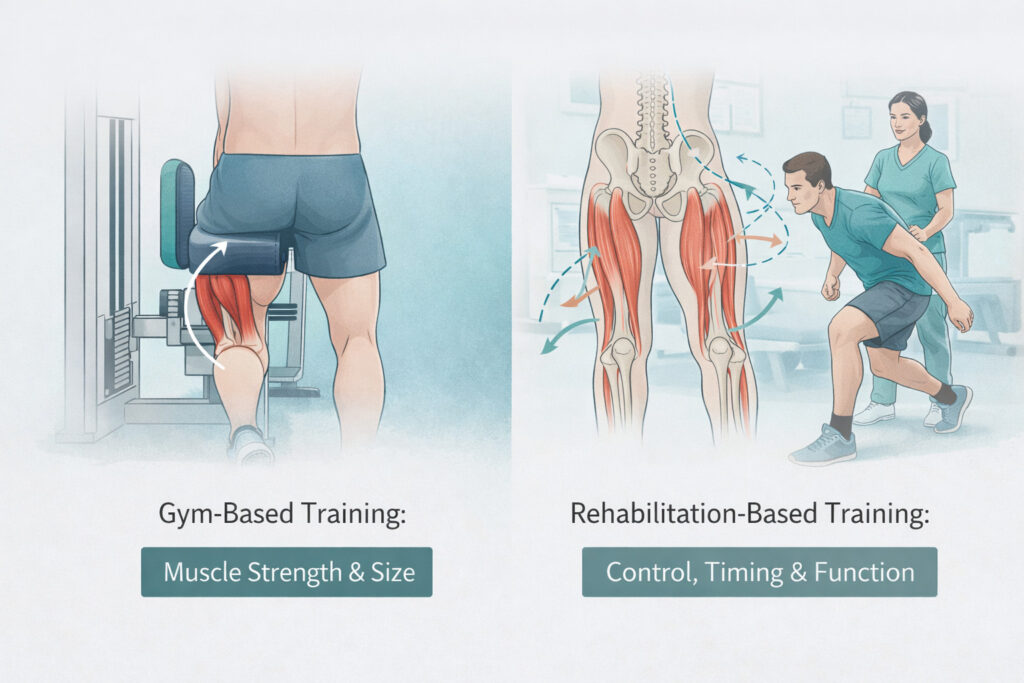
Physiotherapy for swimmers is no longer limited to post-injury rehabilitation. At the elite level, it plays a preventive, performance-enhancing, and career-protecting role.
Swimming places repetitive stress on a limited number of joints—most notably the shoulders and spine. Without structured physiotherapy support, swimmers often adapt by compensating, which temporarily maintains performance but increases long-term injury risk.
Specialized physiotherapy intervenes early by:
Identifying movement inefficiencies before pain appears
Improving force transfer from the core to the limbs
Managing training loads and fatigue accumulation
Supporting recovery between sessions and competitions
The objective is not to reduce training intensity, but to support higher-quality training for longer periods.
Rayara Kirana’s Result-Oriented Approach to Swimmer Performance
Rayara Kirana Physiotherapy brings a performance-first, results-oriented approach to swimmer care. Our work with swimmers focuses on enhancing efficiency, preventing injuries, and supporting long-term athletic development, not just treating pain.
While aquatic therapy is one of our strengths, elite physiotherapy for swimmers goes far beyond water-based rehabilitation. Our programs integrate land-based assessment, movement correction, strength control, and recovery planning—tailored specifically for competitive swimming demands.
Complete Physiotherapy for Swimmers
Although aquatic therapy is a powerful recovery and rehabilitation option—and one of our strengths—this guide is for swimmers and coaches to understand that elite physiotherapy extends far beyond water-based treatment.
Our swimmer-focused physiotherapy includes:
Injury prevention strategies
Core and movement efficiency training
Load management and recovery planning
Aquatic therapy is an added advantage, not a limitation. Whether recovery happens in water or on land, our goal remains the same: faster, safer, and more efficient swimming.

1. Targeted Exercises & Neuromuscular Activation
Physiotherapy is no longer just “treatment after injury”. For aspiring swimmers, it is the pathway to Performance Enhancement and Longevity Protection.
A. Deep Muscle Activation for Shoulder Performance
Rotator Cuff (The Governor): Elite programs in the US and Australia run activation drills before a swimmer even touches the water.
The Power Chain: When deep stabilizers fire well, the Latissimus Dorsi delivers more power with less risk of impingement.
Scapular Control (The Anchor): A stable scapula ensures a stronger pull, better propulsive efficiency, and reduced shoulder overload.
B. Core Stability for Propulsive Transfer
Swimming power originates from the hips and trunk, not just the arms. Physio-designed training improves:
Body Line Stability: Keeping the body horizontal to reduce drag.
Kick-to-Pull Power Transfer: Ensuring every muscle works in harmony.
Reduced “Snaking”: Preventing lateral movements that increase energy expenditure.
2. Screening & Biomechanical Assessment
Before increasing training intensity, a physiotherapist must identify what may be limiting performance. Using Functional Movement Screening (FMS) and swimming-specific assessments, we evaluate:
Shoulder internal rotation deficits and thoracic spine stiffness
Ankle plantarflexion and dorsiflexion range
Core and lumbopelvic control with kick symmetry
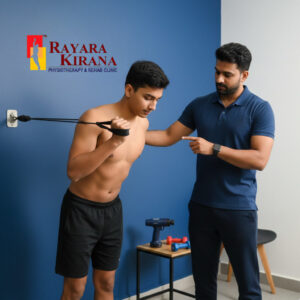
Dr Bhavana PT: “Early identification leads to early correction. Screening prevents silent load accumulation—the kind that forces swimmers out of the pool due to injury rather than fatigue.”
Regular screening allows coaches to adjust training loads intelligently rather than reactively.
3. Core Strength: The Hidden Fuel for Speed
A swimmer with a weak core compensates with their shoulders and lower back. This results in a drop in stroke efficiency and a high risk of overuse injuries.
Physio-guided core programs focus on:
Anti-extension holds: Like plank variations to keep hips high.
Anti-rotation control: Using Pallof presses or band holds.
Hip stability drills: Ensuring the power of the kick is stabilized by the trunk.
4. Injury Prevention & Recovery Management
Progress in swimming depends on consistency. Physiotherapy supports consistency by monitoring training loads and recovery status, reducing the risk of:
Swimmer’s shoulder and tendon overload
Lower back strain
Knee overload, particularly in breaststroke swimmers
Rather than reacting to pain, physiotherapy identifies early warning signs—allowing training to continue with minor adjustments instead of forced rest.
5. Soft Tissue Therapy: Resetting the System
Pre-Training: Short, brisk massages increase blood flow and fascia readiness, which is crucial for Butterfly and IM swimmers.
Post-Training: Techniques to reduce DOMS, lactate buildup, and inflammation, accelerating recovery turnaround.

6. Recommended High-Performance Equipment
| Equipment | Benefit for Swimmers |
| Vasa Swim Bench | Improves dry-land stroke power and technique |
| Blood Flow Restriction (BFR) | Strength gains with minimal joint load |
| Game Ready® | Reduces post-session inflammation through cold compression |
| Normatec Boots | Enhances lymphatic recovery after heavy leg sets |
7. The Golden Routine: Activation & Recovery
Pre-Training (Activation Phase)
Dynamic mobility, arm swings, and thoracic openers.
Band drills for the Serratus and Rotator Cuff.
Note: Static stretching before sprints actually reduces explosiveness.
Post-Training (Recovery Phase)
200–400m easy swim cool-down.
Foam rolling for lats, pecs, and TFL.
Static stretching (20–30 sec) while tissues are warm.
Dr. Swathy, PT: “Swimming places unique and repetitive demands on the body, especially the shoulders, spine, and hips. Specialized physiotherapy helps identify subtle movement inefficiencies early and correct them before they turn into injuries. When therapy is tailored to the swimmer’s stroke, training load, and competition level, it not only reduces injury risk but also significantly enhances performance and endurance in the water.”
Our On-Ground Impact at the Swimming Competition 2025
We were proud to be the Official Physiotherapy Partner for the Nettakallappa Swimming Competition 2025, a prestigious event celebrating competitive swimming excellence.
Being present at the poolside allowed our team to work directly with swimmers and coaches in a real competition environment. Our experienced doctors and physiotherapists provided guidance, assessments, and recovery insights—while maintaining a calm, positive, and athlete-first attitude throughout the event.
This was more than a partnership—it was a demonstration of how experienced physiotherapy teams add real value during competition, not just in clinics.
Experienced Doctors. Positive Team Culture. Athlete-First Mindset
What truly defines Rayara Kirana Physiotherapy is not just expertise, but approach. Our team combines:
Experienced sports physiotherapists and doctors
Deep understanding of swimming biomechanics
Clear communication with coaches and athletes
A positive, confidence-building attitude during high-pressure situations
Coaches appreciated our ability to support performance without disrupting training, while athletes valued the reassurance and clarity provided during competition. Experienced doctors and physiotherapists engaging with swimmers, offering movement screening, guidance, and recovery advice in a high-performance environment.
Experienced doctors and physiotherapists engaging with swimmers, offering movement screening, guidance, and recovery advice in a high-performance environment.



FAQs for Coaches and Swimmers
Q1: How can I tell if a swimmer is developing a shoulder injury?
Dr. Kiran: Look for changes in stroke mechanics, such as a “dropped elbow” or the swimmer rubbing their shoulder during sets. Early intervention can prevent a full injury.
Q2: Is core strength more important than arm strength in swimming?
Dr. Bhavana PT: They are inseparable. Without a strong core, the power from your arms has no “anchor” to pull against, leading to wasted energy.
Q3: Why do my legs sink when I get tired?
This is often a sign of core fatigue. When the core fails, the pelvis tilts, and the legs drop, creating massive drag.
Q4: How does ankle mobility help my start?
Better ankle flexibility allows for a more explosive push-off from the wall and a more efficient streamline during the underwater phase.
Q5: Can physiotherapy help improve my breathing technique?
Yes. By improving thoracic (mid-back) mobility, we allow the ribs to expand more easily, reducing the effort needed to take a breath under pressure.
Q6: What is the best way to recover after a competition?
A combination of active cool-down (easy swimming), proper hydration, and compression therapy like Normatec boots.
Q7: Should aspiring swimmers do heavy weightlifting?
At Rayara Kirana, we recommend “functional loading.” Focus on stability and movements that mimic the swim stroke before moving to heavy weights.
Q8: Can physio help with my “Breaststroke Knee”?
Yes. We focus on hip internal rotation and strengthening the stabilizers around the knee to handle the specific torque of the breaststroke kick.
Q9: How often should a coach screen their team?
Ideally, quarterly biomechanical screenings allow you to adjust training programs based on the physical state of the athletes.
Q10: What is the single most important advice for a young swimmer?
Dr. Kiran: Recovery is training. You don’t get faster in the pool; you get faster while your body repairs itself between sessions.
Conclusion: Training Smart for the Podium
Coaching builds stamina, and strength training builds power. However, Physiotherapy builds the biomechanics and efficiency that represent the actual race difference. Aspiring swimmers and coaches: Don’t wait for pain to take you out of the lane.