Rayara Kirana Physiotherapy & Rehab Clinic – The Gold Standard in Shoulder Care
Shoulder Rehabilitation and Physiotherapy Bangalore residents often search for becomes a necessity when shoulder pain evolves from an occasional complaint into a functional crisis. At Rayara Kirana Physiotherapy & Rehab Clinic, we recognize that the shoulder is not just a joint; it is a complex kinetic chain involving the neck, the upper back, the ribcage, and the arm. When one link fails, the entire system collapses. This 1600-word guide to Shoulder Rehabilitation and Physiotherapy Bangalore is designed to help you navigate the complexities of shoulder health and understand why specialized care is your most powerful tool for recovery.
The Clinical Perspective –
Dr. Kiran S. Murthy, PT
“In my years of clinical practice at Rayara Kirana, I have seen hundreds of patients who ‘tried everything’—painkillers, rest, and even generic massage—before finding their way to us. The problem is almost always a lack of differentiation. If you treat a Rotator Cuff tear like a Frozen Shoulder by aggressively stretching it, you will make the tear worse. If you treat a Frozen Shoulder with total rest, it will lock up permanently. Precision is not an option; it is a requirement.”
The Anatomy of Vulnerability – Why the Shoulder Joint Fails
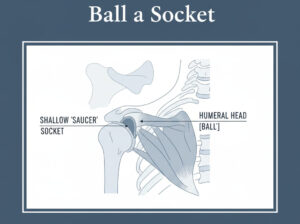
To understand your pain, you must understand the “Ball and Socket” mechanics. Unlike the hip, which is a deep, stable socket, the shoulder socket (glenoid) is shallow—more like a saucer than a cup.
The Role of the Rotator Cuff
The Rotator Cuff is a group of four tendons (Supraspinatus, Infraspinatus, Teres Minor, and Subscapularis) that act as “dynamic stabilizers.” They pull the ball of your arm bone tightly into that shallow saucer. When these muscles are weak or fatigued, the ball “skates” around in the socket, pinching sensitive tissues.
Your shoulder blade (scapula) is the foundation of your arm. If the muscles holding the scapula against your ribcage are weak, the entire shoulder loses its mechanical advantage. This is why we focus heavily on Scapular Stabilization at Rayara Kirana.
Understanding the “Big Three” Shoulder Conditions
1. Shoulder Impingement: The “Digital Age” Disease
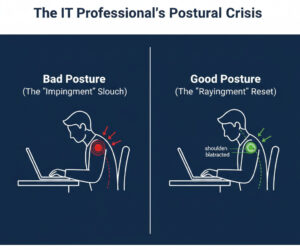
This is the most common condition among Bengaluru’s IT professionals.
The Mechanism: When you hunch over a laptop, your “Subacromial Space” (the tunnel through which tendons pass) narrows. Every time you lift your arm, the bone scrapes against the tendon.
The Clinical Sign: A “Painful Arc.” You feel fine when your arm is at your side, but as you lift it between 60° and 120°, the pain becomes sharp and stabbing.
2. Frozen Shoulder (Adhesive Capsulitis): The Metabolic Trap
This condition is unique because it isn’t always caused by an injury.
The Three Phases:
Freezing: Intense pain, especially at night. Loss of motion begins.
Frozen: Pain may decrease slightly, but the arm is “stuck.” Daily tasks like wearing a shirt become impossible.
Thawing: Motion slowly returns over months.
The Diabetes Connection: At Rayara Kirana, we pay special attention to metabolic health. High blood sugar causes “Advanced Glycation End-products” (AGEs), which act like glue in your shoulder joint.
3. Rotator Cuff Tears: Identifying Structural Failure
A tear can be “Partial” or “Full-thickness.”
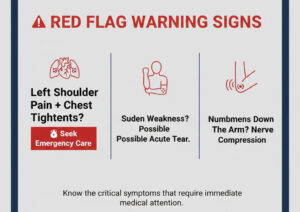
The Warning Signs: You might experience a profound weakness. If you can’t hold a plate or lift a grocery bag, the structural integrity of the cuff might be compromised.
The Physiotherapy Goal: We don’t just heal the tear; we “re-educate” the surrounding muscles to take over the load, often avoiding the need for surgery.
Modern Triggers – Why Your Shoulder is Hurting
A. The Ergonomic Crisis
Modern workstations are often designed for aesthetics, not biomechanics. Prolonged “mouse-reach” stretches the nerves and fatigues the stabilizers, leading to chronic impingement.
B. The “Weekend Warrior” Syndrome
We see many patients who are sedentary from Monday to Friday but attempt heavy “Overhead Presses” or “Crossfit” on Saturdays. The sudden load on a “cold” and “stiff” joint is a recipe for Labral (SLAP) tears.
C. Post-Viral Arthralgia
Recent years have seen a rise in joint pain following viral infections. This inflammatory response often settles in the shoulder, mimicking bursitis.
Advanced Treatment Modalities at Rayara Kirana Clinic
We pride ourselves on using Evidence-Based Technology that goes beyond simple heat packs.
1. Extracorporeal Shockwave Therapy (ESWT)
This is a game-changer for Calcific Tendinitis. If you have calcium deposits in your shoulder, ESWT uses acoustic sound waves to break them down, stimulating a “pro-inflammatory” healing response that clears the debris. It is a non-surgical alternative to “barbotage” or scraping.
2. High-Intensity Laser Therapy & PEMF
We use high-intensity light therapy to penetrate deep into the joint capsule, accelerating cellular repair (ATP production) and reducing the “chemical pain” of inflammation.
3. Clinical Kinesio-Taping
Unlike a rigid brace, Kinesio-tape provides “Neuromuscular Feedback.” It supports the joint while allowing movement, making it perfect for athletes and gym-goers returning to training.
4. Aquatherapy Support for Shoulder Pain
For those in the “Freezing” phase of Frozen Shoulder, movement in water is revolutionary. The warmth relaxes the capsule, while the buoyancy removes the weight of the arm, allowing for pain-free range-of-motion.
The Active Exercise Philosophy
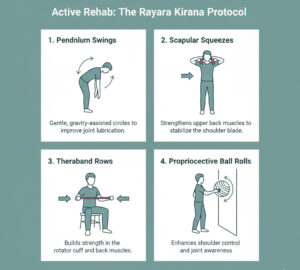
We don’t believe in “handouts.” We believe in Active Rehabilitation. Here is a breakdown of our clinical exercise program:
The Pendulum (Codman’s Exercises): Creating “distraction” in the joint to allow synovial fluid to flow.
Scapular Retraction: Re-training the Trapezius and Rhomboids to “reset” the foundation.
Theraband Resistance: Controlled eccentric and concentric loading to thicken the rotator cuff tendons (Mechanotransduction).
Proprioceptive Drills: Training the brain to know where the shoulder is in space, preventing future dislocations.
Surgery vs. Physiotherapy – The Ethical Discussion
At Rayara Kirana, we believe in Preserving the Natural Joint.
When to choose Physio: Studies show that for degenerative rotator cuff tears and impingement, 6 months of structured physiotherapy is as effective as surgery—without the risks of anesthesia or scar tissue.
When we refer to Surgery: If there is a sudden, traumatic full-thickness tear in a young person, or if there is “progressive neurological deficit” (loss of muscle mass), we ethically refer you to the best orthopedic surgeons in Bengaluru.
Shoulder Rehabilitation FAQs
1. How do I know if my pain is a ‘standard ache’ or something serious?
If the pain wakes you up at night, if you cannot reach your back pocket, or if you feel a “clicking” accompanied by weakness, it is time for a professional assessment.
2. Can physiotherapy help if I have ‘Calcification’ in my shoulder?
Absolutely. Using Shockwave Therapy and specific eccentric exercises, we can often manage calcific tendinitis without surgical intervention.
3. Why does my shoulder hurt when I’m just sitting at my computer?
This is “Postural Fatigue.” Your muscles are working overtime to hold your head and arms up against gravity because of a rounded posture.
4. How long does a typical session at Rayara Kirana last?
A comprehensive session lasts 45 to 60 minutes, including manual therapy, modality application, and supervised exercise.
5. Is Frozen Shoulder permanent?
No. It is a “self-limiting” condition, but without physiotherapy, it can take 2-3 years to resolve and may leave you with permanent 20% loss of motion. We aim to cut that time in half.
6. Can I drive with a shoulder injury?
In the acute phase of a rotator cuff tear or frozen shoulder, sudden steering maneuvers can be painful and dangerous. We advise caution until you regain “steering-range” mobility.
7. Does smoking affect shoulder healing?
Yes. Nicotine constricts blood vessels, significantly slowing down the delivery of nutrients to the tendons, which already have a poor blood supply.
8. What is ‘Bursitis’?
The Bursa is a fluid-filled sac that acts as a cushion. When it gets inflamed, it swells, taking up space and causing impingement.
9. Can shoulder pain be related to my heart?
Yes, specifically left shoulder pain. If the pain is accompanied by chest tightness or shortness of breath, seek emergency medical care immediately.
10. What are ‘Therabands’ and why do you use them?
Therabands provide “progressive resistance.” Unlike dumbbells, they provide tension throughout the entire movement, which is safer and more effective for small stabilizer muscles.
11. Is ‘Dry Needling’ effective for shoulder pain?
Yes, we use it to release “Trigger Points” in the Deltoids and Upper Trapezius that often cause referred pain into the arm.
12. I am a gym-goer; how can I prevent ‘Bench Presser’s Shoulder’?
Balance your “Push” movements with “Pull” movements. For every set of chest press, do two sets of rows or face-pulls to keep the shoulder balanced.
13. Does insurance cover physiotherapy at your clinic?
Many corporate and private insurance plans cover “Rehabilitation Services.” We provide the necessary documentation for your claims.
14. Can I use a ‘Sling’ for my shoulder pain?
Use a sling only if you have a suspected fracture or a severe acute tear. Prolonged use of a sling is a leading cause of Frozen Shoulder!
15. What makes Rayara Kirana different from other clinics in Banashankari?
We offer a “Hybrid Model.” We don’t just use machines; we don’t just do exercises. We use Advanced Modalities (Shockwave/Aqua) + Manual Therapy + Clinical Strength Training all under one roof.
Conclusion – Your Path to Pain-Free Movement
Shoulder pain is a thief—it steals your ability to sleep, to work, and to enjoy your hobbies. But it doesn’t have to be permanent. At Rayara Kirana Physiotherapy & Rehab Clinic, we combine the art of manual healing with the science of modern technology.
“Whether you are an IT professional or an athlete, our protocol for Shoulder Rehabilitation and Physiotherapy Bangalore offers a targeted path to recovery.”
Don’t ignore the ache. Book your comprehensive shoulder assessment at Rayara Kirana today.