The Science of Healing: Why Shockwave Therapy is a Game-Changer in Modern Physiotherapy

By Dr. Kiran S. Murthy, PT (Chief Physiotherapist & Wellness Consultant)
In my 27 years of clinical practice as a Senior Physiotherapist, working alongside some of India’s finest orthopedic surgeons, I have witnessed a consistent pattern. In the Indian healthcare landscape, chronic pain is often ignored until it becomes disabling. Whether it is a homemaker enduring persistent heel pain or an IT professional struggling with a “mouse elbow,” many patients wait until they can no longer perform daily activities before seeking help.
By the time they reach my clinic, they are often caught in a frustrating loop: they want non-surgical pain treatment, yet they are wary of repeated steroid injections and long-term painkillers. This is where Extracorporeal Shockwave Therapy (ESWT) has emerged as a revolutionary bridge between failed conservative care and the operating theater.
At Rayara Kirana Physiotherapy Clinic, we utilize this latest physiotherapy technology to provide an advanced approach for chronic pain that addresses the root cause of tissue degeneration rather than just masking the symptoms.
What Is Shockwave Therapy?
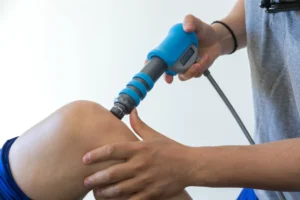
Extracorporeal Shockwave Therapy (ESWT) involves the delivery of high-energy acoustic waves to injured tissues. Despite the name, these are not “electric shocks”; they are mechanical sound pulses.
The Science of “Micro-Trauma” for Healing
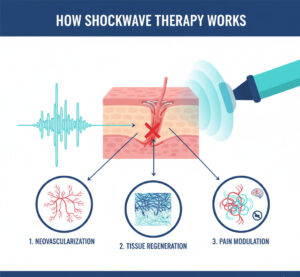
When these waves hit chronically inflamed or degenerated tissue, they create “pro-inflammatory” micro-trauma. This jumpstarts the body’s natural healing response through three primary mechanisms:
Neovascularization: The waves stimulate the growth of new microscopic blood vessels, improving nutrient supply to “dry” tendons.
Tissue Regeneration: It triggers the release of growth factors and stimulates fibroblasts to repair damaged collagen.
Pain Modulation: It overstimulates nerve fibers, effectively “rebooting” the pain threshold and reducing Substance P (a pain-transmitting neurotransmitter).
Radial vs. Focused Shockwave
Radial Shockwave: Spreads energy over a larger area. Excellent for muscle knots (trigger points) and superficial tendons like the elbow.
Focused Shockwave: Penetrates deeper and targets a specific point with high intensity. This is often the gold standard for deep-seated issues like bone spurs or calcifications.
Understanding how shockwave therapy works is essential for patients to realize that this is a biological stimulus, not a temporary numbing agent.
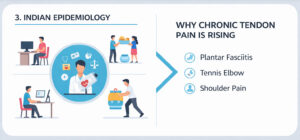
Why Chronic Tendon Pain is Rising
India is currently facing a “dual epidemic” of musculoskeletal issues. On one hand, we have a sedentary urban workforce (the “IT posture”); on the other, we have an increase in “weekend warriors”—people who are sedentary all week but engage in high-intensity sports on Sundays.
Key Factors Driving the Demand for ESWT in India:
Poor Ergonomics: Prolonged sitting and mobile usage leading to “Tech Neck” and chronic shoulder issues.
The Homemaker’s Burden: Repetitive manual tasks leading to De Quervain’s Tenosynovitis or Plantar Fasciitis.
Obesity: Increased load on the weight-bearing joints of the foot and knee.
Delayed Presentation: Most Indian patients present only when the condition has reached a “chronic-on-acute” stage, where standard heat-and-cold therapy is no longer effective.
Conditions Where Shockwave Therapy Works Best
Based on clinical evidence and my decades of experience, ESWT is most effective for “Insertional Tendinopathies”—where the tendon meets the bone.
1. Plantar Fasciitis & Heel Spur
This is perhaps the most common reason patients seek shockwave therapy for heel pain. When the first steps in the morning feel like walking on glass, ESWT can break down scar tissue and stimulate the fascia to heal.
2. Tennis Elbow (Lateral Epicondylitis)
For those seeking shockwave therapy for tennis elbow, this treatment offers a 70–80% success rate even in patients who have failed to respond to braces and rest.
3. Calcific Shoulder Tendinitis
Calcium deposits in the rotator cuff can cause agonizing pain. Shockwave therapy can literally break these deposits into smaller particles that the body can then resorb.
4. Achilles Tendinopathy
Pain at the back of the heel responds exceptionally well to the mechanical stimulation of ESWT.
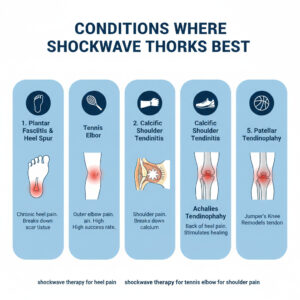
5. Patellar Tendinopathy (Jumper’s Knee)
Common in athletes, this condition often becomes chronic. Shockwave therapy helps remodel the tendon fibers.
Best Treatment for Plantar Fasciitis –
Case Study
Patient: 36-year-old amateur marathon runner (9 months of pain).
Condition: Chronic plantar fasciopathy (Pain score 8/10).
Protocol: 5 sessions of Focused ESWT under our Adrenal Physiotherapy model.
Outcome: After the second session, 50% reduction in pain. By the fifth session, pain reduced to 1–2/10. At 9-month follow-up, the patient remained pain-free.
Best Treatment of De Quervain’s Tenosynovitis in Bangalore –
Case Study
Patient: 42-year-old female (7 months of wrist pain).
Condition: Failed steroid injection and splinting.
Protocol: 4 sessions of Radial Shockwave Therapy combined with tendon-gliding exercises.
Outcome: Pain reduced from 8/10 to 3/10 by the third session. Full return to household activities with no recurrence at 6-month follow-up.
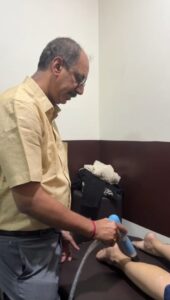
Who Is the Ideal Candidate?
Success depends on rigorous patient selection.
The Ideal Candidate:
Suffering from chronic pain for more than 3 months.
Has tried rest, ice, and basic exercises without improvement.
Wants to avoid surgery.
Contraindications (Who should NOT get ESWT):
Pregnancy: Not used near abdominal/pelvic areas.
Blood Disorders: Patients on heavy anticoagulants.
Tumors: Presence of malignancy in the treatment area.
Steroid Injections: Must wait at least 6 weeks after a cortisone shot.
The Rayara Kirana Clinical Protocol: Our Edge
We don’t believe in “point-and-shoot” therapy. Our protocol ensures long-term results:
Comprehensive Assessment: Analyzing movement patterns (e.g., flat feet or calf tightness).
The “Hybrid” Session: Combining ESWT with manual therapy (joint mobilization).
Corrective Loading: Specific exercises to ensure tendons heal correctly.
Dosing: Most patients require 3 to 6 sessions, spaced 5–10 days apart.
“Shockwave therapy is the spark that starts the fire of healing; corrective exercise is the fuel that keeps it burning.”
Shockwave Therapy vs Other Treatments
| Feature | Shockwave Therapy | Steroid Injections | Surgery |
| Safety | Very High | Risk of tendon rupture | Risks of anesthesia/infection |
| Recovery | Immediate (No downtime) | 2–3 days of soreness | Weeks to months |
| Mechanism | Regenerates tissue | Suppresses inflammation | Removes/repairs tissue |
| Long-term | High success rate | Pain often returns | Varies by procedure |
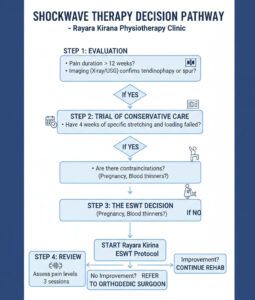
Shockwave Therapy Decision Pathway
Evaluation: Pain duration > 12 weeks? Imaging confirms tendinopathy?
Trial Care: Have 4 weeks of stretching/loading failed?
The Decision: Are there contraindications? If no, start ESWT protocol.
Review: Assess pain after 3 sessions. Improve? Continue. No change? Refer to Surgeon.
Expert Clinical Insights
Dr. Kiran S. Murthy, PT:
“I tell patients: this machine isn’t doing something to you; it’s telling your body to wake up and fix itself.”
Dr. Rajesh Jain (Consultant Orthopedic Surgeon):
“Referring patients for ESWT has reduced my surgical intervention rate for calcific tendinitis by nearly 60%.”
Shockwave Therapy FAQs – Treatment, Benefits, Cost & Recovery Guide
1. Is shockwave therapy painful?
It can be slightly uncomfortable, often described as a “repetitive tapping” or “dull ache.” However, the intensity is adjustable, and most patients tolerate it well without any anesthesia.
2. How many sessions will I need?
Most clinical protocols suggest 3 to 6 sessions, depending on the severity and how long you have had the condition.
3. What is the shockwave therapy cost in India?
The cost ranges from ₹2,500 to ₹5,000 per session. While it seems higher than traditional PT, the reduction in total visits and avoidance of surgery makes it very cost-effective.
4. What are common shockwave therapy side effects?
Some patients experience temporary redness, slight swelling, or a dull ache for 24 hours. This is a positive sign that the body’s healing response has been activated.
5. Can I play sports immediately after a session?
We recommend 48 hours of “active rest”—no high-impact activities—to allow the biological healing process to settle.
6. How soon will I see results?
Many patients feel significant pain reduction after just the second session. However, because it stimulates tissue regeneration, the maximum healing benefit usually occurs 6 to 12 weeks after the final session.
7. Can shockwave therapy help with old injuries (Chronic pain)?
Yes! ESWT is specifically designed for chronic conditions (pain lasting more than 3 months) where the body’s natural healing process has stalled or stopped.
8. Is it better than a steroid (Cortisone) injection?
Unlike steroids, which temporarily “mask” pain and can weaken tendons over time, Shockwave Therapy actually heals and strengthens the tissue from within.
9. Can I take painkillers during the treatment?
We generally advise against taking anti-inflammatory drugs (like Ibuprofen or Aspirin) during treatment, as these may interfere with the “pro-inflammatory” healing process that the shockwaves are trying to create.
10. What is the difference between Shockwave and Ultrasound therapy?
Ultrasound uses high-frequency sound to create mild heat, whereas Shockwave Therapy uses much higher energy pulses to create mechanical “micro-trauma” for deep tissue repair.
11. Is Shockwave Therapy safe for elderly patients?
Absolutely. It is a non-invasive, low-risk treatment that is excellent for seniors who want to avoid the risks associated with surgery or long-term medication use.
12. Will I need to take time off work?
No. It is a “walk-in, walk-out” procedure. Most sessions take only 15–20 minutes, and you can return to your daily office routine or household chores immediately.
13. Does it work for Bone Spurs (Heel Spurs)?
Yes. While it doesn’t always “disappear” the bone on an X-ray, it breaks down the calcification and treats the inflamed tissue around the spur, which is the actual cause of the pain.
14. Are the results permanent?
If the underlying cause (like poor posture or bad footwear) is addressed alongside the therapy, the results are typically long-lasting or permanent because the tissue has been biologically remodeled.
15. Can it be used for lower back pain or neck pain?
Yes, it is highly effective for “Myofascial Trigger Points” (painful muscle knots) in the neck, shoulders, and lower back that haven’t responded to traditional massage or stretching.
Conclusion: The Future of Pain Management
The field of physiotherapy is evolving from simple “heat and massage” to high-end regenerative technology. At Rayara Kirana Physiotherapy Clinic, we offer a scientifically backed path out of chronic pain.
Pain should not be something you learn to live with.