A Complete, In-Depth Recovery Guide for Indian Patients, Athletes, and Post-Surgical Rehabilitation
In India, injury recovery often begins with advice passed down through generations: “Ice laga lo, sab theek ho jayega.” From school playground injuries to post-operative knee pain, ice packs have become the most trusted—and least questioned—tool in recovery.
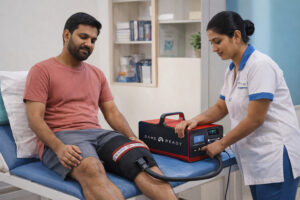
Yet, despite widespread use of ice, many patients continue to struggle with lingering swelling, stiffness, delayed movement, and repeated injuries. This has led to growing interest in advanced recovery technologies such as Game Ready cold compression therapy, commonly seen in sports medicine and post-surgical rehabilitation settings.
The key question patients ask is simple but important:
Is Game Ready actually better than an ice pack, or is it just an expensive alternative?
To answer this honestly, we must move beyond surface-level comparisons and understand how healing really works—not just how pain feels.
This article is written to provide complete clarity, especially for Indian patients who want evidence-based recovery without unnecessary expense or confusion.
Understanding Injury, Inflammation, and Healing
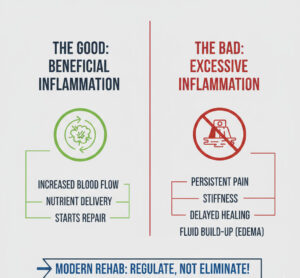
When the body experiences injury—whether from trauma, surgery, or repetitive stress—it triggers an inflammatory response. This response is the body’s way of protecting damaged tissues and initiating repair.
Inflammation involves:
Increased blood flow
Accumulation of fluid
Activation of immune cells
Chemical signaling for tissue repair
In controlled amounts, inflammation is beneficial. However, when inflammation becomes excessive or prolonged, it turns into a barrier to recovery.
Excess inflammation causes:
Persistent pain
Joint stiffness
Reduced range of motion
Muscle inhibition
Delayed return to activity
Modern rehabilitation focuses on regulating inflammation, not eliminating it entirely.
Why Cold Therapy Is Used in Rehabilitation
Cold therapy is used because it influences both pain perception and inflammatory activity. Lower tissue temperatures slow nerve conduction, reducing pain signals. Cold also affects blood flow and metabolic processes in injured tissues.
However, not all cold therapy is equal. The effectiveness of cold depends on:
Depth of penetration
Duration and consistency
Interaction with swelling and fluid movement
This is where the difference between ice packs and cold compression therapy becomes clinically significant.
Ice Packs: The Traditional Approach
Ice packs are the most accessible form of cold therapy. They are inexpensive, easy to use, and widely recommended as first aid.
What Ice Packs Do Well
Ice packs are effective for:
Minor muscle soreness
Acute pain immediately after injury
Temporary pain relief
Short-term reduction in discomfort
They primarily work by numbing nerve endings near the skin, which reduces pain perception.
The Limitations of Ice Packs (Often Overlooked)
Despite their benefits, ice packs have clear limitations that are rarely explained to patients.
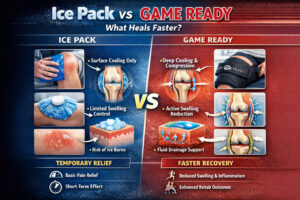
Superficial Cooling Only
Ice packs mainly affect the skin and superficial tissues. Deeper structures such as ligaments, joint capsules, menisci, rotator cuff tendons, and post-surgical edema are minimally influenced.
This explains why patients frequently report: “Pain kam hua, par swelling abhi bhi hai.”
No Active Swelling Management
Swelling is not just a temperature issue—it is a fluid management issue. Ice packs do not assist the lymphatic system in removing excess fluid. Once ice is removed, swelling often returns.
Rebound Effect
After icing, blood flow increases rapidly as tissues rewarm. This can lead to rebound swelling, particularly in joints like the knee and ankle.
Risk of Delayed Healing
Excessive icing can:
Reduce healthy circulation
Slow tissue repair
Mask symptoms, leading to premature activity
Ice packs treat symptoms, not the recovery process itself.
The Indian Recovery Mindset: A Critical Challenge
In India, recovery is often judged by pain relief rather than functional restoration. If pain reduces, patients assume healing is complete.
This mindset leads to:
Early return to work or sport
Incomplete rehabilitation
Chronic pain conditions
Repeat injuries
Ice packs reinforce this cycle by providing temporary relief without addressing underlying swelling, weakness, or movement dysfunction.
What Is Game Ready Cold Compression Therapy?
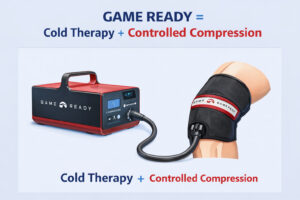
Game Ready is a medical-grade cold compression system designed to manage inflammation more effectively than ice alone.
It combines:
Circulating cold water therapy
Intermittent pneumatic compression
Anatomically designed treatment sleeves
Adjustable pressure and temperature
This combination allows therapists to control inflammation, swelling, and pain in a structured manner.
Why Compression Is the Missing Link in Recovery
Swelling restricts joint movement, inhibits muscle activation, and increases pain sensitivity. Without proper swelling control, rehabilitation progress is delayed.
Compression supports:
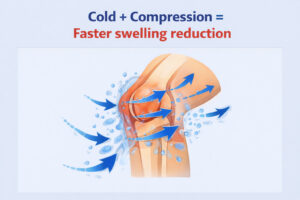
Lymphatic drainage
Venous return
Reduction of interstitial fluid
Improved joint comfort
When compression is combined with cold, the benefits are amplified. Cold reduces pain and metabolic demand, while compression actively assists fluid movement. Together, they create an environment where healing can progress efficiently.
Clinical Advantages of Game Ready Therapy
In supervised rehabilitation settings, Game Ready therapy helps:
Reduce post-surgical edema faster
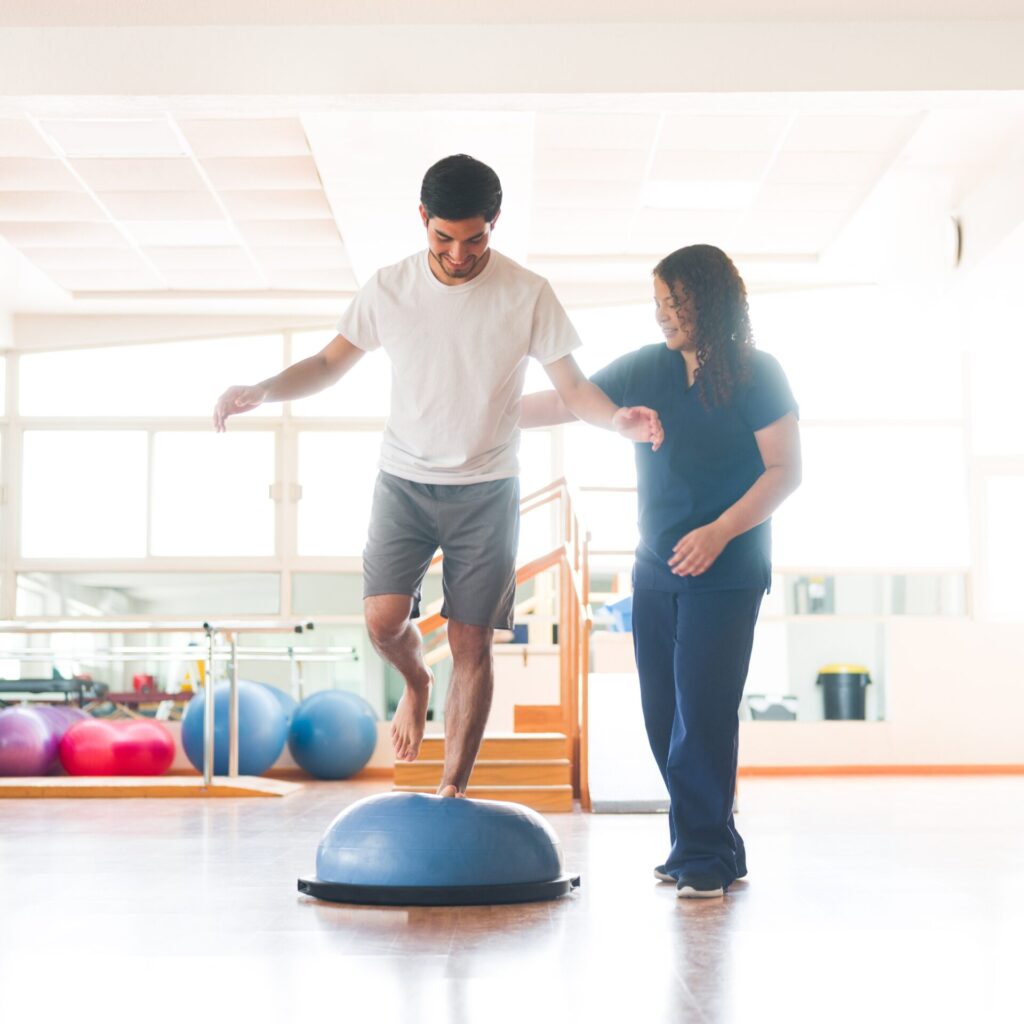
Improve tolerance to physiotherapy exercises
Restore joint movement earlier
Reduce dependency on pain medication
Enhance patient confidence during rehab
It does not replace exercise-based therapy. Instead, it prepares tissues for movement, making rehabilitation more effective.
Real-World Indian Patient Scenarios
Case 1: Post-ACL Surgery Patient
A young working professional undergoes ACL reconstruction. Despite regular icing at home, knee swelling persists, limiting quadriceps activation. With structured cold compression therapy, swelling reduces faster, allowing earlier strengthening and gait training.
Case 2: Shoulder Surgery Recovery
A middle-aged patient after rotator cuff repair struggles with stiffness despite ice usage. Controlled cold compression helps manage inflammation, improving tolerance to passive and active movement exercises.
Case 3: Sports Injury Without Surgery
An amateur footballer with ankle ligament injury experiences recurring swelling after practice. Ice provides short relief, but cold compression therapy helps control edema, enabling consistent rehab progress.
Cost vs Value: The Indian Perspective
Cost concerns are valid. However, recovery decisions should be based on overall rehabilitation cost, not individual session cost.
Delayed recovery often leads to:
Longer treatment duration
Increased doctor visits
Extended medication use
Time away from work or sport
When advanced modalities shorten recovery time, they often reduce total expense and long-term complications.
Insights from Doctors and Physiotherapists
Dr. Yoginder Balaji, PT : “Persistent swelling delays muscle recovery. When inflammation is controlled early, surgical outcomes improve significantly.”
Dr. Kiran S. Murthy, PT : “Ice helps pain temporarily. Cold compression allows us to manage swelling systematically, which directly improves rehab milestones.”
Dr. Swathi, PT : “Professional athletes recover faster because inflammation is managed better. That principle applies to all patients.”
Rehabilitation Consultant: “Patients using structured cold compression therapy often regain movement and confidence sooner.”
When Ice Packs Are Still Useful
Ice packs still have a role in recovery. They are suitable for:
Immediate first aid
Minor injuries
Temporary pain relief
Short-term home management
However, relying solely on ice for serious injuries or post-surgical recovery often leads to delayed healing.
When Game Ready Is More Appropriate
Game Ready is particularly beneficial for:
Post-operative knee and shoulder surgeries
Ligament injuries
Sports injuries with significant swelling
Patients needing faster functional recovery
Cases where swelling limits exercise progress
Common Myths About Game Ready (Explained)
Many myths arise due to lack of awareness.
Some believe it is only for foreign athletes. In reality, it is used globally, including in Indian clinics, when prescribed appropriately.
Others think it is merely a comfort machine. Clinically, it is used to manage inflammation and support rehabilitation.
There is also the belief that ice packs do the same job. Scientifically, cold compression provides advantages ice alone cannot.
Frequently Asked Questions
1. Is Game Ready safe for patients with high blood pressure or diabetes?
Yes, but with caution. For diabetic patients with peripheral neuropathy (reduced sensation in feet), we monitor the temperature closely to prevent skin damage. Always consult our specialists at Rayara Kirana before starting.
2. I had a Knee Replacement (TKR). When can I start Game Ready?
Usually, within 24–48 hours post-surgery, once the primary bandages are managed. It is highly effective in reducing the “tightness” patients feel behind the knee.
3. Why can’t I just use a tight crepe bandage with an ice pack?
Static compression (bandage) can actually restrict blood flow if too tight. Game Ready uses intermittent (on and off) compression, which is much safer and more effective at moving lymphatic fluid.
4. Does it help with chronic “Gathiya” (Arthritis) pain?
While Game Ready is best for acute injuries, it is excellent for “flares” of arthritis where the joint is hot, red, and swollen.
5. Is it painful? My injury is already very sore.
Not at all. Most patients find the “squeezing” sensation very relaxing. It feels like a firm massage combined with a cooling sensation.
6. How many sessions do I need?
For post-surgical cases, we recommend 5–10 sessions during the initial inflammatory phase. For sports injuries, 3–5 sessions often suffice to get you back on the field.
7. Can it help with back pain?
Yes, we have specialized wraps for the lower back (lumbar) that help with acute spasms and post-spine surgery inflammation.
8. Can I use it if I have metal implants or screws in my bone?
Yes. Unlike heat therapy (which can heat up metal), cold therapy is perfectly safe for patients with implants.
9. Why do athletes like Virat Kohli or Neeraj Chopra use this?
Professional athletes use it because it allows them to train harder by “clearing” the metabolic waste from their muscles much faster than rest alone.
10. Is this available for home use in India?
While some units are available for rent, it is most effective when used in a clinic like Rayara Kirana under the guidance of a physiotherapist who can combine it with the right exercises.
Recovery Is Not About Cold—It Is About Control
The debate is not really Ice Pack vs Game Ready.
It is Relief vs Recovery.
Ice packs reduce pain temporarily. Cold compression therapy helps control inflammation, support movement, and accelerate functional recovery.
Modern physiotherapy aims to restore mobility, strength, and confidence—not just numb pain.
About Rayara Kirana Physiotherapy & Rehab Clinic
At Rayara Kirana, recovery is guided by science and clinical expertise. Advanced modalities like Game Ready are integrated into individualized rehabilitation programs under professional supervision—because healing deserves precision, not shortcuts.